
Can Palantir Earnings live up to Wall Street’s aggressive AI growth story or will sky‑high expectations finally crack?

Can Palantir Earnings match sky‑high expectations?
Palantir Technologies Inc. (PLTR) will report Q1 2026 numbers after the closing bell at 4:00 p.m. ET, and expectations are unusually aggressive. Wall Street consensus is calling for earnings of $0.27–$0.28 per share, more than double the $0.13 reported a year ago. Revenue is projected around $1.54 billion, implying roughly 70%–75% year‑over‑year growth after $883.9 million in the prior‑year quarter and about $1.4 billion last quarter.
If delivered, that would mark roughly the 11th consecutive quarter of accelerating sales growth and another step change in profitability. Analysts also expect free cash flow to remain exceptionally strong, with estimates pointing to margins above 50%, up from 47% last year. That combination of rapid top‑line expansion and thick cash margins is why Palantir Earnings have become a key sentiment driver not only for PLTR but for AI‑heavy software names more broadly.
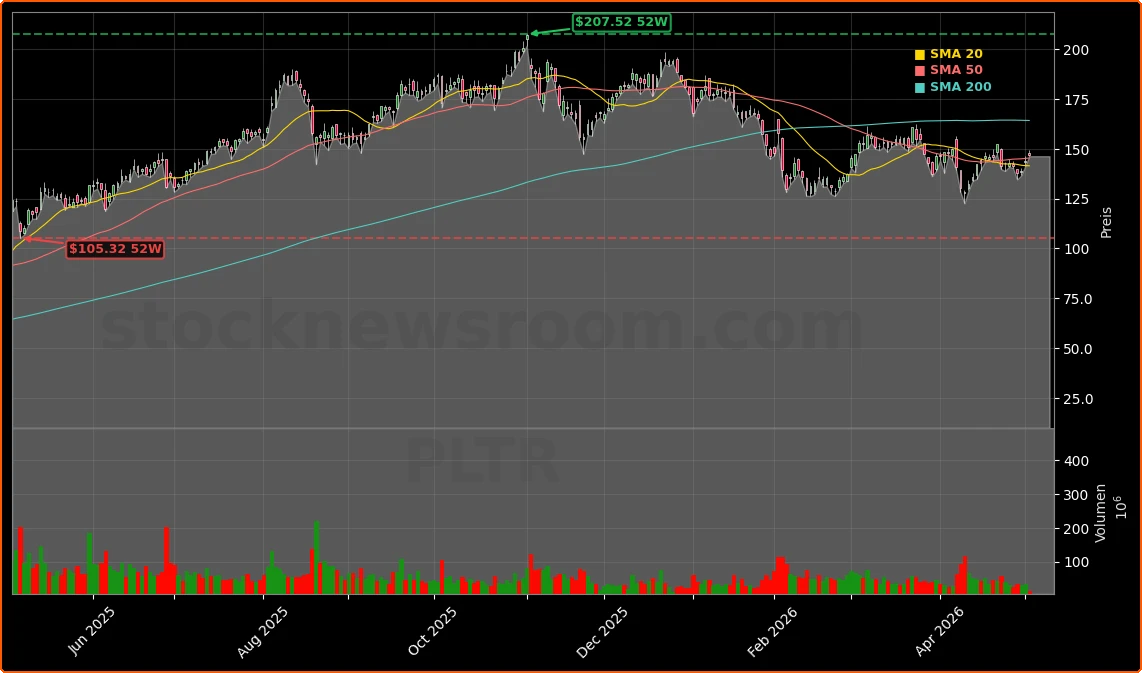
Yet the bar is high. The stock is still about 41% below its all‑time high after a 19% pullback in 2026, and options markets are pricing in elevated volatility around tonight’s release. With implied volatility near the mid‑30s, traders are bracing for a sizable post‑report swing as the market reassesses Palantir’s growth trajectory.
How strong is Palantir’s AI and government pipeline?
Palantir’s core strength remains its deep integration with U.S. defense and intelligence agencies through platforms like Gotham and newer mission‑focused offerings such as its Maven capabilities, reportedly used in conflict zones. U.S. government revenue is expected to grow about 60%+ year over year to roughly $606 million in Q1, underscoring the durability of federal demand even as budgets tighten elsewhere.
The bigger swing factor for Palantir Earnings, however, is the commercial AI business. U.S. commercial sales tied to its Artificial Intelligence Platform (AIP) are projected to climb roughly 130%–140% to just over $600 million, potentially matching U.S. government revenue for the first time. Recent deals, including a three‑year AI partnership with Cleveland‑Cliffs to deploy Palantir’s tools across operations and commercial functions, signal that industrial and enterprise customers are moving from pilots to full‑scale deployments.
Management has argued that Palantir is still early in its AI monetization curve, with CEO Alex Karp positioning the company as one of the few AI players combining real‑world deployments, high margins, and steady government cash flows. That narrative has resonated with many U.S. retail investors who see Palantir as a rare scalable AI software pure‑play alongside hardware leader NVIDIA and data‑rich platforms like Apple. Tonight’s report will test whether the growth in AIP adoption can keep pace with those ambitions.
Do analyst ratings justify today’s valuation?
Despite the recent share price pullback, Palantir still commands a valuation that leaves little room for disappointment. The stock trades at an elevated price‑to‑sales ratio that has been cited as bubble‑like compared with past “next big thing” cycles, and its forward price‑to‑earnings multiple is near triple digits, far above the S&P 500’s roughly 21x.
Wall Street remains sharply divided. Over the past three months, there have been around 32 analyst updates with an average price target near $185, spanning a wide range from $70 to $255. Citigroup’s Tyler Radke maintains a Buy rating but recently cut his target from $260 to $210, reflecting valuation concerns even as he stays constructive on long‑term AI upside. Mizuho’s Gregg Moskowitz also rates Palantir Outperform but trimmed his target from $195 to $185, and Wedbush’s Dan Ives keeps an Outperform with a $230 target, calling current revenue estimates “beatable” and reiterating his view that the company could ultimately reach a $1 trillion market cap.
On the cautious side, HSBC’s Stephen Bersey downgraded Palantir from Buy to Hold and lowered his target from $205 to $151, effectively close to where the stock trades now. DA Davidson’s Gil Luria remains Neutral with a $180 target, pointing to concerns over high personnel costs, heavy use of stock‑based compensation and the risk that expectations for AI growth are becoming excessive.
Insider trading patterns add another layer to the debate. Over the past year, Palantir insiders have reportedly sold more than $1 billion in stock while buying only a few million dollars’ worth, echoing heavy selling seen at AI leaders like NVIDIA. While such activity can be driven by tax and diversification needs, the lack of sizable insider buying reinforces skepticism among some institutional investors.
What’s at stake for software and AI stocks?
Palantir’s role as an AI bellwether has implications beyond its own shareholders. The iShares Expanded Tech‑Software ETF, which holds a broad basket of enterprise software names, is down roughly 18% year to date after a sharp pullback on fears that generative AI tools from players like OpenAI and Anthropic could erode traditional software business models. A strong beat and upbeat guidance from Palantir Earnings could signal that AI‑driven demand is lifting, not cannibalizing, software revenues.
At the same time, concerns about concentration risk in high‑multiple AI names persist. Structured products from banks such as TD now reference Palantir in auto‑callable notes with double‑digit coupons, a sign that demand for leveraged exposure and yield‑enhancement tied to PLTR remains robust. Institutional holders like U.S. Bancorp DE have modestly increased their stakes, even as valuation and insider selling remain key talking points on Wall Street.
Related Coverage: Investors tracking Palantir’s defense and cloud expansion can dive deeper into regulatory and geopolitical risks in this analysis of Palantir’s Defense Cloud warning after a 70% Q4 revenue surge. That piece explores how European pushback and aggressive growth expectations might influence contract pipelines and future Palantir Earnings, and it provides useful context for tonight’s numbers and guidance.
In the end, Palantir Earnings tonight will show whether explosive AI‑driven growth, a powerful government franchise and rising commercial adoption can keep justifying a premium multiple. For U.S. investors weighing richly valued AI leaders against a still‑resilient S&P 500, the report could help reset expectations on growth, profitability and risk in the sector. The next few quarters will reveal whether Palantir can turn today’s optimism into durable cash flow and share‑price leadership in the broader AI race.