Can Palantir Defense Cloud ambitions overcome European pushback and sky‑high growth expectations before the next earnings test hits?

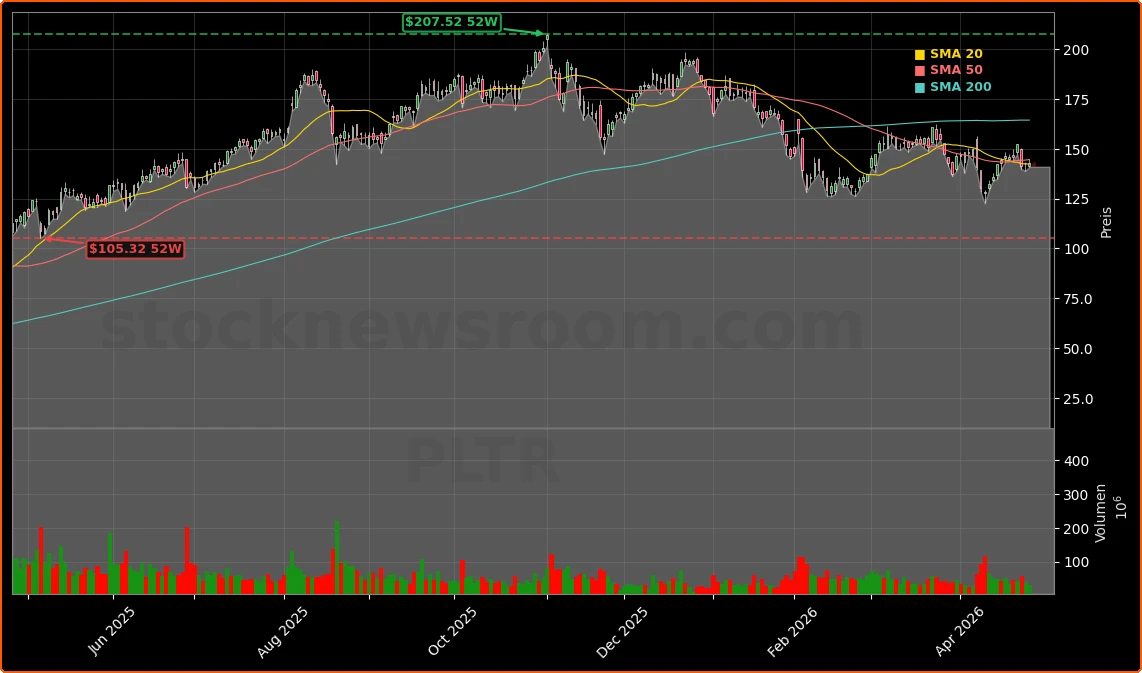
Palantir Technologies Inc. (PLTR) traded at $143.10 on Monday’s close, up 0.01%, with the stock indicated slightly lower in early pre‑market action near $141.62. That modest pullback comes despite a powerful five‑year rally and ahead of a closely watched Q1 earnings release on May 4 after the U.S. market close (ET), when management will again be pressed on how government contracts, commercial AI demand, and any future Palantir Defense Cloud offerings can justify a premium multiple.
Why did the Bundeswehr reject Palantir?
The latest geopolitical wrinkle comes from Germany, where Vice Admiral Thomas Daum, head of the Bundeswehr’s Cyber and Information Space command, made clear that Palantir software will not be used as the backbone for Germany’s planned military cloud. Daum highlighted that Palantir does not meet certain internal Bundeswehr requirements, particularly around who operates the software and how national data is controlled.
Daum acknowledged that Palantir’s Maven platform is deployed within NATO structures and that German forces benefit from insights generated at that level. However, he drew a firm red line at allowing private‑sector employees from Palantir to access or manage a purely national German defense data lake. For a company increasingly pitching a comprehensive Palantir Defense Cloud stack for allied militaries, the message is that operational sovereignty and local control can trump functionality for some European customers.
For U.S. investors, the Bundeswehr’s stance underscores that Palantir’s defense opportunity in Europe is not just a product story but also a regulatory and political one. Germany’s decision could influence other EU members debating how far to integrate U.S. defense software into their own classified systems, even as NATO‑level collaboration deepens.
How strong is Palantir’s AI growth story?
Set against that backdrop, Palantir’s core numbers remain explosive. In Q4, revenue surged roughly 70% year over year to about $1.4 billion, marking the tenth straight quarter of accelerating growth, while non‑GAAP net income jumped 79% to $0.25 per diluted share. Morgan Stanley analyst Sanjit Singh described Palantir as one of the strongest fundamental stories in software, reflecting the company’s unique “ontology” approach that structures enterprise data for decision‑making rather than static analytics.
The AI‑driven Gotham platform, used by the U.S. government and allies for mission planning and real‑time analysis, continues to anchor growth on the public‑sector side. On the commercial front, U.S. revenue has been particularly robust, with management previously highlighting a triple‑digit percentage jump in U.S. commercial sales and guiding for roughly 61% revenue growth for 2026.
Overlaying Gotham is the Artificial Intelligence Platform (AIP), which lets enterprises embed large language models into workflows so that employees and autonomous agents can query data in natural language and trigger automated actions. Together with the company’s ambitions around a broader Palantir Defense Cloud, this puts Palantir in the same strategic conversation as AI leaders like NVIDIA and major cloud providers, even if its market capitalization and index weight remain far smaller than megacaps such as Apple.
Is Palantir Defense Cloud priced for perfection?
Wall Street’s expectations are intense. For the March quarter, consensus calls for about $1.54 billion in revenue, up roughly 74% from a year ago, and earnings per share near $0.28, more than double the prior‑year period. Palantir has beaten EPS estimates for 10 straight quarters and has repeatedly raised its full‑year sales outlook, fueling a narrative that the company may be building an indispensable intelligence and Palantir Defense Cloud ecosystem for governments and enterprises.
But the valuation is stretched by almost any historical standard. The stock trades around 190 times adjusted earnings and entered 2026 with a trailing price‑to‑sales ratio north of 100, far above the 30x P/S threshold that has historically flagged bubbles for even the most transformational tech names. That disconnect has drawn prominent skeptics: well‑known contrarian investor Michael Burry, for example, has remained bearish on PLTR while favoring more mature software cash‑flow machines like Microsoft and while expressing caution on broader AI infrastructure spending.
Despite a median Wall Street price target near $186—implying roughly 30% upside from current levels—analysts from major houses such as Morgan Stanley have repeatedly warned that any stumble on growth or margins could trigger a sharp rerating. Palantir’s own trading history supports that risk: shares have swung between $105 and $207 over the last 52 weeks, and the reaction to recent quarters has ranged from mid‑single‑digit gains to double‑digit losses the next day.
How should U.S. investors position around PLTR?
Retail enthusiasm remains elevated, with some younger investors reportedly allocating extreme concentrations—up to 60% of their portfolios—to PLTR, a level of single‑name risk often compared to past bubbles such as Enron or Bear Stearns. On top of that, leveraged products like the GraniteShares 2x Long PLTR Daily ETF (PTIR) and the options‑overwriting Roundhill PLTR WeeklyPay ETF add further layers of complexity, amplifying both upside and volatility decay.
For diversified U.S. portfolios, the key question is whether Palantir’s mix of Gotham, AIP, and a long‑term Palantir Defense Cloud roadmap can sustain revenue growth above 50% annually without a major compression in multiples. Sector peers in data analytics showcased strong Q4 numbers as well, but Palantir now sits at the extreme end of the AI premium. That makes the May 4 report and forward guidance critical not just for PLTR, but also as a sentiment barometer for AI‑linked software across the NASDAQ and S&P 500.
Related Coverage: For a deeper dive into Palantir’s expanding U.S. federal pipeline, including a recent $300 million contract with the U.S. Department of Agriculture, see this analysis of how the USDA award pushed PLTR higher and what it signals for future government deals. The article explores whether that contract is merely another incremental win or a catalyst for the next leg of the AI and government‑cloud trade.
In summary, the Bundeswehr’s rejection of Palantir for a national military cloud shows that sovereignty concerns can slow the march toward a unified Palantir Defense Cloud even as demand for defense‑grade AI grows. For investors, PLTR remains a high‑beta bet on AI infrastructure where execution, contract wins, and guidance must continually outrun a lofty valuation. The upcoming earnings release and any new color on international defense cloud strategy will be pivotal in determining whether Palantir justifies its premium or faces a reset that could open a more attractive long‑term entry point.