Can the bold GameStop Acquisition of eBay really transform a meme-stock retailer into a credible Amazon challenger—or just break the balance sheet?

How did markets react to the GameStop Acquisition?
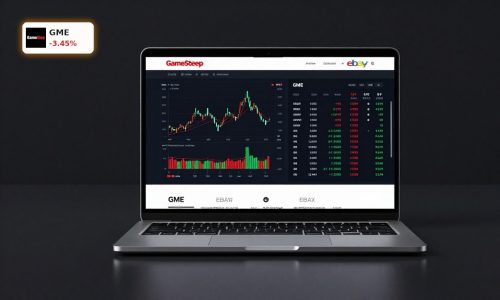
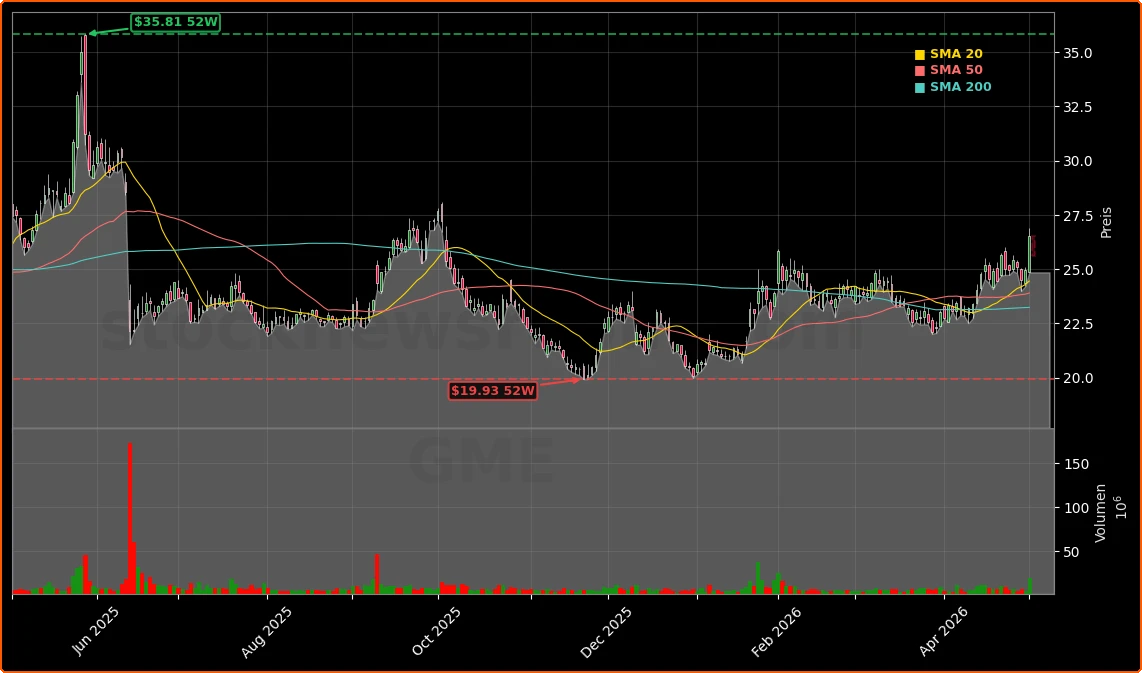
U.S.-listed shares of GameStop Corp. (GME) closed Friday at $27.61 and were indicated around $25.61 in pre-market trading on Monday, down about 3.5% as investors digested the leverage and dilution implied by the offer. That still leaves the stock up roughly 6% versus Friday’s official close, reflecting lingering speculative interest after the announcement. eBay (EBAY) finished Friday at $104.07 and traded near $111.83 before the opening bell, up about 7.5% and marking a fresh 52-week high. The spread relative to the $125 offer price suggests the market assigns a meaningful probability that the GameStop Acquisition will be rejected or revised.
The deal structure calls for eBay investors to receive $125 per share, split 50/50 between cash and newly issued GME stock, with the option to elect their preferred mix subject to pro-rata caps. On paper, the transaction values eBay at roughly $55.5–56 billion, versus a current eBay market cap around $46 billion and GameStop’s roughly $11–12 billion. That stark size mismatch is central to investor debate on whether the company can credibly finance and execute the transaction.
Can GameStop really afford to buy eBay?
Under the proposal, GameStop would fund the cash portion of the purchase with about $9.4 billion in cash and liquid investments on its balance sheet plus up to $20 billion in acquisition financing backed by a “highly confident” commitment from TD Securities. Even assuming the full $20 billion is raised, there is still a large gap to the roughly $28 billion cash obligation implied by a 50% cash component, meaning substantial additional debt, equity issuance, private capital or a deal restructuring would likely be required.
That financing overhang helps explain why GME is softer in pre-market trading while EBAY trades below the offer price. Equity investors in GameStop face the prospect of heavy dilution from issuing tens of billions of dollars’ worth of new shares, alongside a significantly more leveraged balance sheet. For U.S. portfolio managers benchmarked to the S&P 500 or NASDAQ 100, the risk-reward calculus hinges on whether Ryan Cohen can unlock the cost savings and growth needed to justify such a capital structure.
GameStop has already quietly built an economic stake of about 5% in eBay, using a mix of derivatives and common stock. Cohen has also threatened a proxy fight if eBay’s board refuses to engage, signaling that a hostile path remains firmly on the table. In a regulatory filing on Monday, GameStop attached its offer letter and an investor presentation outlining the strategic rationale and synergy math behind the move.
What is Ryan Cohen’s strategic vision for eBay?
Cohen, who took over as CEO of GameStop Corp. in 2023, casts the GameStop Acquisition as a way to build a “legit competitor” to Amazon in global e-commerce. He argues that eBay is under-optimized: the marketplace spent about $2.4 billion on sales and marketing in fiscal 2025 yet added only 1 million net active buyers, from 134 million to 135 million. GameStop claims it can cut a total of $2 billion in annualized costs within 12 months of closing — roughly $1.2 billion from sales and marketing, $300 million from product development, and $500 million from general and administrative expenses.
On GameStop’s own numbers, these cuts alone would lift eBay’s diluted EPS from $4.26 to $7.79 in the first year after completion, even before any revenue synergies. The company also touts its roughly 1,600 U.S. stores as a physical backbone for eBay’s ecosystem: locations could serve as drop-off hubs, authentication centers for high-value collectibles, and studios for live-commerce streaming. That pitch dovetails with GameStop’s pivot into collectibles, digital trading-card platforms, and even crypto-adjacent initiatives, where it increasingly competes with players such as Apple, NVIDIA and Tesla for retail investor attention in speculative growth stories rather than in pure brick-and-mortar retail.
How does this reshape the competitive landscape?
If successful, the GameStop Acquisition would create a hybrid e-commerce and specialty retail group with a combined equity value north of $60 billion, still far smaller than Amazon but large enough to matter for many U.S. mutual funds and ETFs. eBay’s marketplace strength in categories like collectibles, sneakers and gaming hardware overlaps with GameStop’s core audience, potentially enabling deeper cross-selling and loyalty programs. GameStop’s recent “Power Packs” digital collectibles platform and its push into higher-margin services show how management is already trying to move beyond low-margin physical software sales.
Yet execution risk is high. Both GameStop and eBay are in the midst of strategic transitions, and integrating a business nearly four times its size would test GameStop’s lean management team. No major Wall Street firm such as Goldman Sachs, Morgan Stanley, Citigroup or RBC Capital has yet published a detailed rating change or price-target revision tied directly to this bid, but early commentary from e-commerce analysts has leaned cautious, citing uncertain synergies and the risk that aggressive cost cuts could weaken eBay’s long-term growth profile.
“eBay should be worth — and will be worth — a lot more money. I’m thinking about turning eBay into something worth hundreds of billions of dollars.”— Ryan Cohen, CEO of GameStop Corp.
For now, the deal is only a proposal, and eBay has confirmed it received the unsolicited offer but has not committed to talks. The next catalysts for investors will be any formal response from eBay’s board, potential updates on binding debt commitments, and whether Cohen moves ahead with a proxy contest to take his pitch directly to shareholders.