
Are record Palantir earnings and explosive AI demand enough to justify a sky‑high valuation and a volatile share price?

Is Wall Street ignoring record Palantir earnings?
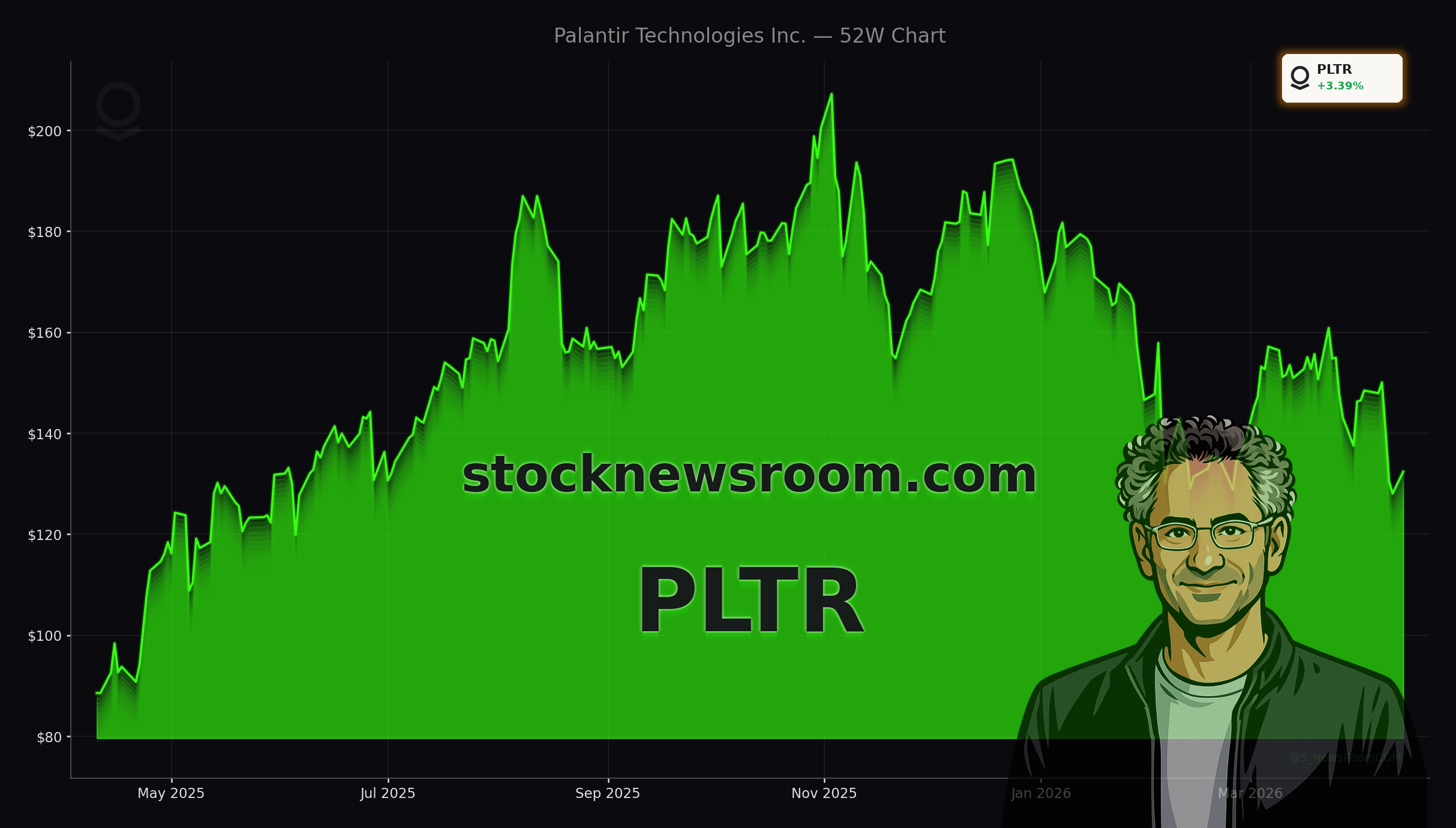
Palantir shares closed at $132.08 on Monday, up 3.10% on the day but still far below the 52‑week high of $207.52. That disconnect stands out when set against the latest Palantir earnings. For Q4 2025, the company delivered $1.406 billion in revenue, up 70% year over year and roughly 6% above consensus. Adjusted EPS came in at $0.25 versus estimates around $0.18, a beat of nearly 39%, while adjusted operating metrics pushed Palantir’s Rule of 40 score to a remarkable 127%—unmatched among large‑cap software peers.
Growth is being driven primarily by the U.S. commercial segment, where revenue surged 137% year over year in Q4. Management has guided full‑year 2026 U.S. commercial revenue to more than $3.144 billion, implying at least 115% growth, powered by its Artificial Intelligence Platform (AIP). Remaining deal value in U.S. commercial alone stands at $4.38 billion, up 145% from a year earlier, providing unusually strong visibility into future Palantir earnings streams.
Despite this, Palantir is down roughly 28% year to date and remains under pressure as investors rotate out of richly valued software. The iShares Expanded Tech‑Software ETF (IGV), which counts Palantir alongside names like Microsoft and Oracle, is off sharply this year, reflecting broad skepticism toward high‑multiple growth even when fundamentals look robust.
How stretched is the Palantir Technologies valuation?
The heart of the bear case is simple: even after the pullback, Palantir is still expensive on standard metrics. Trailing diluted EPS over the past year was just $0.63, leaving the stock trading at more than 200x trailing earnings. On a price‑to‑sales basis, the multiple is also elevated, around the high‑60s for the trailing period, which leaves little room for disappointment in future Palantir earnings or AI contract wins.
Part of the problem lies in aggressive stock‑based compensation. While Palantir’s net income and margins look strong—$609 million of profit in the latest quarter for a 43% margin—the rising share count suppresses EPS and keeps traditional valuation ratios lofty. Bulls argue that if management eventually pivots toward meaningful buybacks, EPS could rise and the multiple would compress, making today’s price more defensible. Bears counter that until that happens, the stock remains vulnerable if growth decelerates even modestly.
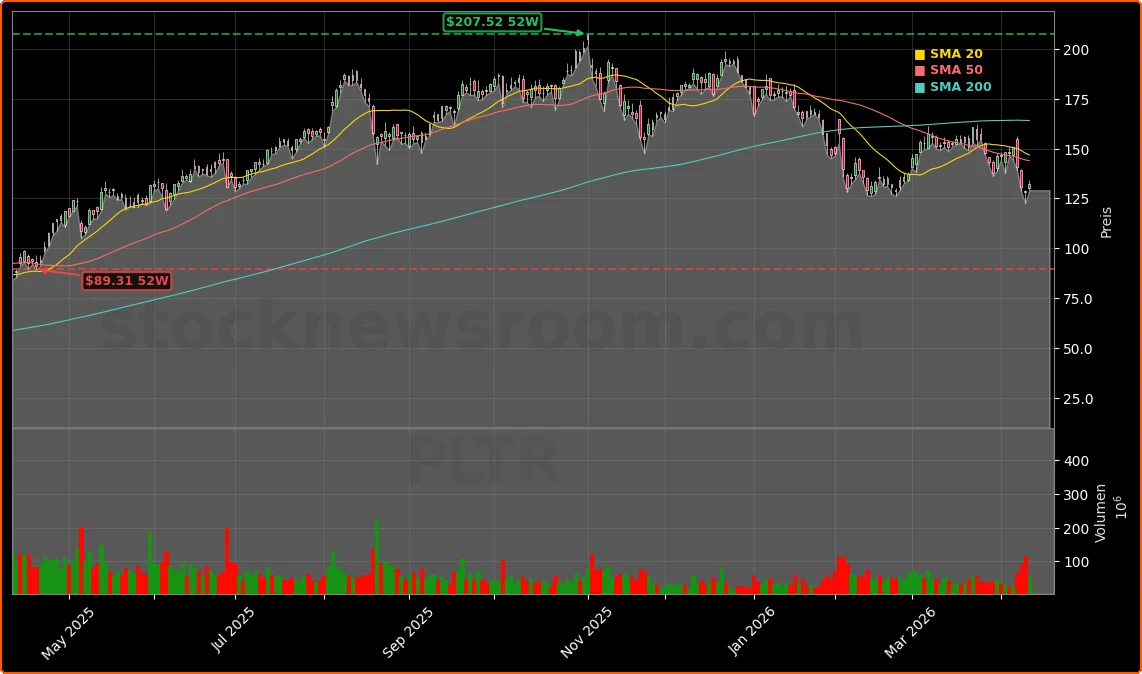
Technical signals also lean cautious. The share price has broken down from recent ranges and technicians highlight a head‑and‑shoulders pattern on both weekly and monthly charts that projects potential downside toward $90 if selling accelerates. Key support sits around $125—an area that previously acted as resistance. Below there, traders flag $120 as the next level, followed by a deeper zone in the $85–$90 range. Some chart watchers see scope for a rebound attempt toward $142 before any renewed slide, especially after a bullish reversal candle formed on Friday.
Palantir earnings vs. Trump, ARK and AI battlefield hype
Palantir has been in the headlines for reasons far beyond quarterly numbers. President Donald Trump recently used his social platform to hail the company as having “great war‑fighting capabilities and equipment,” spotlighting Palantir’s role in next‑generation defense analytics and AI‑driven command‑and‑control. The stock briefly spiked more than 4% above $133 on the comments, but unlike Trump’s historic ability to move Bitcoin, the bump faded quickly as valuation concerns reasserted themselves.
On the institutional side, Cathie Wood’s ARK Invest has leaned into the weakness, buying roughly 85,000 Palantir shares—about $11 million worth—across several of its ETFs, while trimming exposure to Advanced Micro Devices. That aligns Palantir with other high‑conviction ARK names like Tesla and reinforces its standing among growth‑oriented investors who see the latest Palantir earnings as validation of a long‑term AI thesis.
In the defense tech space, Palantir is also emerging as a key player in the fast‑growing counter‑drone market. AI‑enabled detection and tracking solutions are moving from niche to mainstream as militaries look to integrate radio‑frequency sensors with video and other data streams. Companies such as Palantir, BigBear.ai and Kratos are racing to fuse multi‑sensor inputs into unified AI systems, a trend that could support future Palantir earnings through larger and longer‑dated contracts.
Still, Wall Street strategists remain split. Some research shops maintain bullish 12‑month price targets around $185–$195, implying 40–50% upside from current levels if Palantir hits its 2026 revenue guidance range of roughly $7.18 billion and continues to dominate AI infrastructure for governments and enterprises. Others, including valuation‑sensitive analysts at firms like Morgan Stanley and Goldman Sachs, emphasize that at a forward P/E near 60 even after estimate revisions, Palantir is priced for near‑perfect execution.
What do Palantir earnings mean for AI portfolios?
For U.S. investors building AI‑heavy portfolios anchored by names like NVIDIA and Apple, Palantir sits squarely in the high‑risk, high‑reward bucket. Its AIP platform is deeply embedded in intelligence, defense and commercial workflows, and the most recent Palantir earnings underscore that demand is still inflecting higher. At the same time, the stock’s volatility—amplified by social‑media buzz, political endorsements and concentrated retail positions—has made it a poster child for concentrated risk. One widely discussed example is a hypothetical portfolio with a 60% allocation to Palantir, used to illustrate how even a great company can devastate wealth if position sizing is extreme.
Meanwhile, competition in enterprise AI is intensifying. Debates now routinely pit Palantir’s vertically integrated, data‑to‑decision stack against younger players like Anthropic and BigBear.ai, as well as diversified incumbents such as Broadcom and Microsoft. Some analysts even argue that Broadcom is the cleaner AI pick today due to its chip exposure, diversified cash flows and more reasonable valuation, while Palantir remains a “hold” until its earnings power catches up with its market cap.
Related Coverage
For a deeper dive into how valuation risk intersects with the AI narrative, our recent analysis “Palantir AI Analysis: -1.9% Shock After a Huge AI Rally” explores whether the stock’s premium multiple is a durable moat or a fragile bet on flawless execution. You can read it here: Palantir AI Analysis: -1.9% Shock After a Huge AI Rally. Investors interested in the broader AI hardware backdrop may also want to look at how NAND demand is feeding into chip momentum via “SanDisk NASDAQ-100 Inclusion: +10.6% AI NAND Boom Rally” at SanDisk NASDAQ-100 Inclusion: +10.6% AI NAND Boom Rally, which helps frame where data‑infrastructure plays sit relative to software names like Palantir.
You can love the business and still be disciplined on the price you pay for the stock.— Anonymous Wall Street portfolio manager
In sum, the latest Palantir earnings showcase one of the fastest‑growing, most profitable AI software franchises on Wall Street, but also one of the most richly valued. For diversified investors, the stock may warrant a place alongside core AI holdings, provided position sizes account for elevated volatility and technical downside risk. The next few quarters of Palantir earnings and contract wins will be crucial in determining whether today’s pullback is a buying opportunity or an early warning that the multiple needs to reset further.