Can the Palo Alto Networks AI Strategy turn today’s sector-fueled rally into a lasting leadership edge in cybersecurity?

Why is Palo Alto Networks rallying today?
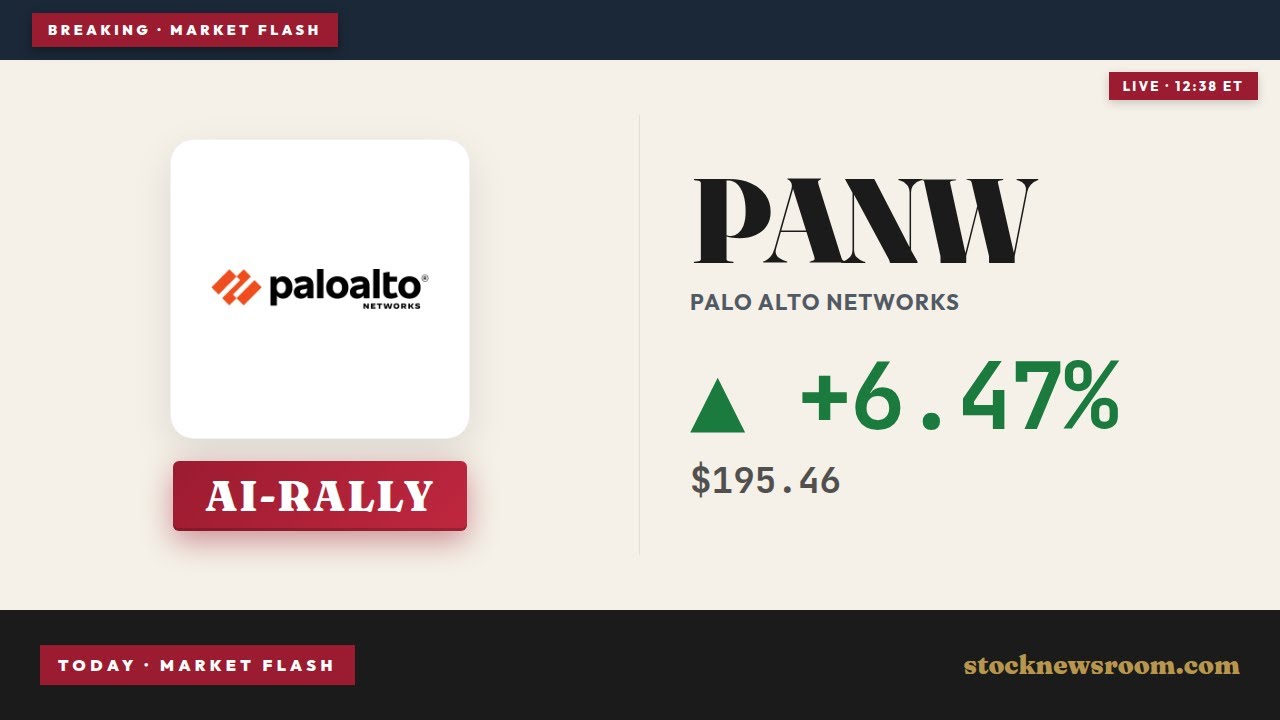
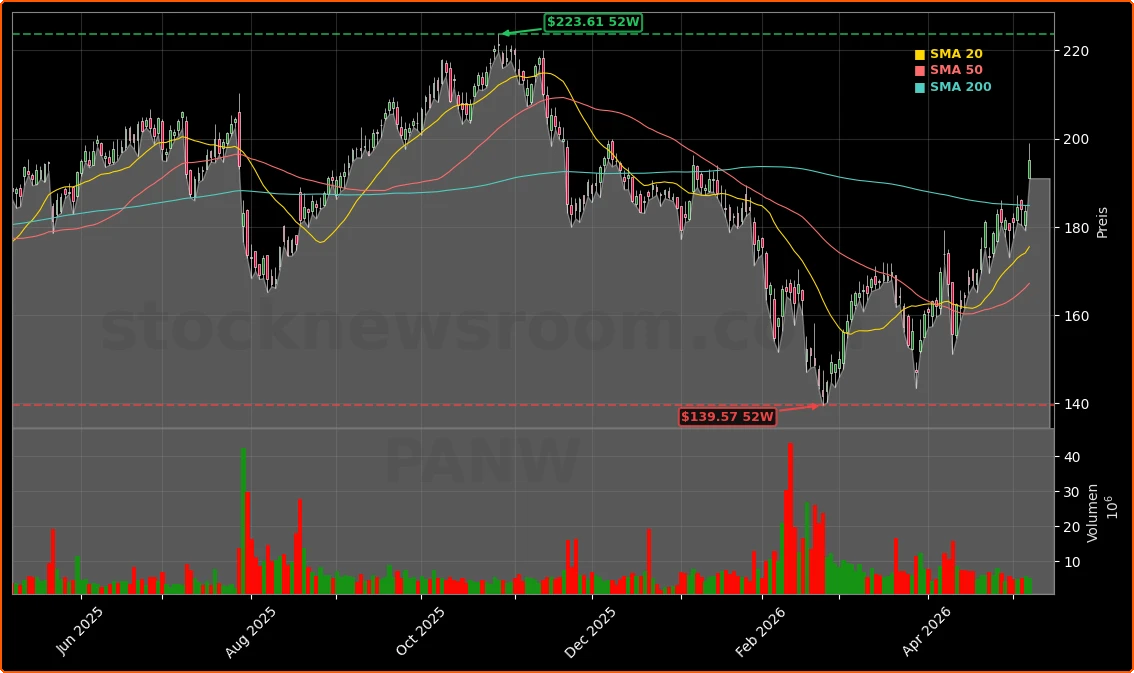
Palo Alto Networks, Inc. was among the strongest cybersecurity names today, rising to $195.24 from a previous close of $187.01, a gain of about 6.35%. The stock benefited from a sector-wide tailwind after Fortinet delivered what BTIG analysts described as an outstanding quarter, sending Fortinet shares up roughly 15% and lifting peers across the firewall and broader security space.
Fortinet’s strong report helped rebuild sentiment around network security spending, which had faced concerns about lengthening deal cycles and tighter IT budgets. With Fortinet controlling around half of the global firewall market, its results are often treated as a bellwether. As that halo effect spread, investors rotated back into high-quality cyber names like CrowdStrike and Palo Alto Networks, Inc., with PANW seen as a key beneficiary thanks to its cloud-delivered platforms and aggressive artificial intelligence roadmap.
Even after today’s jump, PANW remains below its all-time high from Q1 2024, but the stock’s renewed momentum suggests investors are again willing to pay a premium multiple for durable growth and AI leverage. The current P/E ratio around 48 times earnings illustrates that Wall Street is still pricing in above-average expansion relative to many software and S&P 500 technology names.
How central is Palo Alto Networks AI Strategy?
The core of the current bull case is the Palo Alto Networks AI Strategy, which aims to automate and augment nearly every layer of the company’s security stack. PANW uses AI and machine learning models to analyze huge data sets flowing through its platforms, identifying subtle anomalies and malicious behavior patterns that would be difficult or impossible for human analysts to catch in time.
This AI-centric approach allows the company to detect and block zero-day exploits, ransomware campaigns, and other advanced threats in near real time. PANW is also investing in what it calls Precision AI, a set of defenses built specifically to counter attackers who are themselves using AI to craft more dynamic and evasive malware. By meeting AI-enabled threats with AI-driven defenses, the Palo Alto Networks AI Strategy is designed to create a self-improving, resilient security fabric that becomes more effective as it ingests more data.
The practical payoff for customers is automation of routine security operations: incident triage, enrichment, correlation, and even elements of response can be handled by AI, reducing alert fatigue and freeing up security teams to focus on strategic risk management. For large U.S. enterprises and cloud-native companies running complex hybrid environments, this promise of reduced complexity and lower total cost of ownership is a differentiator.
How does Palo Alto Networks compare with Fortinet and peers?
Today’s move also reflects a relative-value readjustment within cybersecurity. Fortinet’s results reassured markets about firewall demand, but investors looking for a broader platform and deeper cloud integration often gravitate toward Palo Alto Networks, Inc.. PANW has expanded well beyond appliances into secure access service edge (SASE), cloud security, and security operations, with AI embedded across these pillars.
Compared with rivals like CrowdStrike in endpoint and identity, Palo Alto Networks competes more directly on network, cloud, and SOC automation. Its Palo Alto Networks AI Strategy positions the company as a potential consolidator in a fragmented security stack, promising customers fewer point solutions and more unified, AI-driven visibility. For investors building AI exposure, PANW sits alongside infrastructure names such as NVIDIA and hyperscalers like Apple’s ecosystem partners as a way to benefit from the AI wave without owning pure-play model trainers.
From a technical perspective, an RSI near 57 indicates the stock is gaining strength but has not yet entered overbought territory, leaving room for trend followers to add exposure if momentum continues. The key watch point for Wall Street traders will be whether PANW can reclaim and sustain levels above $200, which previously acted as both support and resistance.
What are analysts watching now?
While specific target changes were not highlighted today, major Wall Street houses such as Goldman Sachs, Morgan Stanley, and Citigroup closely track the name and have repeatedly emphasized the strategic importance of AI in their Palo Alto Networks theses. With a premium valuation already in place, future rating and price-target revisions from firms like Citigroup or RBC Capital Markets will likely hinge on how effectively the Palo Alto Networks AI Strategy translates into incremental revenue growth, higher platform attach rates, and expanding operating margins.
Investors will be focused on upcoming earnings commentary for concrete metrics around AI-driven products: adoption of AI-powered SOC tools, upsell into cloud security bundles, and any early revenue contribution from Precision AI capabilities. Given that cyber attackers are using generative AI to make phishing and intrusion attempts harder to detect, the market is likely to reward vendors that can show measurable improvements in breach prevention and response times using AI.
For U.S. growth portfolios, PANW remains a high-beta way to play both digital transformation and the arms race between AI-enabled attackers and defenders. The stock’s move today, triggered by Fortinet’s performance, underscores how quickly sentiment can snap back when sector fundamentals look stronger than feared.
Related Coverage: What else should investors read?
Investors looking to understand the management’s conviction behind the Palo Alto Networks AI Strategy may want to revisit the recent insider transaction focus. The article “Palo Alto Networks CEO Purchase: $10M Bet Fuels 5% Rally” analyzes whether the CEO’s $10 million stock purchase signals confidence in the company’s AI-driven roadmap or is simply noise in a volatile cyber market. Combined with today’s AI-fueled sector rebound, this earlier move adds another layer to the debate over how aggressively investors should weight PANW in AI-focused portfolios.
In summary, the Palo Alto Networks AI Strategy is emerging as a key driver of investor enthusiasm as cybersecurity names bounce on strong Fortinet numbers. For Wall Street, PANW offers a scaled, AI-powered platform at the center of the battle against increasingly sophisticated digital threats. The next earnings updates and any fresh analyst calls will show whether the stock’s renewed momentum can carry it back above $200 and potentially toward new highs for long-term AI and cybersecurity investors.