Can the IBM Quantum Breakthrough in drug discovery and AI agents finally turn Big Blue’s deep tech bets into real shareholder upside?

How does the IBM Quantum Breakthrough move the stock?
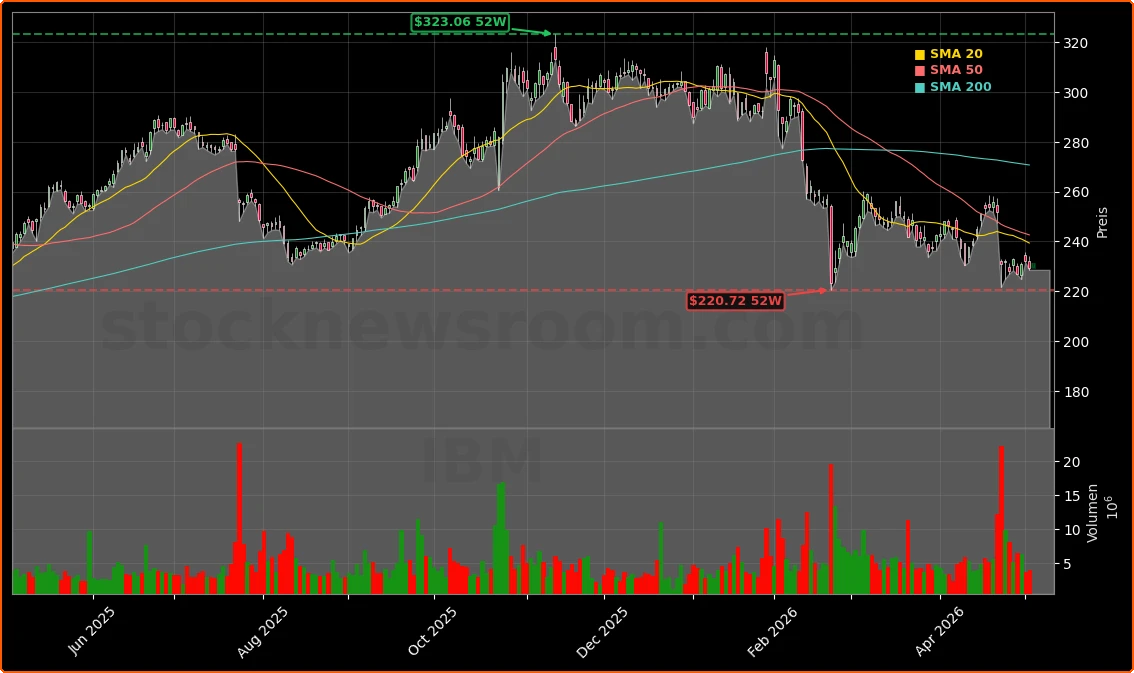
IBM shares closed Monday at $229.48, down 1.17% on the day, before ticking up to about $231.50 in early pre-market indications on Tuesday. That modest bounce comes as investors digest the IBM Quantum Breakthrough and a series of Think 2026 product launches that collectively strengthen the company’s long-term technology story. While the stock remains below the average analyst price targets reported by several Wall Street firms, the new milestones in quantum and AI arrive at a time when the S&P 500’s largest tech names are competing fiercely for future infrastructure spend.
For U.S. portfolios, IBM’s combination of mid-single-digit revenue growth, a roughly 3% forward dividend yield and new higher-value platforms stands in contrast to faster-growing but less income-focused peers like NVIDIA and Apple. The question now is whether the IBM Quantum Breakthrough in drug discovery and the AI operating model unveiled at Think 2026 are enough to close the valuation gap that many analysts still see versus high-profile AI beneficiaries.
What exactly is the IBM Quantum Breakthrough?
The headline scientific achievement is a joint project between IBM, Cleveland Clinic and Japan’s RIKEN research institute. Using IBM’s 156-qubit Heron quantum processors tightly coupled with two of the world’s most powerful supercomputers, Fugaku and Miyabi-G, the team simulated protein complexes of up to 12,635 atoms – the largest biologically meaningful molecules modeled on quantum hardware so far. One of the key test cases was trypsin, an enzyme essential for breaking down proteins in the human body and a classic target in drug discovery.
The work relied on an algorithmic framework IBM describes as quantum-centric supercomputing, where classical machines decompose a complex biochemical system into fragments and quantum processors capture the quantum-mechanical behavior of those fragments. The new hybrid algorithm, dubbed EWF-TrimSQD, enabled simulations roughly 40 times larger than those achieved just six months earlier, with accuracy improvements of up to 210% in parts of the workflow. Scientists involved in the project stress that this does not yet constitute formal “quantum advantage,” but it demonstrates that IBM’s quantum machines are now contributing to real-world scientific problems rather than only lab-scale benchmarks.
For investors, the IBM Quantum Breakthrough matters because it pushes the company’s quantum roadmap closer to commercial relevance in pharma and life sciences – verticals where IBM already has deep enterprise relationships through its consulting and software arms.
How is IBM monetizing AI and hybrid cloud?
Alongside the IBM Quantum Breakthrough, CEO Arvind Krishna used Think 2026 to lay out what he calls the “AI operating model” that will separate companies where AI runs the business from those where AI is still a side project. IBM is expanding its watsonx portfolio into an agent-centric platform: a next-generation watsonx Orchestrate (now an agentic control plane in private preview) and the generally available IBM Bob, a secure agent development partner for enterprise software teams.
On the data side, IBM is integrating Confluent’s real-time streaming technology with watsonx.data to give AI agents governed, low-latency access to enterprise information. New context capabilities and GPU-accelerated Presto – tested with partners like Nestlé and NVIDIA GPUs – aim to cut query costs while speeding analytics across large global datasets. For mainframe-heavy customers, the IBM Z Database Assistant in private preview brings AI-driven monitoring and automation to Db2 and IMS environments, enhancing IBM’s pitch as the bridge between legacy and next-generation AI architectures.
Automation and operations are being addressed through IBM Concert, an AI-powered operations platform in public preview that unifies signals from applications, infrastructure and networks into a single, actionable view. Complementary tools like Concert Secure Coder and IBM Vault 2.0 embed security and secret management directly into developer and infrastructure workflows, a theme that resonates with heavily regulated clients that also rely on competitors such as Tesla’s IT stack only at the edge, not in core systems.
What is IBM Sovereign Core and why does it matter?
To complete its AI stack, IBM announced the general availability of IBM Sovereign Core, a software platform designed to make digital sovereignty operational across hybrid environments. Rather than treating sovereignty as a static compliance checklist, Sovereign Core embeds policy at the infrastructure runtime layer, giving enterprises and governments a customer-operated control plane, in-boundary identity and encryption services, and continuous compliance monitoring with automated evidence collection.
Crucially for global clients, the platform supports governed AI execution, ensuring that models, inference workloads and agents run within defined sovereign boundaries and can be audited at scale. Built on Red Hat OpenShift and Red Hat AI, Sovereign Core leverages an ecosystem of partners including AMD, Intel, Mistral, MongoDB and security vendors like Palo Alto Networks. For U.S. investors, Sovereign Core underscores IBM’s strategy to differentiate against hyperscalers by leaning into open, hybrid deployments where customers retain maximum control – an approach that may appeal to governments and regulated industries wary of vendor lock-in from cloud-first rivals.
How are analysts and institutions reacting?
On the sell-side, HSBC recently upgraded IBM from “Sell” to “Hold” and raised its price target from $218 to $231, explicitly assigning a $35 billion valuation to the company’s quantum computing business. HSBC also noted that if IBM’s quantum revenue were valued at similar enterprise-value-to-sales multiples as pure-play players like IonQ or Rigetti, the segment could be worth closer to $51 billion, highlighting how central the IBM Quantum Breakthrough narrative has become to the long-term story.
Other coverage compiled by MarketBeat shows a broader “Moderate Buy” consensus with average price targets well above the current share price, even after IBM’s post-earnings pullback in April. Institutional appetite appears solid: Fulcrum Wealth Advisors, for example, disclosed a new position of 12,685 IBM shares worth roughly $3.8 million, making the stock its ninth-largest holding. For dividend-focused investors, IBM also continues to stand out among large-cap tech names alongside income payers like Apple, with more than three decades of consecutive dividend increases supported by recurring software and consulting revenue.
Related Coverage
Investors looking to understand how the IBM Quantum Breakthrough and Think 2026 launches fit into the broader earnings picture may want to review IBM’s latest quarterly numbers. Our recent analysis in “IBM Earnings -8.3% Plunge: Strong Q1 Beat, AI Shock” explores why the stock sold off despite a solid Q1 2026 beat and growing AI traction, and how sentiment around the company’s software and quantum strategy is shaping near-term trading.
For years, quantum computing has been a promise. Now, quantum computers are producing results that matter to science.— Jay Gambetta, Director of IBM Research
Altogether, the IBM Quantum Breakthrough in protein simulation, paired with a more complete AI and sovereignty platform, reinforces IBM’s role as a long-duration infrastructure provider rather than a momentum AI trade. For U.S. investors balancing growth, income and technological exposure, IBM offers a differentiated mix of dividend stability and optionality in quantum and agentic AI. The next few quarters of client wins and quantum milestones will show whether this thesis translates into sustained multiple expansion on Wall Street.