Is the Qualcomm AI Strategy truly transforming a handset champion into a long-term AI infrastructure winner or just fueling momentum hype?

Is Qualcomm becoming an AI infrastructure winner?
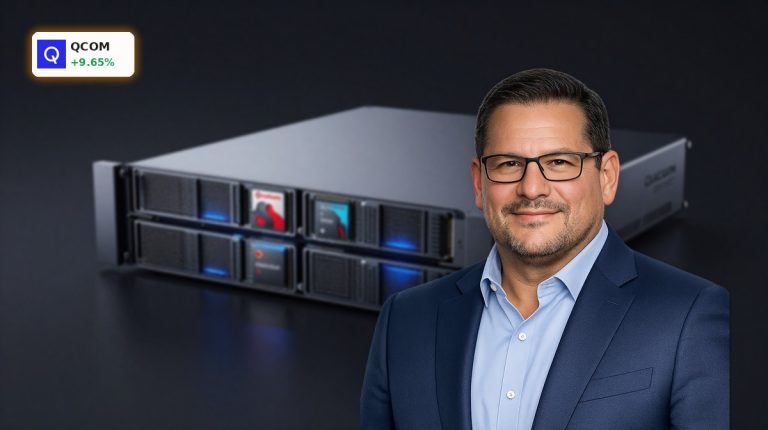
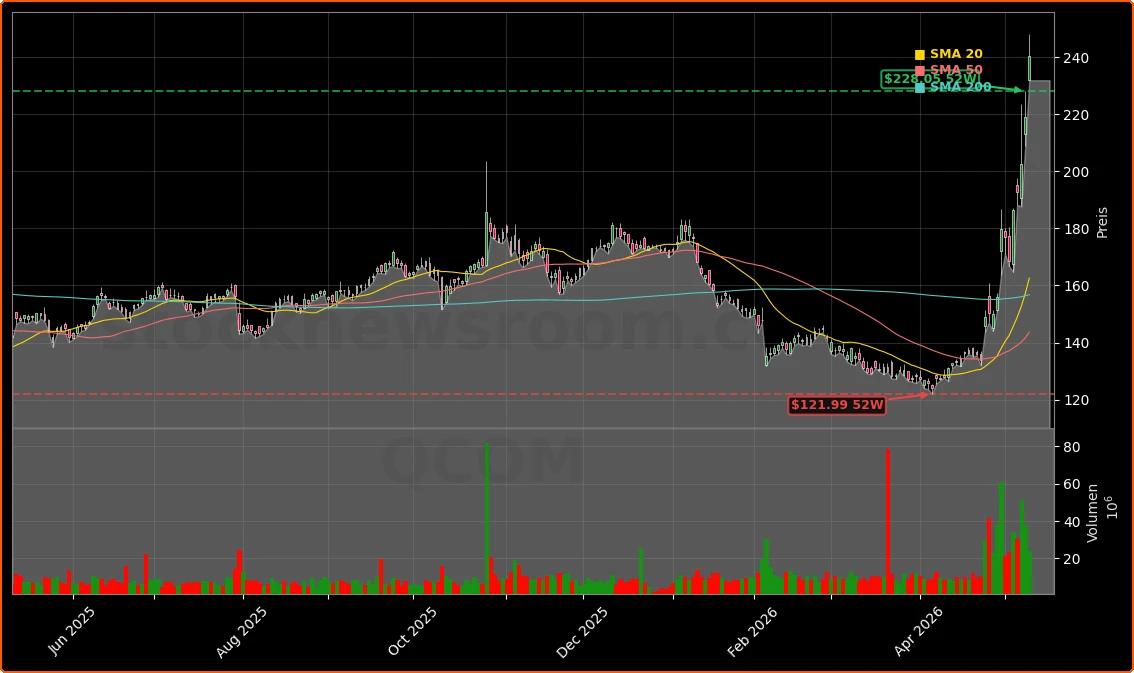
Chip stocks once again led U.S. markets higher on Monday, even as S&P 500 futures pointed to a softer open. Qualcomm Incorporated surged to around $240.24, up 9.65% on the day and roughly 86% over the past month, putting it among the top contributors to S&P 500 gains in 2026. The latest spike follows an 8% jump on Friday, underscoring how aggressively investors are repricing Qualcomm as a data-center and AI infrastructure name rather than just a handset supplier.
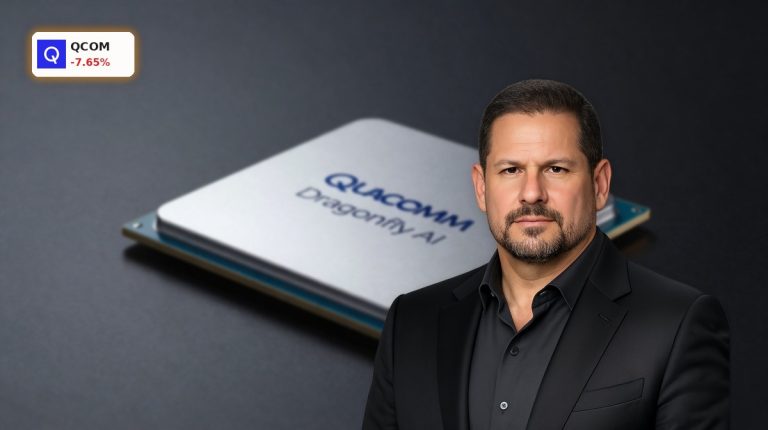
The Qualcomm AI Strategy is anchored in a clear pivot: CEO Cristiano Amon has highlighted an “entry into the data center,” with a custom silicon engagement for a leading hyperscaler slated for initial shipments later this calendar year. That announcement, made alongside fiscal Q2 results on April 29, has become the focal point of the rally and will be detailed further during the company’s June 24 Investor Day, which is now a key date on every tech investor’s calendar.
The move comes as the broader semiconductor complex rips higher on AI demand. While NVIDIA still dominates GPU-based training workloads, investors are searching for the next beneficiaries of AI inference, edge computing, and Arm-based data-center architectures, and Qualcomm’s sudden re-rating reflects that shift.
How strong are Qualcomm’s latest fundamentals?
Fundamentals have provided the spark for the Qualcomm AI Strategy. For fiscal Q2 2026, Qualcomm Incorporated delivered non-GAAP EPS of $2.65 on revenue of $10.6 billion, slightly ahead of Wall Street estimates. Automotive revenue was a standout at $1.33 billion, up 38% year over year, showing that Qualcomm’s diversification into connected vehicles and ADAS silicon is gaining real traction.
Beyond operating results, capital allocation has turned more shareholder-friendly. Qualcomm has authorized a new $20 billion share repurchase program and increased its quarterly dividend to $0.92 per share, signaling confidence in long-term cash generation. Several institutional investors, including Kepler Cheuvreux Suisse SA, Asahi Life Asset Management and other asset managers, have recently boosted or initiated positions in QCOM, contributing to institutional ownership above 74%.
Valuation is no longer cheap in absolute terms. At the current price, QCOM trades around 24x earnings, rich compared with its historical handset-cycle multiples but still below high-flying AI peers. That multiple, however, reflects the market’s belief that the Qualcomm AI Strategy could unlock a structurally higher growth profile, particularly if the data-center CPU and AI inference opportunity scales over the next few years.
How are analysts reacting to Qualcomm’s AI pivot?
Sell-side analysts have been scrambling to catch up with the speed of the move. Daiwa analyst Louis Miscioscia upgraded Qualcomm Incorporated to Outperform from Neutral on May 8 and lifted his price target to $225 from $140, explicitly citing the company’s emerging data-center AI CPU opportunity and its ability to ride broader Arm-based AI inference trends. Tigress Financial also raised its target to $280 from $270 while reiterating a Buy rating, pointing to Qualcomm’s expansion beyond wireless into AI-driven connectivity across devices, vehicles, and data centers.
Baird went even further, boosting its target to $300 from $177 and maintaining an Outperform rating following earlier quarterly results. Despite these aggressive hikes, the broader analyst community remains more cautious: the average target still sits well below the current price, and the consensus rating is closer to Hold than Strong Buy. That gap between targets and tape encapsulates the debate: has the Qualcomm AI Strategy structurally changed the company’s earnings power, or is the stock in a late-stage momentum phase?
Some institutional holders have taken profits as prices soared. Securian Asset Management and Midwest Trust, for instance, trimmed positions in Q4, even as others such as NewEdge Wealth and Wesbanco Bank added to stakes. The mix of insider selling and institutional rotation is typical for a parabolic phase in mega-cap semis and underscores the importance of risk management for new entrants at these levels.
How does Qualcomm compare with other AI chip leaders?
For U.S. investors, the Qualcomm AI Strategy sits within a broader portfolio question: how to balance exposure between entrenched AI leaders and emerging beneficiaries. NVIDIA remains the benchmark for AI data-center demand, while Apple continues to build AI capability into its own silicon stack for iPhones and Macs. Qualcomm’s edge is its breadth: handset SoCs, automotive platforms, IoT chips, and now Arm-based data-center silicon, all leveraging shared IP and design expertise.
The stock’s performance has been spectacular but not unique across the AI complex. Micron’s recent run, for example, mirrors Qualcomm’s parabolic move, while energy names and other cyclicals have also participated in the broader rotation. Still, Qualcomm’s participation in high-profile geopolitical events—such as CEO-level representation at a Trump–Xi meeting in Beijing alongside Apple and NVIDIA executives—underscores how central leading U.S. chipmakers have become to both economic and diplomatic agendas.
Related Coverage: What else should investors read?
Investors looking for deeper background on how the Qualcomm AI Strategy evolved over the past few weeks should review prior coverage on stocknewsroom.com. An in-depth earlier piece, “Qualcomm AI Strategy +7.8% Rally After Q2 AI Shock”, walks through the initial post-earnings re-rating, examines cyclical handset headwinds, and explains why AI and data-center optionality are starting to justify a premium multiple. Together with today’s price action, it helps frame how quickly market perception has shifted from skepticism to enthusiasm.
In summary, the Qualcomm AI Strategy has propelled Qualcomm Incorporated into the front row of Wall Street’s AI infrastructure trade, backed by solid earnings, a hyperscaler data-center win, and major analyst upgrades. For U.S. investors, the stock now represents a high-beta way to play the expansion of AI beyond GPUs into Arm-based CPUs, edge devices, and automotive platforms. The June 24 Investor Day will be pivotal in confirming whether this new narrative can support current valuations and potentially drive the next leg of the rally.