Can Qualcomm’s bold AI and data center push offset handset weakness as the stock slides 3.9% after recent earnings euphoria?

How are Qualcomm Earnings reshaping the stock story?
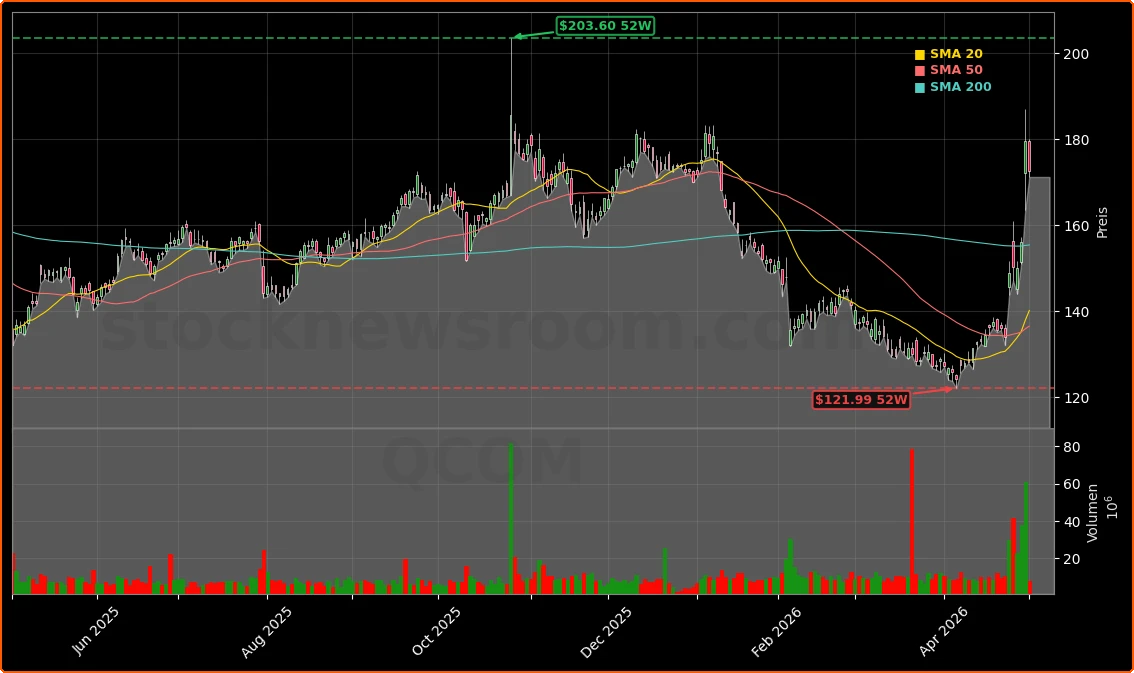
The latest Qualcomm Earnings cemented the company’s transition from a pure smartphone cyclical to a broader AI and infrastructure play. Fiscal Q2 revenue slipped about 3% year over year and handset sales fell double digits, confirming that the traditional core business is under pressure. Nevertheless, adjusted EPS and revenue topped Wall Street forecasts, and the stock spiked from roughly $150 to above $180 in late April as investors focused on long-term catalysts rather than short-term weakness.
That optimism is rooted in mix shift and capital allocation. Automotive revenue hit a record near $1.33 billion, up roughly 38% year over year, while the combined automotive and IoT businesses grew about 20%. Licensing remained highly profitable, with an earnings-before-tax margin above 70%, supporting strong cash generation. Free cash flow over the last fiscal year reached about $12.8 billion, up nearly 15%, giving the company room to fund growth and return capital.
At the same time, Qualcomm is leaning into shareholder-friendly policies. The board has authorized a massive $20 billion buyback, with around $2.8 billion in stock repurchased in Q2 alone, and the quarterly dividend stands at $0.92 per share. At today’s prices, the trailing free cash flow yield of roughly 6% and a forward P/E near 15 suggest the market is paying a modest multiple for earnings that could rise if new AI initiatives deliver.
Why is the data center pivot so crucial for Qualcomm?
The real excitement around Qualcomm Earnings comes from the company’s move into data centers, traditionally dominated by players like NVIDIA and increasingly targeted by rivals such as Apple with custom silicon. Management confirmed a “leading hyperscaler” engagement for custom AI silicon, with initial chip shipments expected later this calendar year. While the customer is not yet named, the deal signals that Qualcomm can compete in the highest-value segment of the AI stack, not just at the handset edge.
Beyond custom silicon, Qualcomm is developing an agentic CPU and a dedicated AI accelerator for the cloud, seeking to extend its low-power leadership from mobile into data center workloads. An Investor Day on June 24 will focus on Data Center and what the company calls “Physical AI” — embedding advanced intelligence into devices, vehicles, and networked systems. For U.S. investors comparing Qualcomm to AI leaders and PC-chip names, this event could be a key catalyst that clarifies revenue potential and margin structure in the server market.
Strategists on Wall Street argue that AI enthusiasm has largely centered on GPU vendors and a handful of megacap platforms, leaving room for diversified chipmakers like Qualcomm to rerate if they can prove durable AI revenue. Exchange-traded funds tracking semiconductors have already increased their exposure to QCOM following the earnings pop, putting it in the same AI narrative that has driven outsized gains in names like NVIDIA and Tesla.
What are the main risks after upbeat Qualcomm Earnings?
Despite the positive long-term story, guidance from Qualcomm Earnings was cautious. For fiscal Q3, the company projected revenue in a range of $9.2 billion to $10.0 billion and non-GAAP EPS of $2.10 to $2.30, both below consensus expectations. Management attributed the softness primarily to memory constraints in AI data centers, which are crowding out supply for smartphone OEMs, and to continued weakness in the Chinese handset market.
CFO Akash Palkhiwala indicated that the June quarter should mark the trough, with a recovery in China and better component availability expected from the September quarter onward. Still, the near-term reality is that revenue and operating income are likely to dip again, and the market must bridge that gap before data center revenue becomes visible. The 52-week trading range of $121.99 to $205.95 highlights both the upside if AI execution succeeds and the downside risk if handset headwinds persist longer than expected.
Analyst sentiment reflects this push-and-pull. JPMorgan Chase & Co. recently raised its price target on Qualcomm to $160 but kept a neutral rating, signaling that current levels already discount much of the medium-term upside. Another major Wall Street firm maintained an Equal-Weight stance while nudging its target from $150 to $160, even as it projected roughly a 10% potential pullback. Overall, consensus skews toward Hold, with relatively few outright Sell calls but limited conviction Buys compared with megacap AI beneficiaries.
How should U.S. investors frame Qualcomm versus peers?
From a portfolio perspective, Qualcomm sits at the intersection of several key U.S. equity themes: AI infrastructure, 5G handsets, connected cars, and edge computing. While it lacks the software flywheel of a cloud operator or platform giant like Apple, its valuation is undemanding compared with many AI favorites and its balance sheet is strong, with net debt at well under 1x EBITDA. That combination of cash generation and optionality appeals to investors seeking AI exposure outside the most crowded trades.
However, Qualcomm is not a pure AI play. Handsets still represent a significant share of revenue, tying the stock to global consumer cycles and Android OEM health. Investors who want cleaner AI beta may prefer hyperscalers, GPU providers, or infrastructure software, while those looking for diversified semiconductor exposure might pair Qualcomm with foundry names or analog chipmakers. For income-oriented investors, the growing dividend and buyback program could make QCOM a core holding if the data center strategy translates into sustainable earnings growth.
Related Coverage
For a deeper dive into how the recent rally unfolded, including detailed discussion of the 14% post-report surge and the hyperscaler announcement, readers can review this analysis of Qualcomm Earnings and the AI data-center pivot. That piece explores whether the market reaction was justified given the softer guidance and outlines key questions heading into the June Investor Day.
In summary, the latest Qualcomm Earnings show a company in transition, with handset weakness offset by early but promising AI and data center initiatives. For U.S. investors, QCOM offers a blend of value, income, and AI optionality that could become more compelling if the June Investor Day confirms meaningful hyperscaler-driven growth. The next few quarters will reveal whether Qualcomm’s data center strategy can join automotive and IoT as durable growth engines and keep the stock in Wall Street’s AI spotlight.