Is Qualcomm’s AI strategy finally convincing Wall Street that this former handset giant deserves a premium AI valuation?

Is Wall Street Repricing Qualcomm After Q2?
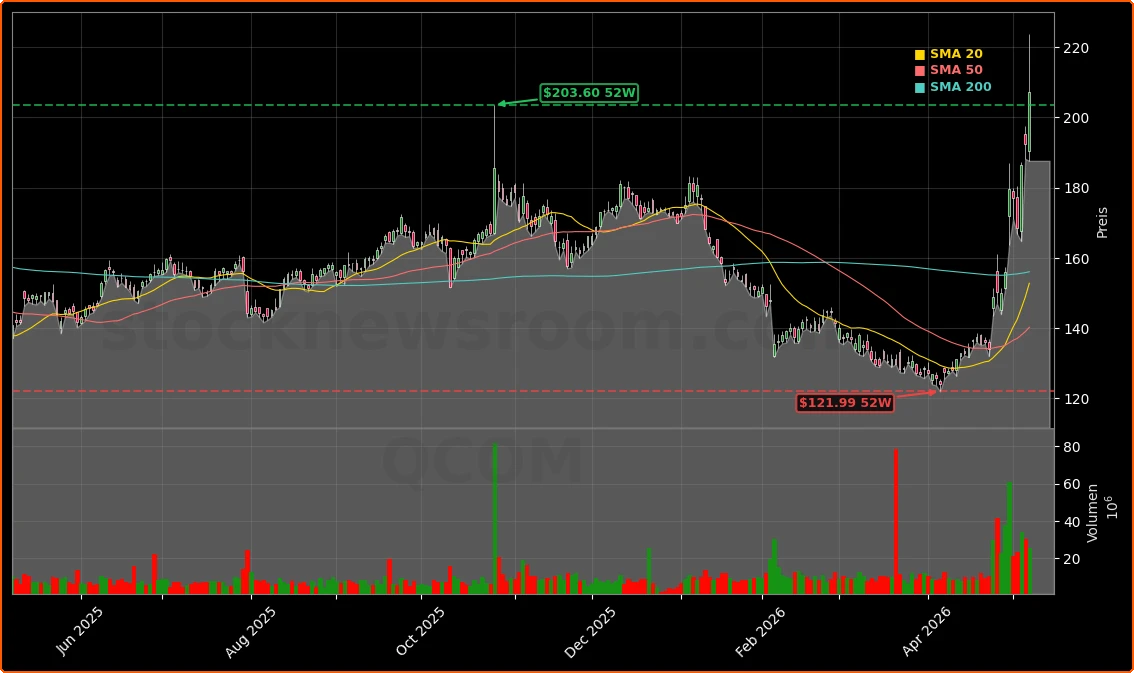
Qualcomm stock has sharply outperformed this week as traders reassess its role in the AI cycle. The shares, now near the top of their 52‑week range (52‑week high about $216), have rallied on the back of fiscal Q2 2026 results that once again topped expectations. Revenue came in around $10.6 billion with adjusted EPS of $2.65, beating consensus while still reflecting pressure from a soft global smartphone market.
The immediate drivers were threefold: confirmation that Qualcomm will ship custom AI chips to a leading hyperscaler later this year, record automotive revenue above $1.3 billion at roughly 38% year‑over‑year growth, and a powerful capital return package led by the new $20 billion repurchase authorization and a dividend hike to $0.92 per share. Together, these moves are giving the Qualcomm AI Strategy more credibility with institutional buyers who had long treated the stock as a slow‑growth handset supplier.
Multiple large investors including Gateway Investment Advisers, Principal Financial Group and Swedbank recently increased positions, reinforcing the view that QCOM is migrating from a value trap to a total‑return AI compounder. Several quant and momentum services have also flagged a sharp improvement in the stock’s trend profile as buying pressure has intensified.
How Is Qualcomm AI Strategy Shifting Beyond Handsets?
For years, Qualcomm’s dependence on smartphones, particularly in China, weighed on its valuation even as peers like NVIDIA, Broadcom and Advanced Micro Devices were rewarded for AI data center exposure. Management is now executing a deliberate Qualcomm AI Strategy to escape that perception. CEO Cristiano Amon has confirmed a multi‑generation engagement with a “leading hyperscaler” for custom AI accelerators, focused on inference workloads where energy efficiency and cost per query matter more than brute‑force training performance.
This data center push builds on Qualcomm’s strength in low‑power compute and follows its acquisition of Alphawave’s assets to bolster connectivity and silicon IP. At its upcoming June 24 Investor Day, the company plans to lay out detailed roadmaps for data center and so‑called “physical AI,” including edge inference silicon, AI‑enabled PCs and automotive platforms. Management has already indicated that non‑handset chip revenue — spanning automotive, IoT and PCs — could reach roughly half of segment sales by the end of the decade.
The Qualcomm AI Strategy also extends directly to PCs via the new Copilot+‑class platforms, which can deliver up to 45 trillion operations per second on device. These chips are designed to handle local generative AI tasks that today still run mostly in the cloud, positioning Qualcomm as a beneficiary as more AI workloads migrate to the edge for latency, privacy and cost reasons.
How Does Qualcomm Stack Up Against Other AI Leaders?
Despite the rally, valuation remains a central part of the bull case. Qualcomm trades on a forward P/E near the mid‑teens with a free cash flow yield above 6% and a PEG ratio under 1. By contrast, AI bellwethers such as NVIDIA, Broadcom and AMD command earnings multiples several times higher as investors crowd into pure‑play data center stories.
In fiscal 2025 Qualcomm generated about $44.3 billion in revenue and $12.8 billion in free cash flow, supporting a return on equity around 23%. With forward EPS estimates hovering near $14.50, some models point to fair value in the mid‑$240s, implying meaningful upside even after this week’s spike. That relative discount is why value‑oriented managers like Aristotle Capital continue to hold the name despite near‑term drag from handset weakness.
There are still risks. Memory price spikes tied to AI server demand have constrained smartphone builds and pushed major OEMs to run leaner inventories. Chinese handset softness and ongoing geopolitical tensions also loom, though a recent 90‑day tariff pause between Washington and Beijing has temporarily eased pressure on Qualcomm’s Chinese partners. Management expects Chinese handset revenue to bottom in the current quarter and to return to sequential growth afterward, while automotive and IoT continue to post double‑digit expansion.
What Role Do Buybacks And Dividends Play Now?
Capital returns are a critical, and sometimes underappreciated, element of the Qualcomm AI Strategy. In FY25 the company returned roughly $12.6 billion to shareholders, and it repurchased about 19 million shares in Q2 FY26 alone. The new $20 billion authorization gives it ample dry powder to shrink the float further, especially if volatility offers pullback opportunities.
The quarterly dividend, now $0.92 per share, equates to a yield of roughly 2% at current prices and remains well covered, with interest coverage near 19x. For U.S. retirement and income‑oriented investors who want AI exposure but are wary of richly valued high‑beta names, that combination of durable cash distributions and potential multiple expansion is a notable differentiator versus growth‑only stories like Tesla.
Analyst sentiment is gradually catching up. Benchmark recently lifted its price target on Qualcomm to $225, while firms such as Zacks have moved from aggressively negative views toward more neutral stances. The consensus rating still clusters around “Hold,” but the direction of travel is improving as Wall Street builds more confidence in management’s ability to transition beyond handsets without sacrificing profitability.
Related Coverage
Investors who want a deeper dive into the risks around this transition can review the earlier analysis, “Qualcomm Earnings -3.9%: AI Data Center Pivot Under Pressure”, which examined how handset softness initially overshadowed the AI narrative. Taken together with the latest developments, that piece helps frame how quickly sentiment around the Qualcomm AI Strategy has swung from skepticism to cautious optimism.
We view these headwinds as cyclical rather than structural. Qualcomm continues to evolve from a handset‑centric company into a broader connected computing and AI platform.— Aristotle Capital Management, Value Equity Strategy
In summary, the Qualcomm AI Strategy is evolving from a narrative to a tangible growth driver as data center wins, edge AI products and automotive gains begin to offset handset volatility. For U.S. investors, the blend of discounted AI exposure, rising capital returns and a clearer diversification roadmap makes QCOM an increasingly relevant name on Wall Street watchlists. The upcoming June Investor Day and the first hyperscaler AI chip shipments will be key milestones to determine whether this rerating has further to run.