
Is the Qualcomm China Visit a catalyst for the next AI leg higher or the moment investors realize expectations ran too far?

How is Qualcomm trading after record highs?
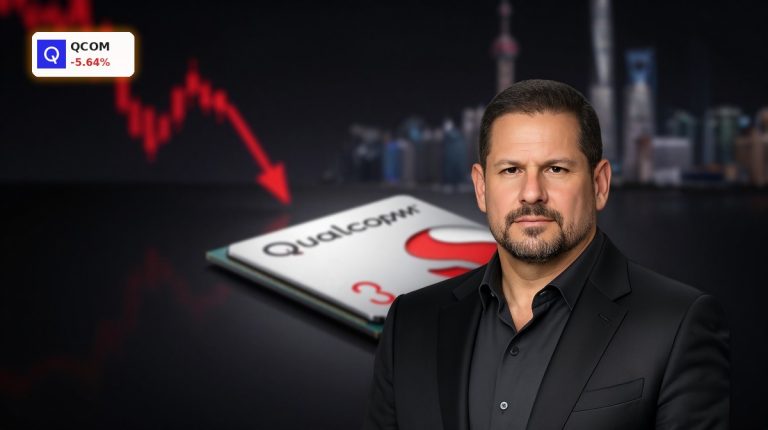
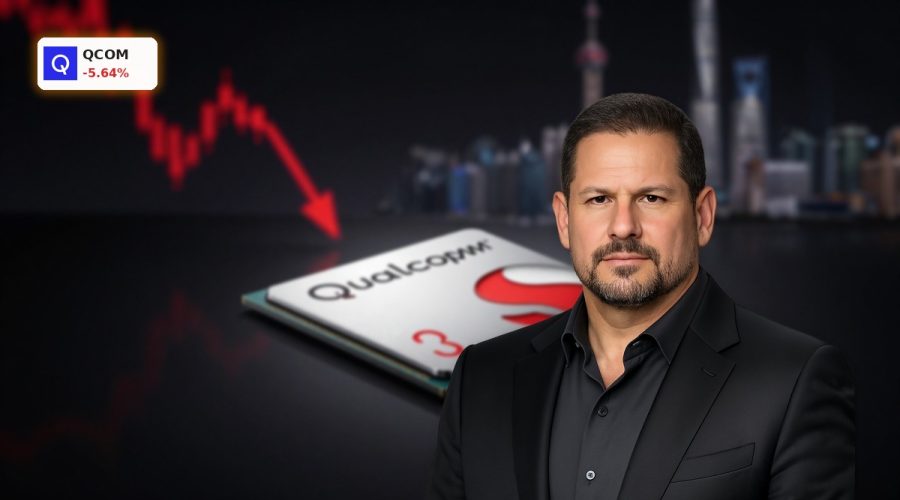
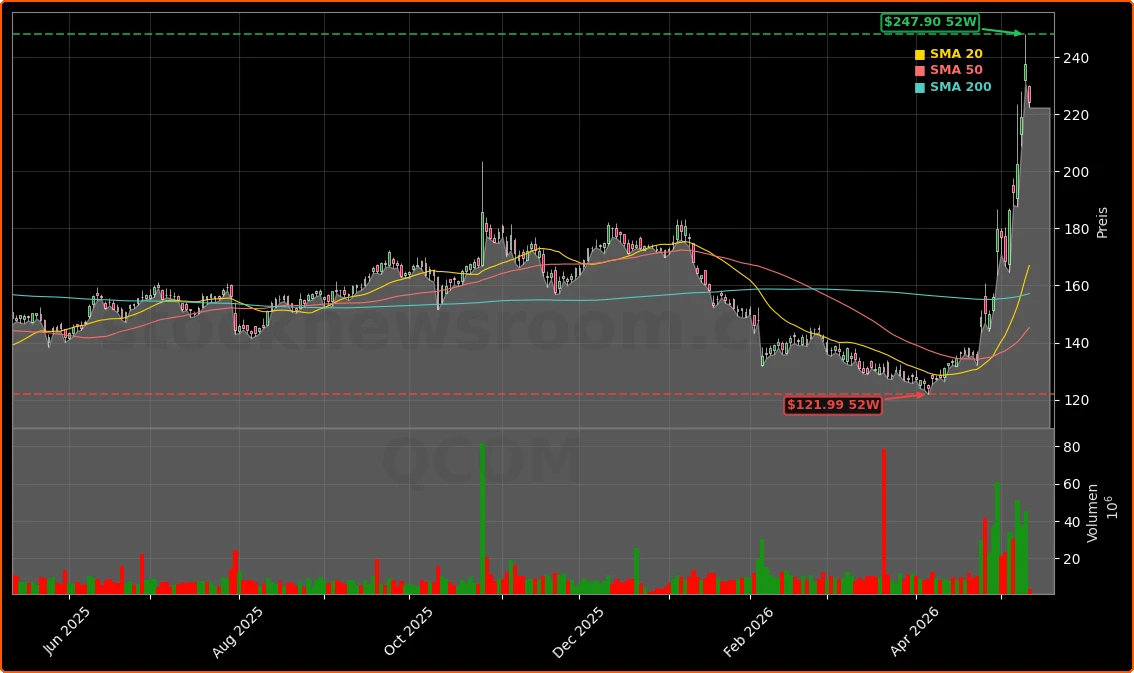
After an explosive run that nearly doubled the share price in a matter of weeks, Qualcomm Incorporated is finally cooling off. The stock now changes hands at about $224.21, versus a previous close of $238.85, a sharp 5.64% intraday drop that follows a parabolic move fueled by AI optimism and strong quarterly numbers. Recently, QCOM tested record territory, with an intraday peak around $247.90, far above prior 52‑week highs, before profit‑taking set in.
The pullback comes against a backdrop of a red‑hot semiconductor complex on the NASDAQ and S&P 500. A major chip index has just logged a record close and is trading at its widest gap above the 200‑day moving average since the dot‑com era. That context makes today’s weakness in QCOM notable: it highlights how stretched sentiment had become and how sensitive the stock now is to any shift in news, from tax rumors in Korea to political optics around the Qualcomm China Visit.
Why does the Qualcomm China Visit matter?
The Qualcomm China Visit is not just a photo op. Amon is traveling with former president Donald Trump and a group of U.S. tech executives, including Tesla’s Elon Musk and Apple’s Tim Cook, to a summit with China’s Xi Jinping. China remains a core market for Qualcomm’s smartphone chip business and a key swing factor in its broader AI device strategy. Management has signaled that QCT handset revenues from Chinese customers should bottom in the fiscal third quarter before returning to sequential growth.
That timing makes the trip strategically important. Any thaw in U.S.–China tech relations could support volumes in Android handsets, 5G modems, and future AI‑centric devices powered by Snapdragon and the new Dragonwing platforms. Conversely, renewed tension would underscore how exposed Qualcomm is to regulatory risk compared with more data‑center‑heavy peers like NVIDIA. For U.S. investors, the Qualcomm China Visit is effectively a live stress test of the company’s China dependency at a moment when the stock price already reflects aggressive AI expectations.
Is AI still driving the investment case?
AI remains the center of the Qualcomm bull thesis. The company is repositioning from a pure wireless pioneer to a leader in “intelligent connectivity” and edge AI, targeting devices, vehicles, and eventually data centers. Recent partnerships with OpenAI and other large AI ecosystems, as well as a custom silicon deal with a major hyperscaler, have reinforced the narrative that more AI inference workloads will migrate from the cloud to end devices.
On the latest earnings call for fiscal Q2 2026, management reported non‑GAAP EPS of $2.65, beating consensus, on revenue of $10.60 billion. Net income jumped to about $7.4 billion, helped by a $5.7 billion tax benefit tied to U.S. minimum tax rules. More importantly for the long‑term story, automotive revenue hit a record $1.33 billion, up roughly 38% year over year, and the QCT Automotive segment is projected to accelerate to around 50% year‑over‑year growth in fiscal Q3. That gives Qualcomm a differentiated growth pillar next to handset chips and sets up a clearer comparison with Tesla’s self‑driving ambitions and other auto‑tech plays.
Guidance for fiscal Q3 calls for revenue between $9.2 billion and $10 billion and non‑GAAP EPS between $2.10 and $2.30, reflecting some short‑term pressure from industry‑wide memory dynamics impacting handset demand. Even so, the company continues to emphasize “physical AI” devices — everything from smart glasses and wearables to novel “secret form factors” Amon has hinted at — as an answer to concerns that smartphones still account for more than two‑thirds of chip revenue.
What are Wall Street analysts saying?
Despite today’s pullback, the Qualcomm China Visit and the AI pivot have helped push analyst targets higher. Tigress Financial Partners reaffirmed its Buy rating on QCOM and raised its price target from $270 to $280, explicitly citing Qualcomm’s evolution into a key player across devices, vehicles, and data centers. Daiwa Securities recently upgraded the stock to “Outperform” with a $225 target, reflecting growing confidence in the data‑center and AI infrastructure opportunity.
On the institutional side, fresh 13F filings show continued appetite for the name. Valley Wealth Managers Inc. increased its QCOM position by 6.1% in the fourth quarter to more than 40,000 shares, while Kepler Cheuvreux Suisse SA boosted its stake by 9.9% to over 52,000 shares. Other funds like Asahi Life Asset Management and Wesbanco Bank have also added positions, contributing to institutional ownership of roughly three‑quarters of the float. At the same time, some players such as Securian Asset Management have taken profits, a reminder that the recent surge has been fast enough to trigger portfolio rebalancing.
Capital returns add another layer to the story. Qualcomm has lifted its quarterly dividend from $0.89 to $0.92 per share — $3.68 annually — and authorized a new $20 billion share repurchase program, leaving ample dry powder to offset dilution and support the stock. For income‑oriented U.S. investors, that combination of dividend growth and aggressive buybacks is a meaningful counterweight to the volatility around AI sentiment and the Qualcomm China Visit headlines.
How does this fit with Qualcomm’s broader AI pivot?
Investors will get more detail on June 24, when the company hosts its Investor Day and lays out growth initiatives in data‑center silicon and edge AI. Management is expected to quantify the addressable market in data centers, where Qualcomm will compete not only with NVIDIA but also with CPU incumbents and custom chips from hyperscalers. Compared with other AI beneficiaries like Apple, whose AI plans are still partially under wraps, Qualcomm is positioning itself as the silicon backbone of an “ecosystem of you” — personal devices that run AI locally rather than constantly pinging the cloud.
That vision was discussed in more depth in a recent analysis, “Qualcomm AI Strategy +9.7% Rally: Record Hype Around Data-Center Pivot”, which examined whether the data‑center push truly transforms Qualcomm into a durable AI infrastructure winner or merely amplifies momentum. Today’s sell‑off, following the Qualcomm China Visit headlines and a euphoric chip rally, shows how thin the margin for error has become. The next catalysts — Investor Day, follow‑through in China handset demand, and concrete AI design wins — will determine whether QCOM consolidates at higher levels or gives back more of its recent gains.
Related Coverage: For readers who want a deeper dive into the AI leg of this story, this detailed look at Qualcomm’s AI strategy and data-center pivot explores how the company is trying to move beyond smartphones and what that could mean for long‑term margins and valuation on Wall Street.
In summary, the Qualcomm China Visit is adding a geopolitical layer to a stock already driven by AI enthusiasm, automotive growth, and hefty buybacks. For U.S. investors, QCOM now hinges on whether management can convert political access and handset stabilization in China into durable earnings power beyond smartphones. The upcoming Investor Day and subsequent quarters will show if Qualcomm’s AI and auto ambitions justify Tigress’s $280 target or if today’s correction is the start of a longer reset.