Why did Qualcomm Edge AI surge on AI enthusiasm only to tumble hard as investors reassessed the bigger competitive picture?

Why Did Qualcomm Edge AI Just Rally — Then Reverse?
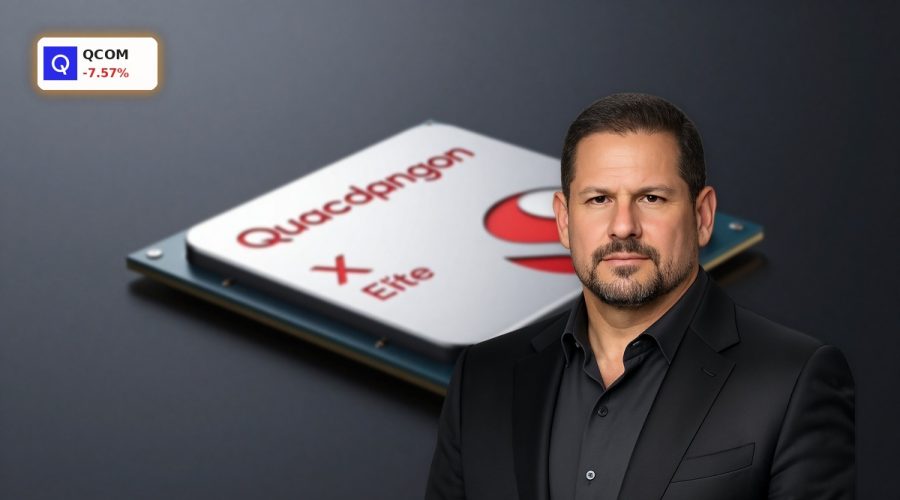
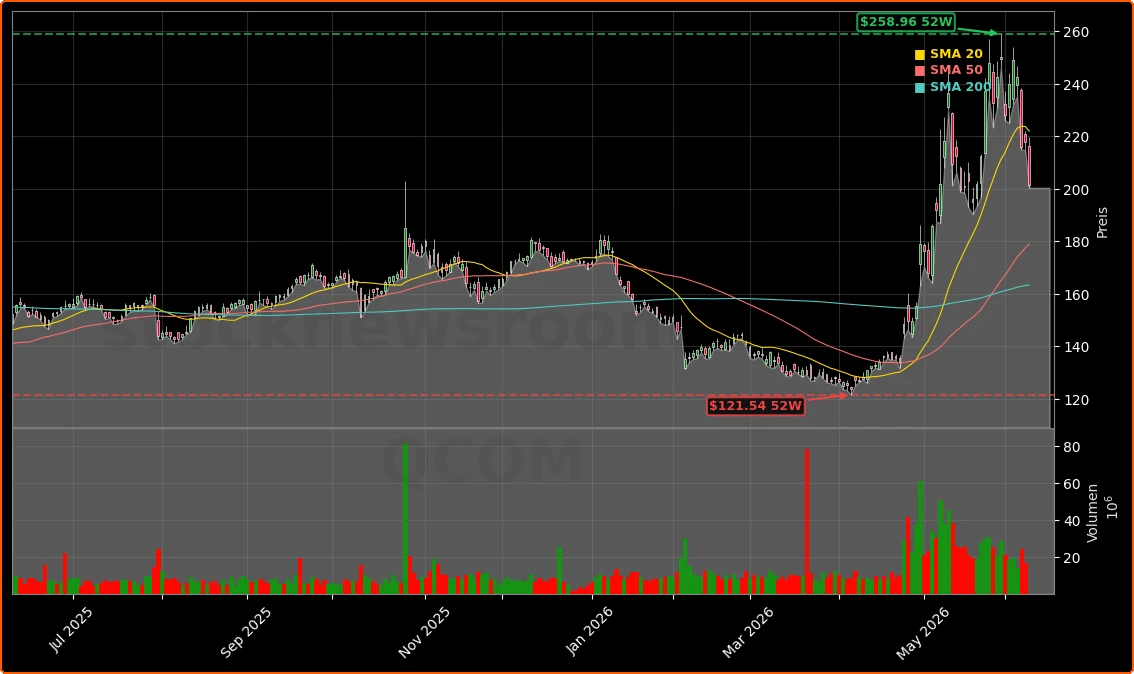
Despite closing down 7.57% at $201.29, Qualcomm Incorporated saw sharp intraday volatility tied directly to sentiment shifts around its AI positioning. After rising over 3% in after-hours trading on Monday following Nvidia CEO Jensen Huang’s public recommendation — ‘Buy their stock’ — the shares reversed sharply at the open. The reversal coincided with broader chip-sector weakness following Friday’s tech selloff and NVIDIA’s RTX-Spark launch, which directly targets Qualcomm’s Snapdragon X Elite PC ambitions. Yet the volatility masks underlying strength: options volume surged to 79,154 contracts on June 8, with open interest hitting 1.16 million — signaling heightened institutional positioning ahead of the June 24 Investor Day.
What Does the SLB Deal Mean for Wall Street?
SLB (formerly Schlumberger) announced a memorandum of understanding with Qualcomm Technologies to co-develop edge AI solutions for real-time decision-making across wells, facilities, and production systems. This isn’t theoretical — it leverages Qualcomm’s low-power AI processors and SLB’s Agora™ edge AI platform, built for remote, harsh environments. For U.S. investors, this validates Qualcomm Edge AI in a high-margin, capital-intensive sector where latency, power efficiency, and rugged reliability matter more than raw FLOPS. It also signals early traction outside consumer electronics — a critical diversification vector as smartphone revenues stabilize. Competitors like NVIDIA and Intel lack comparable low-power edge silicon optimized for industrial IoT, giving Qualcomm a first-mover advantage in energy, manufacturing, and logistics.
How Does Jensen Huang’s Endorsement Reshape the AI PC Race?
Jensen Huang’s public buy recommendation — delivered during a widely circulated video — wasn’t flattery. He explicitly acknowledged Qualcomm’s leadership in mobile AI execution and admitted NVIDIA lacks equivalent competency in that domain. His remark underscores a strategic truth: AI PCs require both high-performance inference (where NVIDIA excels) and ultra-efficient on-device processing (where Qualcomm Incorporated dominates). While RTX-Spark targets the high-end, Qualcomm Edge AI enables AI everywhere — in laptops, tablets, and edge gateways — a reality already embraced by Microsoft, Lenovo, and HP. The market’s overreaction to Huang’s comments reveals how tightly investor sentiment is now tied to AI-PC validation — and how much upside remains if Snapdragon X Elite adoption accelerates this fall.
Can Data Center Revenue Hit $35 Billion by 2031?
Buy their stock.— Jensen Huang, CEO of NVIDIA
JP Morgan analyst Samik Chatterjee raised his price target for Qualcomm Incorporated to $265 — up from $160 — citing a credible path to $3 billion in data center revenue by fiscal 2027 and up to $35 billion by 2031. His thesis rests on three pillars: custom AI chips for hyperscalers, a new high-performance CPU for inference servers, and inference-optimized accelerators. Unlike Apple or Tesla, which build AI chips for internal use, Qualcomm is licensing IP and selling silicon to third parties — a scalable, capital-light model. With a forward P/E of just 20.2 — well below peers like AMD and Marvell — the valuation gap reflects skepticism, not fundamentals. That gap may narrow sharply after the June 24 Investor Day, where CEO Cristiano Amon is expected to detail roadmap milestones and customer traction.