
Can Ripple Tokenization’s surge in real-world assets really move the needle for XRP holders, or is the network outgrowing its own token?

Is Ripple Tokenization really a game changer?
On paper, the story behind Ripple and the XRP Ledger (XRPL) looks tailor‑made for Wall Street’s next wave of blockchain adoption. Over the 30 days ending May 13, the value of tokenized real‑world assets (RWA) on XRPL rose by roughly **$1.1 billion** in net inflows, lifting total represented and tradable assets toward **$3.6 billion**. That puts Ripple Tokenization clearly on the map in the race to host bonds, commodities and other traditional instruments on‑chain, even if it still trails Ethereum’s roughly $17 billion RWA footprint by a wide margin.
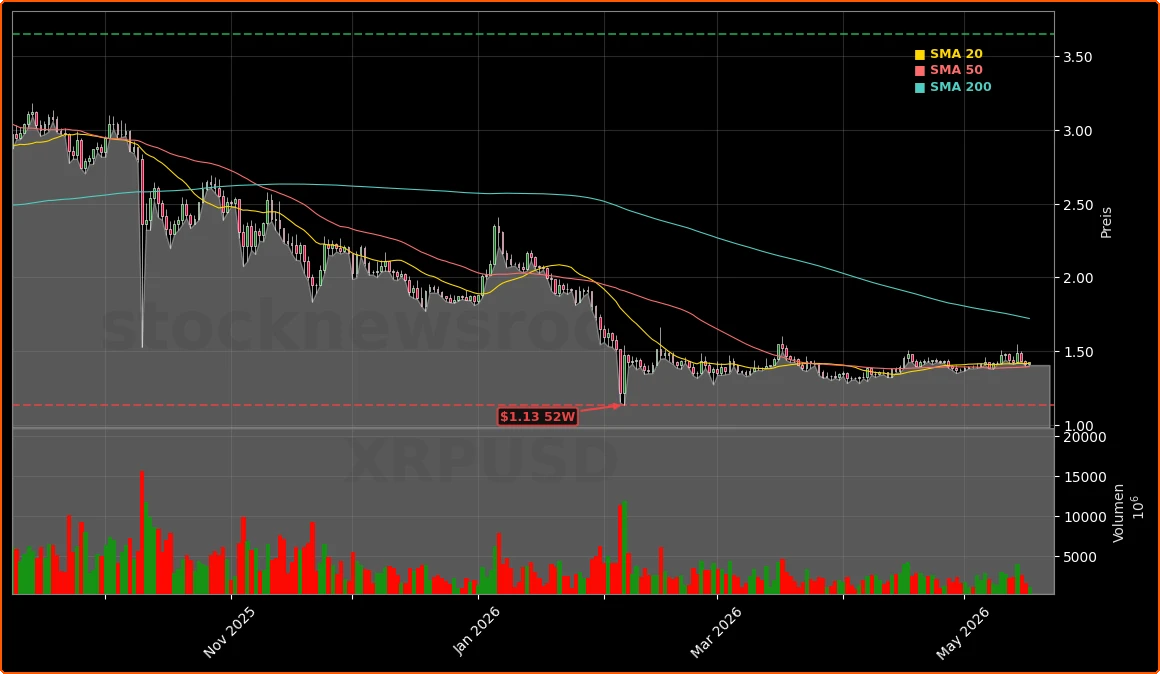
The nuance for XRPUSD traders is that this surge in tokenized assets does not automatically create equivalent demand for the coin. Activity on XRPL is cheap: each transaction costs a tiny fee in XRP, and that amount is permanently destroyed. Since launch in 2012, however, only about **14.3 million XRP** have been burned, roughly **0.02%** of the current 61.8 billion circulating supply. Billions of dollars in settlement volume can flow through XRPL while the net coin supply barely moves and the price of XRPUSD, now up about **0.99%** on the day to **$1.42**, can still stagnate.
What makes XRP Ledger attractive vs. Ethereum and Solana?
For U.S. asset managers comparing blockchains the way they compare cloud providers or custodians, XRPL’s strongest pitch is compliance‑first design. Features that support know‑your‑customer (KYC) and anti‑money‑laundering (AML) processes are embedded natively into the protocol. That reduces the need to stitch together external tools in the way institutional users must on Ethereum or Solana, lowering operational and regulatory friction for banks or fund managers experimenting with Ripple Tokenization.
This is one reason some institutions have shifted pilot projects toward XRPL even as Ethereum and Solana recorded net RWA outflows in the same recent 30‑day period. Still, XRPL’s RWA base remains a fraction of what runs on Ethereum, and it is far from clear that this short burst of inflows represents a structural preference rather than temporary experimentation. For U.S. investors who already hold major NASDAQ names like NVIDIA or Apple and are looking at digital assets as a satellite allocation, the key is whether XRPL can sustain higher growth across multiple quarters, not a single strong month.
How weak is the XRP burn and scarcity thesis?
Many long‑time XRP holders have argued that simply waiting for network usage to climb would be enough to tighten supply meaningfully, thanks to the burn mechanism. The math undercuts that thesis. Recent XRPL activity reached around **71.5 million transactions in a single month**, a record for the network. Even at that elevated pace, the ledger would burn only about **4 million XRP per year**. At that rate, erasing just **1%** of the circulating supply – roughly 618 million XRP – would take more than **151 years**.
Flipping the numbers highlights the gap. To burn 1% of supply in just one year, XRPL would need to process at least 130 billion transactions annually, or around 350 million per day. That approaches about 40% of Visa’s estimated global daily volume, while XRPL has only just crossed roughly 3 million daily transactions for the first time. In other words, even extremely optimistic adoption scenarios would barely dent supply. For U.S. crypto traders used to high‑burn models in other ecosystems, Ripple Tokenization today does not provide a powerful deflationary engine for XRPUSD.
What role do narrative and politics play for Ripple?
With limited mechanical scarcity support, XRP’s price has historically moved more on narrative than on fundamentals. When legal risks from the U.S. Securities and Exchange Commission eased and speculation grew that more banks might adopt XRPL, XRPUSD at one point soared more than **650%** within a few months before giving back much of the move. The pattern resembles commodity stories in traditional markets, where enthusiasm around metals like silver can run ahead of actual industrial demand.
Politics are now part of that narrative. Ripple veteran **David Schwartz** recently provided financial support, in XRP, to U.S. Senate hopeful **John Deaton**, a prominent XRP backer who previously challenged Senator Elizabeth Warren, one of Washington’s firmest crypto skeptics. Deaton emphasizes small‑dollar contributions and rejects PAC and lobbyist funds, framing his bid as a grassroots effort. At the same time, the broader digital asset industry is leaning heavily on super PACs such as Fairshake, backed by companies including Ripple Labs, which has spent tens of millions of dollars to promote pro‑crypto candidates.
This political push underscores how central policy and regulation have become for the sector. While major S&P 500 names like Tesla continue to explore various crypto integrations and payments use cases, regulatory clarity in the U.S. will heavily influence whether institutional capital treats Ripple Tokenization as a core infrastructure play or keeps it in the experimental bucket.
A thriving ledger and a thriving coin are not the same thing, and investors in XRP need to keep that difference front and center.— Independent digital asset strategist
For now, the separation between a thriving ledger and a still‑uncertain coin economics model remains the central issue. Unless XRPL’s protocol is updated to more directly link RWA growth to XRP demand – for example, by requiring higher XRP collateralization or introducing new utility sinks – even large inflows of tokenized assets may deliver more benefit to fintech intermediaries than to XRPUSD holders.