
Are weaker Robinhood Earnings just a crypto hangover—or the start of a deeper shift in how this fintech makes its money?

What do the latest Robinhood Earnings show?
Robinhood Markets, Inc. reported Q1 2026 revenue of $1.07 billion, missing analyst expectations of roughly $1.13 billion to $1.17 billion. Adjusted EPS came in at $0.38, about three cents below the $0.41 to $0.43 range many on Wall Street were looking for. The shortfall was driven primarily by a sharp downturn in cryptocurrency trading and lower fee rates in both crypto and options.
Crypto transaction revenue fell to $134 million, a steep 47% year‑over‑year decline. Management highlighted that crypto now represents roughly the low‑teens percentage of total revenue, but the volatility of that stream was still enough to overshadow strength elsewhere in the business. Options fee rates also compressed by about $0.03 per contract, and Robinhood’s crypto take rate slipped by roughly 7 basis points, creating further top‑line pressure.
Despite the weaker Robinhood Earnings headline, underlying customer engagement remained robust. Net deposits reached about $18 billion in the quarter, the third‑best inflow in company history, signaling that retail investors continue to migrate assets onto the platform even as crypto enthusiasm cooled.
How did Wall Street react to Robinhood Markets?
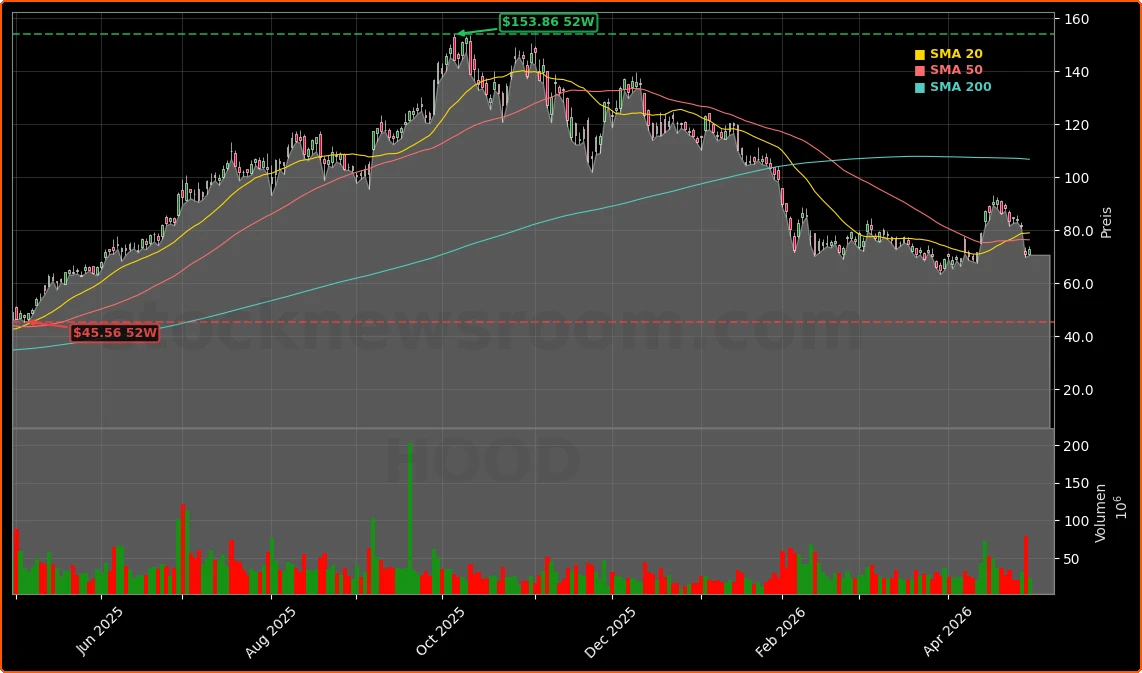
The initial reaction to the Robinhood Earnings release was brutal: HOOD dropped more than 13% in the following session and briefly traded near $70, extending a drawdown of over 50% from its October 2025 peak around $140. Yet the stock has since bounced to $73.06, as some high‑profile investors used the weakness as a buying opportunity.
ARK Invest’s Cathie Wood stepped in aggressively, purchasing 553,892 shares of Robinhood, worth roughly $39 million at the time. Robinhood is now a top‑six holding in multiple ARK ETFs, underscoring Wood’s conviction that the platform will be a long‑term winner in fintech, crypto and prediction markets.
On the analyst side, the verdict is mixed but far from bearish capitulation. Barclays analyst Benjamin Budish cut his price target from $89 to $82 but maintained an Overweight rating, arguing that April trends support a recovery narrative if fee rates stabilize. Keefe, Bruyette & Woods trimmed its target from $75 to $65 while keeping a Market Perform stance, reflecting caution on near‑term fee compression and competition in prediction markets.
For U.S. investors benchmarking against the NASDAQ and S&P 500, HOOD remains a high‑beta fintech vehicle rather than a defensive holding. The split between Barclays and KBW illustrates that the next few quarters will be pivotal in determining whether the post‑earnings bounce has legs.
Where are Robinhood’s growth engines now?
Beneath the weak Robinhood Earnings headline, several business lines are accelerating. The “other transactions” segment, dominated by event contracts and prediction markets, generated about $147 million in Q1 revenue, up roughly 320% year over year. Management expects prediction markets to hit roughly $3 billion in contract volume in April alone, even if Robinhood still trails specialist venues such as Kalshi in total market share.
Subscription revenue is also gaining traction. Robinhood Gold membership climbed approximately 32% year over year and delivered around $50 million in sales for the quarter, adding a more recurring, less market‑sensitive revenue stream to the mix.
Customer engagement is not just about trading. Robinhood’s IPO Access feature has become a meaningful differentiator, giving retail clients the chance to participate directly in U.S. IPO allocations. Management reports that the retail share of U.S. IPOs has jumped from roughly 5‑10% historically to about 20%, with some issuers now eyeing 30% or more going to individual investors via platforms like Robinhood. The firm has also invested through its venture arm in high‑profile names such as OpenAI’s parent structure and is exploring ways to open even earlier‑stage financing access to qualified customers.
Internally, over 90% of employees are using AI tools in their workflows, with management emphasizing speed of product delivery and cost savings that can be passed on to customers rather than outright headcount cuts. For U.S. portfolios, this positions Robinhood alongside tech‑heavy peers like NVIDIA and Apple as part of a broader AI‑driven productivity trend, even though HOOD itself is not a chip or hardware name.
Can Robinhood benefit from 24/7 markets?
One of the most important long‑term angles that doesn’t show up fully in current Robinhood Earnings is the shift toward 24/7 tokenized trading. The NYSE has filed plans for a blockchain‑based platform that would allow round‑the‑clock trading and instant on‑chain settlement for stocks, ETFs and fractional shares. NASDAQ has received approval for a 23/5 trading framework expected in the second half of 2026.
Robinhood is positioned early for this world. It already offers tokenized U.S. stocks with 24/5 access in the EU and has publicly committed to enabling 24/7 trading combined with DeFi connectivity. If the U.S. exchanges expand trading from roughly 32 hours a week to as much as 168, and even a fraction of that incremental time sees real volume, Robinhood’s addressable trading window could grow by 30–40% over time.
In parallel, the company has acquired Bitstamp and developed Robinhood Chain, while also running a prediction‑markets joint venture with Susquehanna. Legacy brokers like Schwab and Fidelity have yet to match this crypto‑plus‑tokenization stack, and younger U.S. investors, as well as international users, disproportionately favor Robinhood’s app‑first experience over traditional wirehouse platforms.
Expansion into Canada and Singapore is on the roadmap, further diversifying Robinhood’s revenue base beyond U.S. crypto and options trading. For American investors, HOOD increasingly looks less like a pure meme‑trading proxy and more like a high‑growth, higher‑risk gateway to the future structure of global markets, including 24/7 equities, prediction markets and tokenized assets.
Related Coverage
For a deeper dive into how the recent crypto downturn has reshaped sentiment around the stock, readers can review this detailed analysis of Robinhood Earnings and the crypto slump, which explores whether the latest volatility exposes structural fragility in the fintech rally or simply marks another cyclical reset.
Perception lags reality; investors are still underestimating how much our business has diversified beyond crypto.— Vlad Tenev, CEO of Robinhood Markets, Inc.
Robinhood Earnings clearly disappointed on the surface, but strong net inflows, booming prediction markets and a powerful April rebound suggest the growth story is far from over. For U.S. investors, HOOD remains a volatile but compelling way to play the convergence of retail trading, crypto, and 24/7 tokenized markets. The next few Robinhood Earnings reports will show whether management can translate today’s product momentum into sustainable, less cyclical revenue growth.