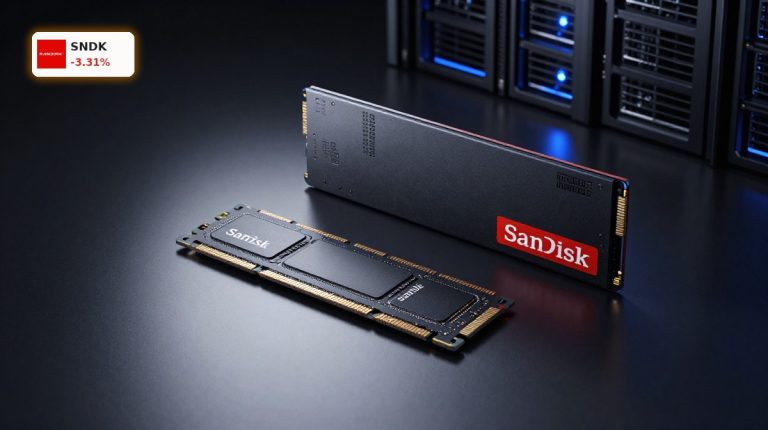

Is the latest SanDisk AI Storage pullback a warning sign or just a rare entry point into the AI infrastructure boom?

Is SanDisk AI Storage sell-off just profit-taking?
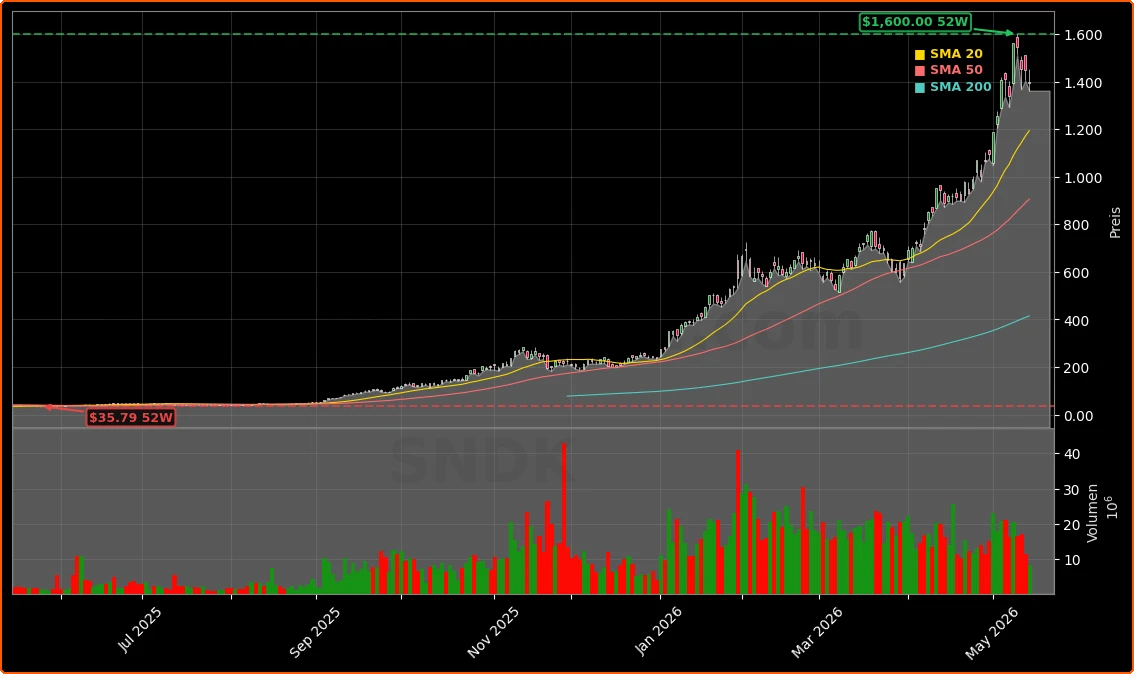
SanDisk stock has slipped into a multi-day slump, with today’s drop following a 7.6% slide earlier in the week and a roughly 6% hit during a broader chip-sector selloff. The pullback comes after the company recently traded near its 52-week high around $1,500, capping a year-to-date gain of more than 500% and over 3,500% in 12 months. At $1,400.13, shares are still extremely elevated versus 2025 levels but now sit meaningfully below recent peaks, reflecting both profit-taking and a shift to risk-off positioning across high-multiple tech.
There is little evidence of deterioration in company fundamentals. Revenue in the latest reported quarter jumped 251% year over year to about $5.9 billion, while non-GAAP EPS surged more than 2,000% to the mid-$20s per share. Data-center products, anchored by SanDisk AI Storage offerings for AI inference clusters and enterprise SSDs, represented roughly 25% of sales and grew more than 200% sequentially. The stock’s slump, therefore, looks more valuation- and sentiment-driven than business-driven.
How critical is SanDisk in AI infrastructure?
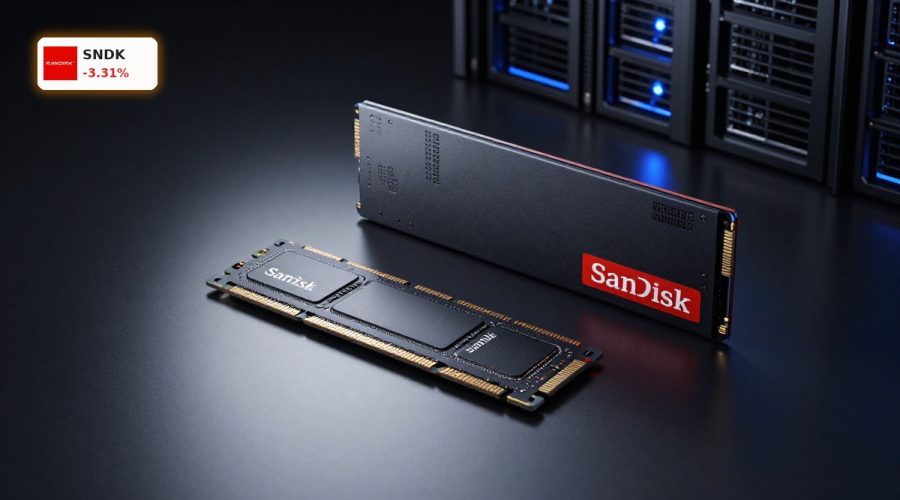
SanDisk sells a broad portfolio of flash memory and storage, from consumer drives to smartphone storage, but the real growth engine is data-center NAND and enterprise SSDs. As hyperscalers roll out ever-larger AI models and inference workloads, they need low-latency, high-endurance flash storage to feed GPUs from NVIDIA and other accelerators with data fast enough to avoid bottlenecks. This is where SanDisk AI Storage is becoming an indispensable layer of the stack.
Workloads such as long-context chatbots, complex reasoning engines, vector databases, and autonomous AI agents require huge volumes of data to be stored close to compute with rapid retrieval. SanDisk has leaned into this trend with high-performance TLC-based enterprise SSDs and is preparing to ramp its QLC “Stargate” solutions, optimized for high-capacity, cost-efficient AI data lakes. Management argues that these workloads represent a structural shift, potentially making the historically boom-bust NAND market more durable.
Can SanDisk escape the memory cycle?
Historically, memory and storage names have been among the most cyclical segments in semiconductors: demand spikes, capacity ramps, prices collapse, and profits evaporate. SanDisk is trying to break that pattern by locking in long-term, volume-committed agreements tied to AI infrastructure. The company has signed five multiyear supply deals that together embed roughly $42 billion in minimum revenue commitments and more than $11 billion in financial guarantees, including prepayments and third-party arrangements.
Management says more than one-third of expected fiscal 2027 output is already covered by such contracts, a figure that could climb above 50% if additional agreements are inked. By anchoring a large portion of capacity to hyperscaler demand for SanDisk AI Storage, SanDisk aims to smooth out pricing swings and gain better visibility into cash flows. The company has also extended its NAND manufacturing joint venture with Kioxia through 2034 and invested about $1 billion into Taiwan’s Nanya Technology to secure DRAM supply for enterprise SSDs, reinforcing its role as a core AI infrastructure supplier rather than a short-cycle commodity player.
How does SanDisk stack up against NVIDIA and Micron?
On Wall Street, SanDisk is increasingly mentioned in the same breath as NVIDIA and Micron when investors talk about AI infrastructure baskets. While NVIDIA captures the lion’s share of GPU profits and headlines, SanDisk’s percentage growth has been even more dramatic off a smaller base. Analysts expect SanDisk revenue to grow about 160% year over year to roughly $19 billion in fiscal 2026, with EPS projected to climb more than 2,000%. For comparison, Micron’s revenue is seen rising around 190% to ~ $109 billion with a roughly sixfold jump in EPS over a similar period.
Valuations reflect those expectations. After the recent pullback, SanDisk still trades around 53 times trailing earnings, with a price-to-free-cash-flow multiple in the mid-60s. Forward P/E is closer to the mid-20s, similar to NVIDIA’s high-20s multiple, even though NVIDIA sits at a more mature scale and dominates AI compute. That parity raises the bar for SanDisk: investors are effectively assuming that SanDisk AI Storage will prove as strategically indispensable to hyperscalers as NVIDIA GPUs, with fewer cyclical air pockets than memory names have historically endured.
What are analysts and insiders signaling now?
Despite volatility, Wall Street remains broadly constructive on SNDK. Susquehanna recently lifted its price target to $2,000, one of the highest on the Street, arguing that SanDisk’s data-center storage franchise and long-term contracts justify further upside even after the stock’s massive run. Several other firms maintain “Buy” or “Strong Buy” ratings, pointing to accelerating AI storage demand and tighter supply conditions as near-term tailwinds.
At the same time, insider activity is drawing attention. Director Necip Sayiner sold 579 shares at about $1,503 apiece, totaling roughly $870,000, as the stock traded near its highs, though he still holds a meaningful position. Another executive disposed of shares to cover taxes on vested equity, a non-open-market transaction. Combined with broader profit-taking in AI and chip names, these moves have fed a narrative that some early believers are locking in gains just as macro risk and policy headlines, such as potential taxation of AI profits in Asia, inject more uncertainty into the trade.
Related Coverage
Investors looking for more context on SanDisk’s volatility can revisit the sharp downturn earlier this week in “SanDisk NAND Boom: -9.7% Plunge After Record Earnings”. That coverage explores whether the recent selloff marks the start of fatigue in the NAND supercycle or simply another shakeout in a still-intact AI storage uptrend, complementing today’s focus on valuation, contracts, and competitive positioning.
Data center has become our fastest-growing market, and the workloads driving that demand — including inference, reasoning, and agentic systems — represent a structural and durable shift in how the world’s most consequential technology is built and deployed.— David Goeckeler, CEO of SanDisk
In summary, SanDisk AI Storage has transformed **SanDisk (Western Digital)** into a core player in AI data-center infrastructure, even as its stock digests a historic run and elevated valuation. For U.S. investors, the key question is whether long-term supply deals, technology leadership in enterprise SSDs, and AI-driven demand can offset the sector’s notorious cyclicality. The next few quarters of execution and contract ramp will be crucial in determining whether SanDisk AI Storage justifies buying the dip or simply signals that expectations have finally caught up with reality.