Can ServiceNow AI Strategy turn enterprise AI cost anxiety into a durable growth engine for the next decade?

Is ServiceNow AI Strategy Winning the Cost-Control War?
While Anthropic’s projected $11 billion quarterly revenue dazzles headlines, enterprise buyers are pivoting hard toward control — not just capability. Executives at Uber, Snowflake, and ServiceNow itself have raised alarms about AI spending surging beyond budgets, with Uber burning through its full-year AI allocation in early 2026. ServiceNow AI Strategy directly answers that pain: its AI Control Tower, embedded in Now Assist and the new Action Fabric, enables enterprises to route tasks across LLMs, track token usage, enforce compliance, and govern external agents — all from one platform. BNP Paribas analyst Stefan Slowinski notes customers are now prioritizing tools that ‘monitor usage, manage risk, and demonstrate returns’ — precisely ServiceNow’s core strength in complex IT environments.
How Does ServiceNow Compare to Palantir and Meta?
Palantir (PLTR) is betting on multi-model orchestration — but ServiceNow owns the operational context. Unlike Palantir’s FDE-driven custom builds, ServiceNow ships pre-integrated AI governance into 10,000+ live workflows across IT, security, HR, and customer service. Meanwhile, Meta’s open-source LLMs fuel the infrastructure layer, but lack the enterprise-grade access controls, audit trails, and process ownership ServiceNow delivers. That differentiation matters: Phenom’s new AI hiring agents integrate directly into ServiceNow — not Meta’s Llama stack — because hiring workflows require HRIS sync, approval chains, and EEOC compliance, not just conversational fluency. ServiceNow’s hybrid pricing model — seat-based + consumption-based AI — has already delivered 20–30% uplift on base contracts, per Slowinski.
Can ServiceNow Hit $30B in Subscription Revenue by 2030?
BNP Paribas reaffirms ServiceNow’s fiscal 2030 base-case target of over $30 billion in subscription revenue, supported by 25%+ CAGR in AI Control Tower, Security & Risk, and CRM — offsetting slower growth in mature ITSM. Acquisitions like Armis (125 bps contribution) and Moveworks (100 bps) are accelerating that transition. Wall Street’s consensus price target stands at $139, with Bank of America maintaining a Buy at $130 and Bernstein lifting its forecast to $236 (though holding Market Perform). The bull case hinges on execution: ServiceNow must convert AI experimentation into production-scale agent deployment — and prove it can sustain gross margins above 80% by routing tasks to smaller, in-house LLMs rather than relying solely on frontier models.
What Do Recent Security Incidents Mean for Trust?
Three external reports — from Cybernews, The Hacker News, and BleepingComputer — confirm ServiceNow patched a critical API misconfiguration that allowed unauthenticated access to customer instance tables. The flaw affected customers on the Australia release and older platform versions. While ServiceNow acted swiftly, the timing is sensitive: investor scrutiny of AI governance is at an all-time high. Yet the market’s reaction — ServiceNow outperforming the Nasdaq Composite by over 300 basis points Wednesday — suggests the incident hasn’t derailed confidence in its AI Control Tower vision. Instead, it underscores why enterprises need ServiceNow: to detect, contain, and audit such vulnerabilities across hybrid cloud environments.
Is the Technical Picture Turning Constructive?
Customers are moving from broad AI experimentation toward tools that help monitor usage, manage risk, and demonstrate returns — which aligns with ServiceNow’s strength in simplifying complex IT environments.— Stefan Slowinski, BNP Paribas analyst
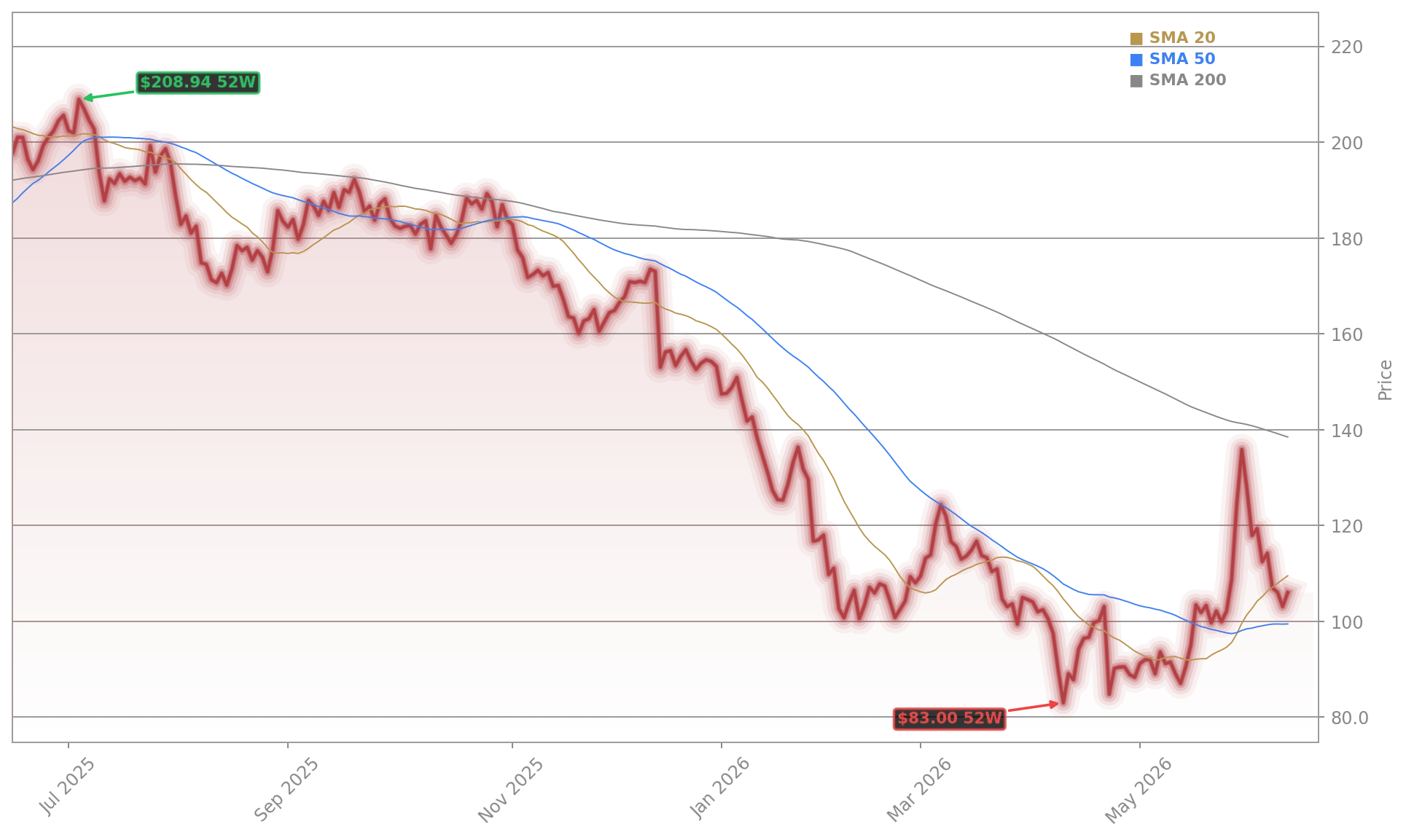
Yes — but selectively. ServiceNow shares now trade above the 20-, 50-, and 100-day SMAs ($107.08, $99.42, $106.40), signaling near-term strength. RSI sits at 50.06 — neutral, not stretched. Key resistance looms at $111; support holds at $98, aligned with the 50-day SMA. The 200-day SMA ($139.52) remains a psychological hurdle — ServiceNow is still 22.2% below it. Still, TIAA Trust National Association boosted its stake by 351.3% last quarter, acquiring 146,659 new shares. That institutional vote of confidence — paired with GuruFocus estimating ServiceNow at 52.8% below its GF Value™ of $226.86 — suggests long-term investors see current volatility as mispricing, not a fundamental break.