
Can Elon Musk’s ambitious orbital data center plans rescue SpaceX from its accelerating valuation crisis?

Why Has the SpaceX Stock Selloff Accelerated?
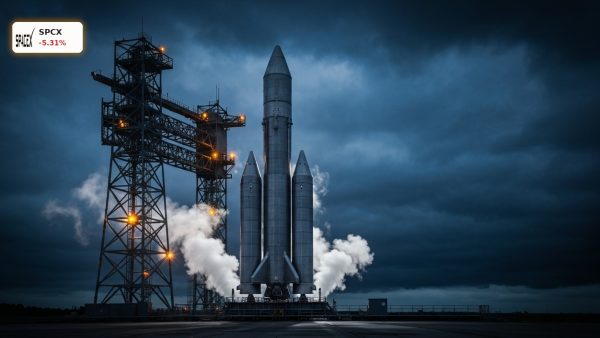
The primary catalyst behind the sudden SpaceX Stock Selloff is a mix of technical setbacks and valuation gravity. Last week, the company had to abort its highly anticipated 13th Starship test flight after four of the rocket’s 33 Raptor engines failed to ignite. Although founder Elon Musk quickly announced plans to replace the faulty engines and rescheduled the launch for Thursday, July 23, the market reacted with immediate skepticism. The launch delay alone erased roughly $100 billion in market value in a single day, illustrating how sensitive the stock is to operational execution.
Furthermore, the company’s financial fundamentals are coming under intense scrutiny. SpaceX generated $19 billion in revenue last year but posted a net loss of over $4.9 billion. At its peak valuation of $2.64 trillion in June, the stock traded at an astronomical multiple. Former hedge fund manager Whitney Tilson recently warned that even after the decline, the stock trades at over 90 times trailing revenues, calling it severely overvalued and advising investors to avoid bottom-fishing at current levels.
How Do Wall Street Analysts View the Future of SpaceX?
Despite the ongoing SpaceX Stock Selloff, opinion on Wall Street remains highly polarized. Many major financial institutions maintain their bullish long-term outlooks, viewing the current dip as a buying opportunity. For instance, JPMorgan analyst Doug Anmuth maintains a Buy rating with a price target of $225. Similarly, Needham analyst Ryan Koontz has set a price target of $250, while Raymond James analyst Brian Gesuale remains exceptionally optimistic with an $800 price target.
Conversely, Piper Sandler recently initiated coverage with a Neutral rating, reflecting growing caution. Short sellers have also aggressively ramped up their bets, with short interest now sitting at approximately 30% of the free float. This bearish pressure is compounded by the looming expiration of insider lockup agreements on August 11, which will free up about 1.37 billion shares—roughly 20% of the float—for trading, potentially creating further downward pressure on the stock.
Can Orbital Data Centers and Defense Deals Save SpaceX?
To justify its $1.6 trillion market cap, SpaceX is positioning itself as a major player in the artificial intelligence infrastructure boom. The company’s growth thesis relies heavily on launching orbital data centers capable of capturing a significant share of the global AI compute market. Additionally, reports indicate that SpaceX is in discussions with the U.S. Department of Defense regarding a multi-billion-dollar contract to lease its high-performance computing capabilities, which could leverage hardware from partners like NVIDIA.
However, competition is heating up, and the broader tech sector is showing signs of risk aversion. The recent launch of the Kimi K3 model by Chinese startup Moonshot AI has shaken the industry by offering comparable performance to top US models at a fraction of the cost, raising questions about the valuation of Western AI plays. With Tesla also facing its own market pressures, investors are watching closely to see if Elon Musk can stabilize his broader corporate empire.
Related Coverage
For more insights into how technical delays and insider selling are impacting the company, read about the SpaceX Stock Drop: Starship Abort and Lockup Fears Cause -5.3% Plunge. Meanwhile, in the broader aerospace and defense sector, investors are closely watching other major players, such as RTX, whose subsidiary recently secured a massive government contract; details can be found in the report on the RTX Contract: Pratt & Whitney Secures $1B Military Deal.
Zoom out and none of this changes the thesis: we’re in the early innings of a multi-decade infrastructure cycle, and Starship is the centerpiece.— Chad Anderson, Space Capital CEO
In conclusion, the current SpaceX Stock Selloff highlights the delicate balance between visionary growth and financial reality. While the company’s long-term orbital and AI ambitions remain unmatched, short-term headwinds like the upcoming lockup expiration and technical launch hurdles will likely test investor patience. The upcoming second-quarter earnings release on August 4 will serve as the next major test to see if the company’s financial trajectory can begin to support its premium valuation.