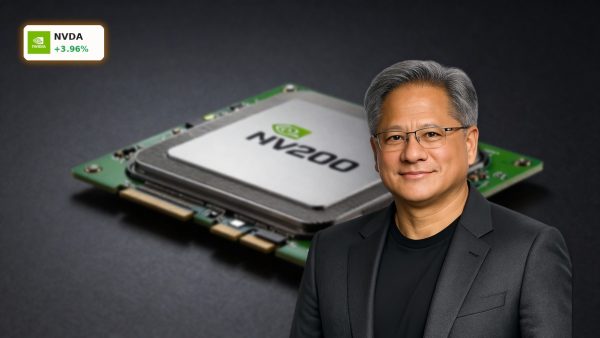

Can NVIDIA’s dominant position in the global hardware market survive the double threat of Apple’s rising valuation and cheap Chinese AI models?

Is Apple Overtaking NVIDIA in Market Cap?
During early trading on Friday, Apple reclaimed the crown as the world’s most valuable public company, reaching a market capitalization of $4.88 trillion and edging past NVIDIA’s $4.85 trillion valuation. This shift highlights a growing divergence in investor sentiment. While NVIDIA has been the undisputed champion of the hardware boom, Wall Street is increasingly rewarding Apple’s capital discipline and its massive consumer ecosystem. Analyst firm HSBC recently upgraded Apple to a “Buy” rating with a target price of $366, noting that the iPhone maker only plans to spend about 2.5% of its projected 2026 revenue on capital expenditures, compared to the massive 39% average spent by digital hyperscalers. At the same time, NVIDIA’s stock slipped 1.32% to $204.28, reflecting a broader 22% correction in the PHLX Semiconductor Index over the past month.
Will Chinese Rivals Threaten NVIDIA AI?
The immediate catalyst for Friday’s chip sell-off was the release of the “Kimi K3” open-source model by Chinese AI startup Moonshot, which is heavily backed by Alibaba. The new model allegedly rivals top-tier American systems from OpenAI and Anthropic, but operates at a fraction of the traditional training and operational cost. This “Kimi moment” has reignited fears that future **NVIDIA AI** developments might require less expensive hardware than previously assumed, potentially threatening the high-margin GPU dominance that NVIDIA currently enjoys. Despite these worries, some market participants remain highly optimistic. Counterpoint Research analyst Marc Einstein pointed out that NVIDIA is actively cementing its position as the “missing link” in Japan’s sovereign AI ecosystem. During a recent visit to Tokyo, CEO Jensen Huang announced a landmark partnership to build a massive 27,500-GPU AI factory focused on physical robotics, proving that global hardware demand remains incredibly diverse.
Is NVIDIA Still a Buy for US Portfolios?
While the short-term momentum has turned negative, NVIDIA’s underlying financial health remains exceptionally strong compared to its semiconductor peers. The company boasts a Return on Equity (ROE) of 33.06%, which is far above the semiconductor industry average of 7.76%. Furthermore, NVIDIA’s forward price-to-earnings (P/E) ratio has compressed to a reasonable 24, which is significantly lower than competitors like Advanced Micro Devices. This suggests that the current market pullback may have already priced in a projected growth slowdown for fiscal 2028. Analysts at Citigroup and other major institutions are closely watching the upcoming earnings season to see if Big Tech hyperscalers will maintain their aggressive capital expenditure plans. If demand remains robust, the current dip in **NVIDIA AI** infrastructure spending could prove to be an attractive entry point for long-term US investors.
Related Coverage
Nvidia likely to be a significant participant in whatever happens going forward.— Benjamin Hall, Vice President of Alpha Research at Segal Marco Advisors
To better understand the current market dynamics, read our analysis on NVIDIA AI Under Pressure: Stock Drops 3.3% as Tech Sector Slides to see how supply chain anxieties are impacting short-term pricing. Additionally, explore our report on TSMC Earnings Drop -2.9% as Massive CapEx Outlook Shocks Wall Street for insights into how rising capital expenditures and foundry pricing are shaping the broader semiconductor landscape.