Is HSBC’s stark Trade Desk Downgrade a late reaction to fading growth or the start of a deeper rerating in ad tech?

Why does HSBC’s Trade Desk Downgrade matter now?
HSBC cut its rating on The Trade Desk, Inc. to Reduce from Hold and set a $20 price target, implying further downside from Monday’s $21.41 quote. The firm argues that slower revenue growth, intensifying competition from Amazon’s ad stack, and rising friction with major ad agencies are eroding the company’s edge as the leading independent demand-side platform on the open internet.
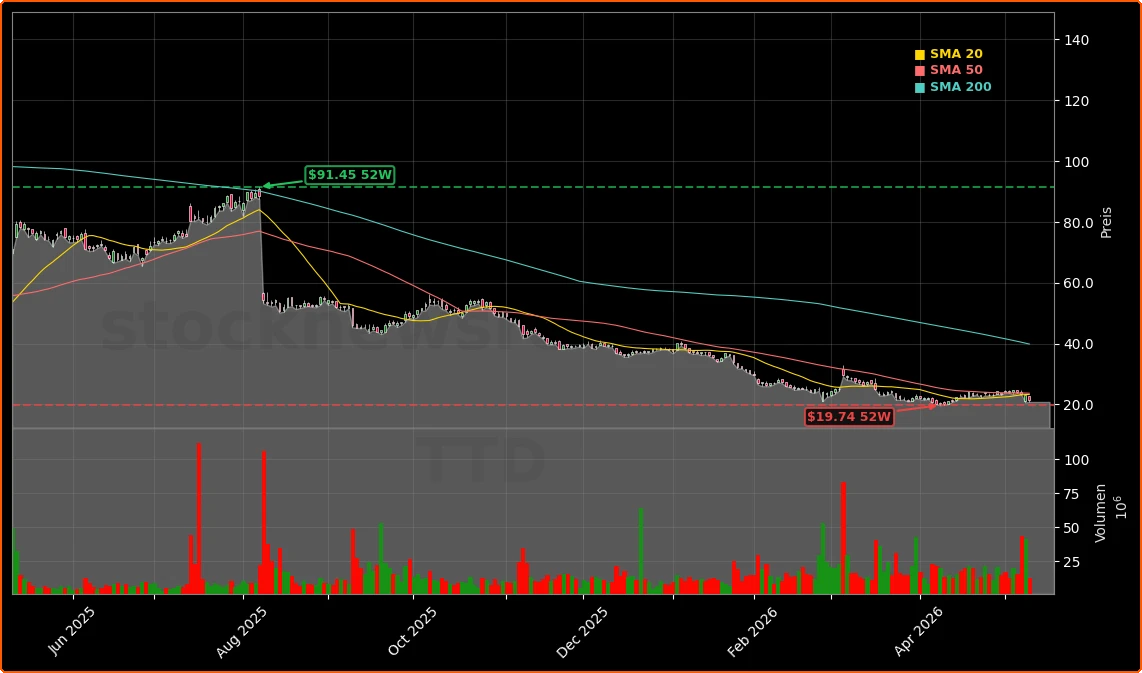
The Trade Desk Downgrade lands just as the stock is already under heavy pressure. Shares have fallen roughly 43% year to date and nearly 70% over the past 12 months, bringing the new target close to the 52-week low around $19.74. For Wall Street, a Reduce rating at HSBC is effectively equivalent to an Underweight or Sell call, signaling a potential break in the long-term bull thesis rather than a simple reset in expectations.
On Monday afternoon in New York (ET), TTD was among the worst performers in the S&P 500, with the roughly 7% intraday slide adding to steep losses after its Q1 2026 earnings and guidance disappointed growth-focused investors.
How are other analysts positioning on Trade Desk?
The HSBC Trade Desk Downgrade caps a string of negative moves from other major brokerages. Over just a few trading days, KeyBanc downgraded the stock to Sector Weight from Overweight, Oppenheimer moved to Perform from Outperform, and William Blair cut its rating to Market Perform from Outperform. Guggenheim, while maintaining a Buy stance, trimmed its price target to $25 from $28, signaling reduced upside even among the remaining bulls.
Elsewhere on Wall Street, sentiment has also cooled. Bank of America Securities recently assigned a Sell rating to Trade Desk, putting it in the same cautious camp as HSBC and reinforcing the message that patience is wearing thin. Meanwhile, Rosenblatt Securities reiterated a Hold rating with a $25 target, and Wedbush upgraded the stock only to Hold with a $23 target, reflecting more tempered expectations rather than outright optimism.
This wave of downgrades comes as other advertising and cloud-related names, from NVIDIA-powered AI infrastructure plays to app-based ad networks like AppLovin, have drawn more favorable commentary. The contrast underscores how investors are re-sorting their exposure across the broader digital advertising and cloud ecosystem, favoring platforms with stronger proprietary data and more visible AI advantages.
What do the latest results say about The Trade Desk?
Fundamentally, Trade Desk remains a sizable and profitable platform, but its growth profile is clearly moderating. For Q1 2026, the company reported revenue of $688.86 million, up 12% year over year, a sharp slowdown from 25% growth in the same quarter a year earlier. Non-GAAP EPS slipped to $0.28 from $0.33, and adjusted EBITDA margin narrowed to 30% from 34%, highlighting both top-line deceleration and margin compression.
Management guided for at least $750 million in revenue for Q2 2026 and pointed to new initiatives like Koa Agents, an agentic AI tool for media planning, as well as expanded partnerships with LinkedIn in B2B connected TV and Dollar General in retail media. Customer retention remained above 95%, and the company repurchased roughly $164 million of stock during the quarter, underlining confidence in its long-term story despite near-term turbulence.
Yet, several research houses, including Morningstar, have highlighted structural challenges: Trade Desk lacks the proprietary ad inventory and closed-loop data that giants like Apple, Tesla’s in-car ad ambitions, or walled-garden platforms such as Google and Amazon can leverage. That leaves the company more exposed to data deficits, cookie deprecation trends, and pushback on fees from its largest agency and brand clients.
Is the Trade Desk Downgrade about structure or sentiment?
Analysts increasingly frame the Trade Desk Downgrade trend as a response to structural headwinds rather than a short-lived macro wobble. Advertising budgets are migrating toward retail media networks, including Amazon Ads and Walmart Connect, and into other closed ecosystems where advertisers can link impressions more directly to sales outcomes. As those walled gardens tighten their grip on first-party data, open-web demand-side platforms like Trade Desk may struggle to match targeting precision and measurement transparency.
In addition, global geopolitical tensions and regional conflicts are weighing on ad budgets in certain markets, while some large agencies are reportedly restricting or scrutinizing Trade Desk usage more heavily. That increases the risk that both ad spend routed through the platform and the effective “take rate” could come under pressure, precisely the scenario HSBC is flagging with its Reduce call.
For portfolio managers, the key question is whether the current price already discounts these risks. Trade Desk still generates robust free cash flow and carries a light balance sheet, making it less vulnerable than many smaller ad-tech peers. But after five meaningful downgrades in a week, the burden of proof now rests squarely on upcoming quarters to show that new AI features, connected TV gains, and retail media partnerships can reignite growth.
Related Coverage
For a deeper dive into how slowing growth first shook investor confidence this quarter, readers can review The Trade Desk Earnings: Q1 Slowdown Sparks Wall Street Shock, which analyzes the initial reaction to the company’s Q1 2026 report and guidance.
The current Trade Desk Downgrade cycle underscores a pivotal moment: Wall Street is no longer willing to give the company the benefit of the doubt on execution and competitive moats. For U.S. investors, that means rethinking position sizing, entry points, and the role of independent ad-tech in a portfolio increasingly shaped by data-rich titans like Amazon and NVIDIA. The next few quarters, starting with Q2 2026 results, will be crucial in determining whether today’s skepticism fades or deepens, making this Trade Desk Downgrade a catalyst that could either mark a bottom or confirm a longer structural reset.