Can Alibaba Regulation derail the AI story, or is the market overreacting to another Beijing warning shot?

What triggered Alibaba’s sharp pre-market drop?
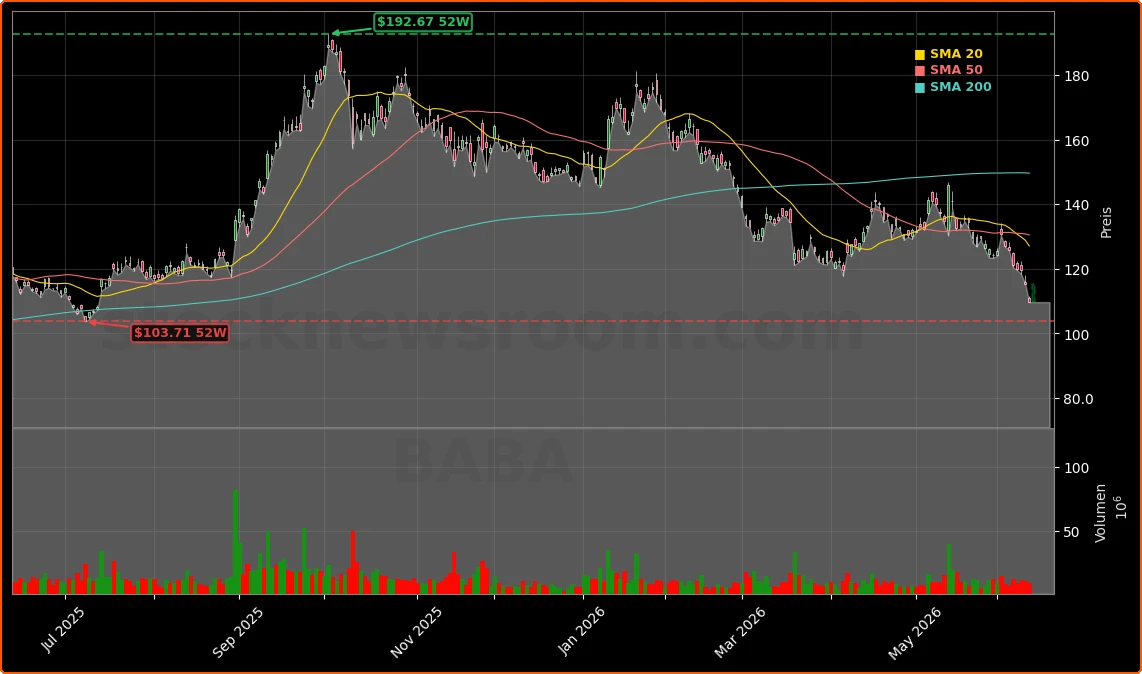
Alibaba Group Holding Limited shares gapped down sharply in pre-market trading on Thursday, June 11, 2026, after China’s State Administration for Market Regulation issued an unprecedented public reprimand targeting Alibaba and JD.com for ‘misleading advertising’ ahead of the 618 Shopping Festival. Regulators accused both platforms of promising subsidies and discounts without disclosing eligibility criteria or actual benefit structures — a move widely interpreted as part of Beijing’s broader campaign to rein in ‘race-to-the-bottom’ pricing in e-commerce. The announcement, aired by CCTV, coincided with a broader selloff in Chinese tech ADRs on the NYSE and NASDAQ, dragging the S&P 500’s communication services sector down 1.2%.
How does Alibaba Regulation compare to U.S. enforcement?
Unlike U.S. Federal Trade Commission actions — which typically follow investigations and formal complaints — China’s regulatory rebuke was immediate, public, and symbolic. While no fines or penalties were announced, the move signals heightened scrutiny of disclosure transparency during peak sales events. This contrasts with recent U.S. enforcement against Meta and Apple over app store billing practices, which emphasized procedural due process. For U.S. investors, Alibaba Regulation represents a distinct risk factor: less predictable, more politically calibrated, and increasingly tied to national consumer protection narratives — not just antitrust or data privacy.
Is Alibaba Regulation overshadowing AI progress?
Yes — but temporarily. Alibaba’s Cloud Intelligence Group reported 40% external revenue growth in Q4 FY2026, with CEO Eddie Wu confirming that AI-related products now account for 30% of that segment’s revenue. Yet the market punished the stock, ignoring that Alibaba’s Qwen LLM and T-Head AI chips are delivering structural cost advantages. Meanwhile, NVIDIA-powered data center demand in China remains robust, and Alibaba’s $19 billion buyback program through 2027 stands intact. Analysts at Morgan Stanley maintain a ‘Buy’ rating with a $190 price target — implying ~40% upside — citing ‘cloud margin expansion from 9% to 12% and AI monetization scaling over 12–24 months.’ Citigroup echoes this, raising its target to $185 on ‘increasing enterprise adoption of Alibaba Cloud AI services.’
What’s next for Alibaba Regulation and investor positioning?
Alibaba Regulation is no longer just about market share — it’s about narrative control in China’s digital economy.— Li Wei, Senior China Tech Analyst, Moomoo Research
Alibaba Regulation is entering a new phase: less about breaking up platforms, more about standardizing commercial conduct. Regulators are now focusing on ‘truth in promotion’ — a shift that could extend to livestream commerce and AI-powered recommendation engines. With Ant Group’s planned capital raise and Token Foundry’s AI unit launch, Alibaba is doubling down on infrastructure while navigating dual oversight from Beijing and Washington. The Pentagon’s recent addition of Alibaba to its ‘Chinese Military Companies’ list — which Alibaba denies and plans to legally challenge — adds cross-border regulatory complexity. Still, institutional investors remain divided: Brandes Investment Partners cut its stake by 2.7%, while Northwestern Mutual and ARK Investment Management increased theirs. The stock’s 0.3x price-to-sales ratio reflects deep discounting — but also embedded optionality.