AMC Refinancing has pushed out costly debt maturities, but is this lifeline enough to offset mounting losses and dilution?

Does AMC Refinancing change the risk profile?
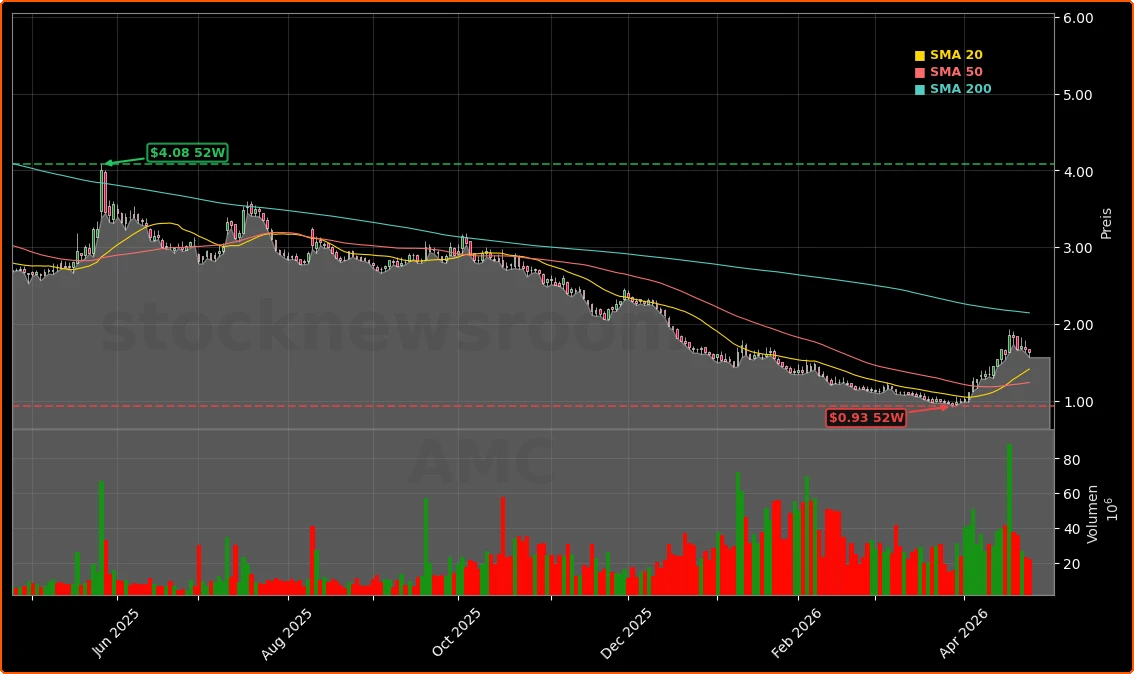
After losing roughly 99% of its value since the 2021 meme frenzy, AMC sits firmly in penny-stock territory. The stock closed at $1.66 on Friday and last traded at about $1.64 in after-hours action, reflecting fragile sentiment as Wall Street weighs theater recovery hopes against a stretched balance sheet.
The latest AMC Refinancing move tackled $425 million of secured notes that were due in 2027 and carried a punishing 12.75% coupon. AMC replaced them with new debt maturing in 2031 at a 10.5% interest rate. That lowers annual interest expense on this tranche and, more importantly, pushes a looming maturity several years into the future, giving management more runway to stabilize operations.
Even so, AMC still faces a large overall debt load and a business model that has not yet returned to pre-pandemic profitability. The refinancing is therefore best seen as a breathing-space maneuver rather than a decisive turnaround catalyst for long-term investors.
How healthy is AMC’s core theater business?
Despite the stock collapse, the broader theater industry is not in free fall. Ticket sales in the U.S. and Canada increased from about 760 million in 2024 to roughly 769 million in 2025, signaling that moviegoing demand is gradually normalizing. That uptrend, combined with a robust early‑2026 box office boosted by releases like “The Super Mario Galaxy Movie,” has supported higher concession and ticket revenue at AMC locations.
For 2025, AMC generated around $4.8 billion in revenue, up about 5% from 2024. Yet the company still reported a net loss of approximately $632 million, significantly worse than the $353 million loss a year earlier. Free cash flow remained firmly negative at about $366 million, forcing AMC to rely heavily on capital markets to stay liquid.
To plug the gap, AMC has massively diluted shareholders. Over the last five years, its share count has surged by more than 400% to nearly 514 million outstanding shares. While this equity financing has helped keep doors open, it has eroded per‑share value, a key concern for institutional investors comparing AMC to profitable peers like Cinemark.
What does the market say about AMC Refinancing?
On Wall Street, opinion on AMC remains cautious. Recent trading patterns on technical platforms such as TradingView show a mix of speculative bullish ideas and strongly bearish takes, underscoring how sentiment-driven the stock remains rather than fundamentals-driven. Short-term rallies have often followed positive box office headlines or consolidation talk among major studios, only to fade as traders refocus on AMC’s balance sheet.
Analysts surveyed ahead of AMC’s upcoming Q1 2026 earnings maintain largely neutral stances. Several brokerage notes describe AMC as a “Hold” with muted upside, and consensus price targets around the low-$1 range imply limited expected returns from current levels. While firms such as Citigroup and Morgan Stanley have highlighted the benefit of lower interest expense from AMC Refinancing in broader sector commentary, they continue to flag negative cash flow and dilution as major overhangs.
Legal risk adds another layer. Law firms including Pomerantz LLP and Bronstein, Gewirtz & Grossman have filed class action suits over the treatment of AMC Preferred Equity Units (APEs) in connection with a past special dividend. Those cases focus on an alleged technical loophole in preferred stock documentation that left some investors excluded, and while they may take years to resolve, they keep governance and capital-structure decisions under a spotlight.
How does AMC compare to other entertainment plays?
For U.S. investors constructing diversified portfolios, AMC competes not just with Cinemark and other theater chains but also with streaming and tech heavyweights like Apple and NVIDIA that dominate the Nasdaq and S&P 500. Many institutional managers prefer asset-light, high-margin growth stories or stable cash generators over a leveraged, loss‑making exhibitor.
In addition, investors looking for consumer‑discretionary exposure can choose among profitable large caps such as Tesla or media conglomerates with strong direct‑to‑consumer platforms. Against that backdrop, AMC’s value proposition hinges on the company eventually converting box office recovery into positive free cash flow, which would reduce the need for further share sales and potentially allow additional, more constructive rounds of AMC Refinancing.
Related Coverage
For a deeper dive into how earlier restructuring moves intersect with the current debt profile, readers can review AMC Refinancing +3.4% Rally: Can Debt Warning Stop the Comeback?. That analysis examines how a prior refinancing step and an S&P downgrade collided with a short-lived share price bounce driven by box office momentum and trading enthusiasm.
In conclusion, AMC Refinancing has clearly reduced near-term default risk and slightly eased interest costs, but it has not solved the company’s fundamental problem of sustained losses and cash burn. For investors on Wall Street and abroad, AMC remains a speculative turnaround story rather than a stable core holding. The next few quarters of earnings and any further balance‑sheet moves will show whether management can turn this extra time into a durable recovery.