Can AMC Entertainment Refinancing really outrun mounting losses, or is the company simply buying time before the next crunch?

Can AMC survive on refinancing and a box office rebound?
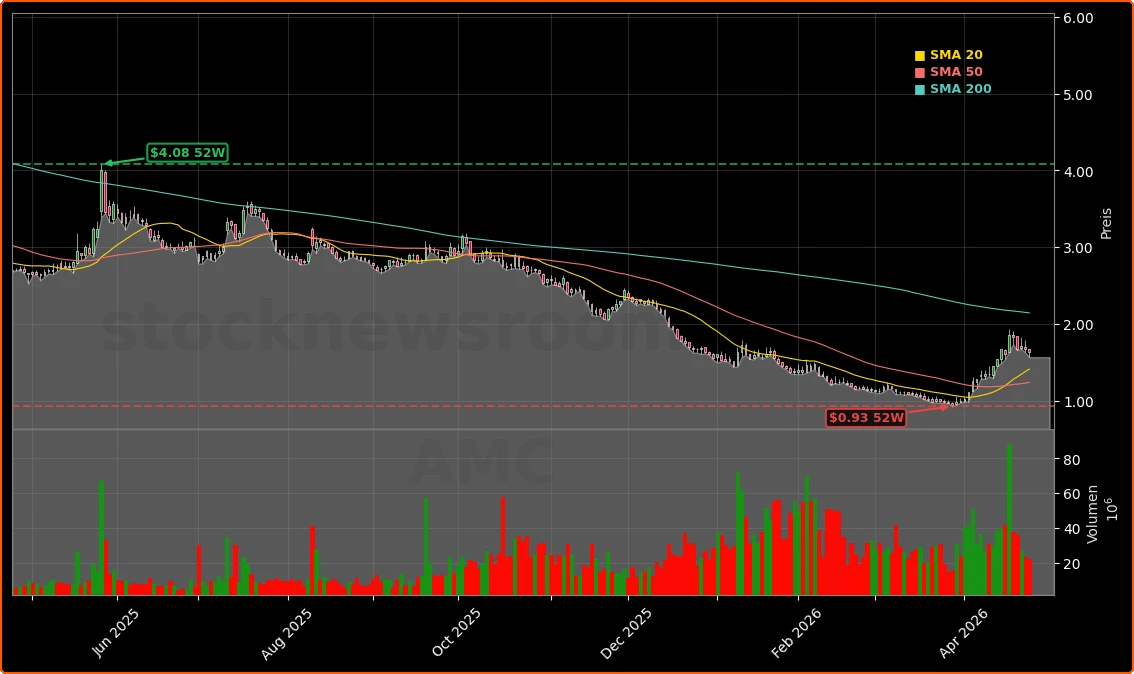
Shares of AMC Entertainment Holdings, Inc. (AMC) closed at $1.64 on Friday, slipping 1.8% on the day and trading flat after hours. That leaves the company far below its 2021 meme‑stock peaks and reflects mounting skepticism that stronger ticket sales alone can repair the balance sheet. The latest AMC Entertainment Refinancing move in March addressed a key near‑term risk, but it did not erase the company’s structural challenges.
Industrywide, the theatrical market has stabilized rather than collapsed. U.S. and Canadian movie ticket sales climbed to roughly 769 million in 2025, up from 760 million in 2024, even though volumes remain well below 2019’s pre‑pandemic levels. For AMC, that recovery translated into about $4.8 billion in 2025 revenue, a roughly 5% increase year over year, helped by blockbuster releases and high‑margin concessions. However, higher sales have not yet translated into profitability.
AMC posted a net loss of about $632 million for 2025, significantly worse than the roughly $353 million loss in 2024. Free cash flow was negative by about $366 million, and the company ended the year with liquidity of roughly $429 million. Those figures underline why the capital structure — and specifically AMC Entertainment Refinancing actions — has become the dominant driver of the stock.
How much relief does AMC Entertainment Refinancing really bring?
In March, AMC refinanced $425 million of debt, paying off secured notes that were due in 2027 and carried a steep 12.75% interest rate. The new debt matures in 2031 and bears interest at 10.5%, trimming the coupon and, more importantly, pushing out a looming maturity wall. In isolation, this AMC Entertainment Refinancing step should modestly reduce annual interest expense and lower default risk over the next few years.
Even so, the overall debt load remains heavy, and interest costs are still elevated compared with healthier issuers in the consumer and entertainment space. The company has leaned heavily on equity issuance to stay afloat: its outstanding share count has surged roughly 404% over the past five years to nearly 514 million shares. That dilution means that, even if operations improve, each share now represents a much smaller claim on any future recovery.
Market sentiment has reflected this tug‑of‑war. Recent trading saw an 8% slide after a short‑lived rally tied to optimism about studio consolidation and a strong early‑2026 box office slate, including the success of major franchise titles. Analysts at several brokerages maintain a cautious stance, with an average “Hold” rating and a consensus price target around the mid‑$1 range; Sahm Capital, for example, highlights both improving revenue expectations for Q1 2026 and the technical pressure from earlier spikes in trading momentum.
How does AMC compare with other theater operators?
One of the more troubling takeaways for investors is that AMC’s issues are not purely industry‑wide. Rival Cinemark has managed to report profits in both 2024 and 2025, despite facing the same streaming competition and post‑pandemic demand shift. That suggests AMC’s cost structure, debt burden and capital‑allocation choices — including the aggressive equity issuance — are central to its underperformance.
On the positive side, AMC has reported record revenue over key holiday periods such as Easter weekend, a sign that premium formats and event‑style releases still draw crowds. The proposed Paramount–Warner Bros. Discovery combination, cheered publicly by AMC’s CEO, could also increase the number of theatrical releases and extend exclusive theatrical windows, potentially supporting attendance and concession sales. For investors who follow content‑driven trades such as NVIDIA or Apple in streaming and media ecosystems, AMC represents the physical‑world counterpart to those digital distribution plays.
Nevertheless, the company is not yet generating the positive free cash flow that would allow it to deleverage organically. Until that changes, AMC remains highly sensitive to interest‑rate conditions, credit‑market access and equity‑market risk appetite — a very different profile from mega‑caps like Tesla that can tap capital markets on more favorable terms.
What about lawsuits and investor sentiment?
Beyond balance‑sheet stress, AMC faces headline risk from multiple class‑action lawsuits tied to its preferred equity units (APEs) and a controversial special dividend. Law firms including Pomerantz LLP and Bronstein, Gewirtz & Grossman have filed suits on behalf of investors who held APEs between August 2022 and November 2023, alleging that AMC relied on a technical loophole in its preferred‑stock documentation that left former APE holders excluded from a later dividend. Lead‑plaintiff deadlines currently extend into April 2026.
These actions do not immediately threaten AMC’s liquidity, but they deepen mistrust among the retail base that fueled the 2021 meme frenzy. With the share price now near $1.64 and far removed from that speculative spike, the bull case rests less on a new wave of social‑media buying and more on a sustained operating turnaround backed by disciplined capital management and further AMC Entertainment Refinancing progress.
Related Coverage
Investors looking for a deeper dive into earlier balance‑sheet moves can review the article “AMC Refinancing +3.4% Rally: Can Debt Warning Stop the Comeback?”. That piece explores how a prior refinancing step and an S&P downgrade interacted with a short‑term share price rebound, offering additional context on how credit‑rating actions may influence future financing costs and equity volatility.
AMC Entertainment Refinancing has clearly bought the company time, but not yet a clean bill of health. For U.S. and global investors, the key questions now are whether ticket sales and concessions can turn persistent losses into positive free cash flow, and whether management can slow dilution while chipping away at debt. The next few quarters of box office performance and any further refinancing moves will show whether AMC remains a high‑risk speculative play or can evolve into a more sustainable turnaround story.