
Is AMD’s AI-fueled surge hitting turbulence, or is this sharp pullback just the next entry point in a much bigger rally?

How fragile is AMD’s AI‑driven rally now?
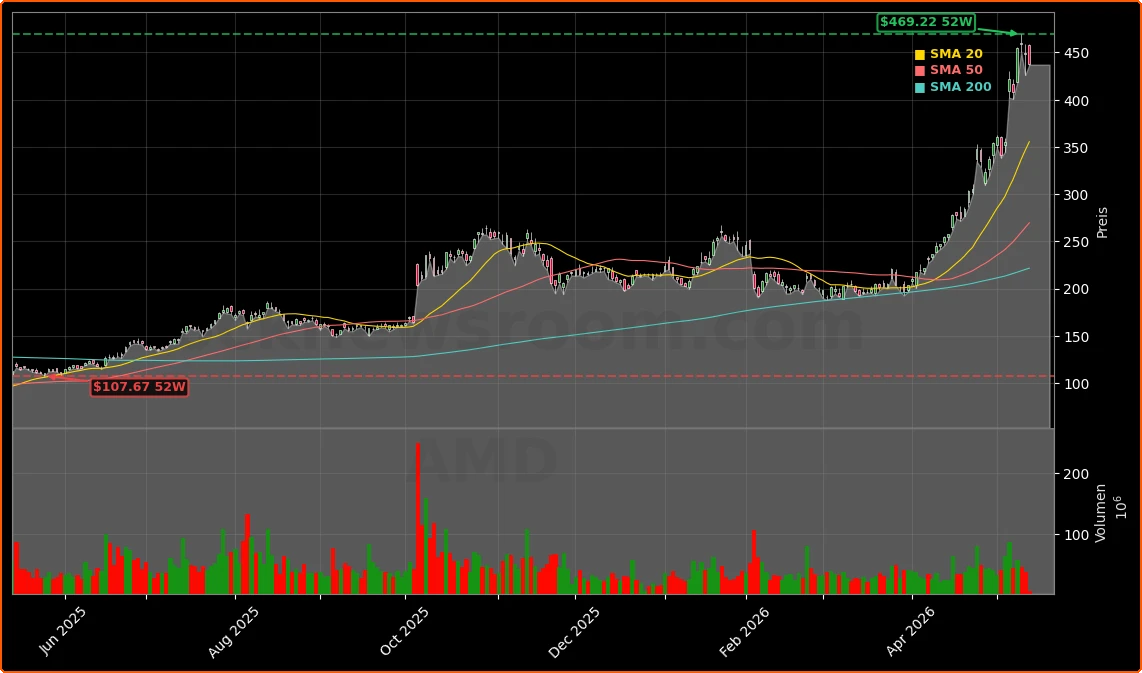
AMD has been one of Wall Street’s highest‑octane AI beneficiaries in 2026, with the stock up well over 100% year to date despite today’s intraday weakness. The current quote of $437.62 leaves the share price about 7% below its 52‑week high near $469.21, but still far above the 200‑day moving average around $220. Valuation has expanded accordingly: AMD trades at roughly 149x trailing earnings, reflecting investors’ belief that an AI data center supercycle will dramatically lift profits over the next several years.
Technically, the setup looks powerful but stretched. The stock recently traded more than 30% above its 20‑day moving average and over 100% above its 200‑day line, with an RSI in the upper‑70s pointing to overbought conditions. That makes it easier for headlines – from macro jitters to a TV host warning about an AI reversal – to trigger sharp pullbacks across semiconductors, even when company fundamentals remain strong. The latest slide saw AMD drop more than 3% alongside peers like Micron and TSMC as traders locked in gains in the crowded AI trade.
What is driving the updated AMD AI Forecast?
The core of the bullish AMD AI Forecast is the structural shift in data center workloads. Q1 2026 results showed revenue jumping 38% year over year to about $10.25 billion, with data center sales up 57% to a record $5.8 billion. Non‑GAAP EPS climbed 43% to $1.37, beating Wall Street expectations. Management guided Q2 revenue to roughly $11.2 billion – around 46% growth – and non‑GAAP gross margin near 56%, up roughly 13 percentage points year over year. That combination of accelerating growth and widening margins is rare among large‑cap S&P 500 names.
CEO Lisa Su argues that “agentic” AI workloads – autonomous systems that plan, act, and iterate – fundamentally change server architecture. Instead of traditional CPU‑to‑GPU ratios of 1:4 or 1:8, she sees the industry drifting toward more CPU‑intensive 1:1 configurations, meaning data centers will need far more high‑end server CPUs alongside accelerators. That view underpins an AMD AI Forecast that more than doubles expected CPU market growth: management now projects server CPU demand expanding at over 35% annually through 2030, versus 18% previously. For investors, that implies a CPU addressable market of at least $120 billion by the end of the decade, plus additional upside from AI accelerators.
How are analysts positioning versus NVIDIA and Intel?
On Wall Street, several banks have moved quickly to reflect the new AMD AI Forecast. Mizuho raised its AMD target from $415 to $515 and reiterated an Outperform rating, explicitly calling AMD a “cleaner share gainer” than Intel in hyperscale data centers. Bank of America also lifted its target to $500, citing a rapidly expanding AI data center market. Cantor Fitzgerald maintains a Buy rating with a $500 target as well, while Citigroup nudged its target to $358 and kept a Neutral stance, highlighting valuation risk after the parabolic move.
Daiwa took a more cautious route, downgrading AMD from Buy to Outperform even as it doubled its target price from $250 to $500, arguing that a 150% surge over roughly two months leaves limited margin of safety in the near term. Morningstar now pegs fair value around $450 and sees the stock trading close to that mark, upgrading its long‑term revenue and earnings outlook but warning that the “easy money” has likely been made. Still, consensus expectations call for EPS to grow roughly 50% or more annually over the next several years, supported by large AI contracts.
Relative to NVIDIA, AMD’s revenue base is smaller, which means big wins can have an outsized impact. Meta Platforms and OpenAI have agreed to deploy up to 12 gigawatts of AMD Instinct accelerators in coming years, anchored by custom MI450 GPUs and EPYC “Venice” CPUs integrated into Helios racks. One estimate suggests the Meta deal alone could add around $100 billion of revenue over time, potentially allowing AMD’s top line to grow faster than NVIDIA’s from here – even if NVIDIA retains dominant accelerator share.
Where does AMD fit in the broader AI ecosystem?
The AMD AI Forecast is not just about hyperscalers. AMD is also pushing deeper into enterprise and hybrid AI infrastructure. A multiyear partnership with Rackspace aims to build a managed Enterprise AI Cloud using EPYC CPUs and Instinct GPUs, targeting regulated industries that need performance but can’t rip out existing architectures. Dell is adding Instinct MI350P PCIe GPUs to its PowerEdge servers so customers can scale AI workloads in existing data centers without a full rebuild. Meanwhile, AMD expanded its Ryzen PRO 9000 lineup with 3D V‑Cache for workstation users running simulations, data analysis, and AI‑assisted content creation.
Competition remains intense. Besides NVIDIA’s roughly 80% share of the AI accelerator market, Intel is attempting a turnaround in CPUs and accelerators, while custom ASIC efforts from Broadcom, Google, and Amazon target specific AI workloads. Yet hyperscalers are in an investment cycle of more than $200 billion for AI infrastructure, and AMD’s chiplet architecture, open software approach and dual CPU‑GPU offering position it as a key alternative for cloud and enterprise buyers who want to avoid dependence on a single vendor like NVIDIA or a closed in‑house solution.
Related Coverage
For a deeper look at how the latest quarter reset expectations, including the immediate share‑price shock, see AMD Earnings: -5.9% Plunge After Record Q1 AI Boom. That analysis explains how blockbuster numbers and a strong AMD AI Forecast collided with fears of an overheated chip cycle, and why volatility may remain elevated as traders test just how much good news is already priced in.