
Can blockbuster AMD Earnings and surging AI demand outweigh a sharp share-price pullback and growing investor nerves around an overheating chip cycle?

How are AMD Earnings colliding with AI jitters?
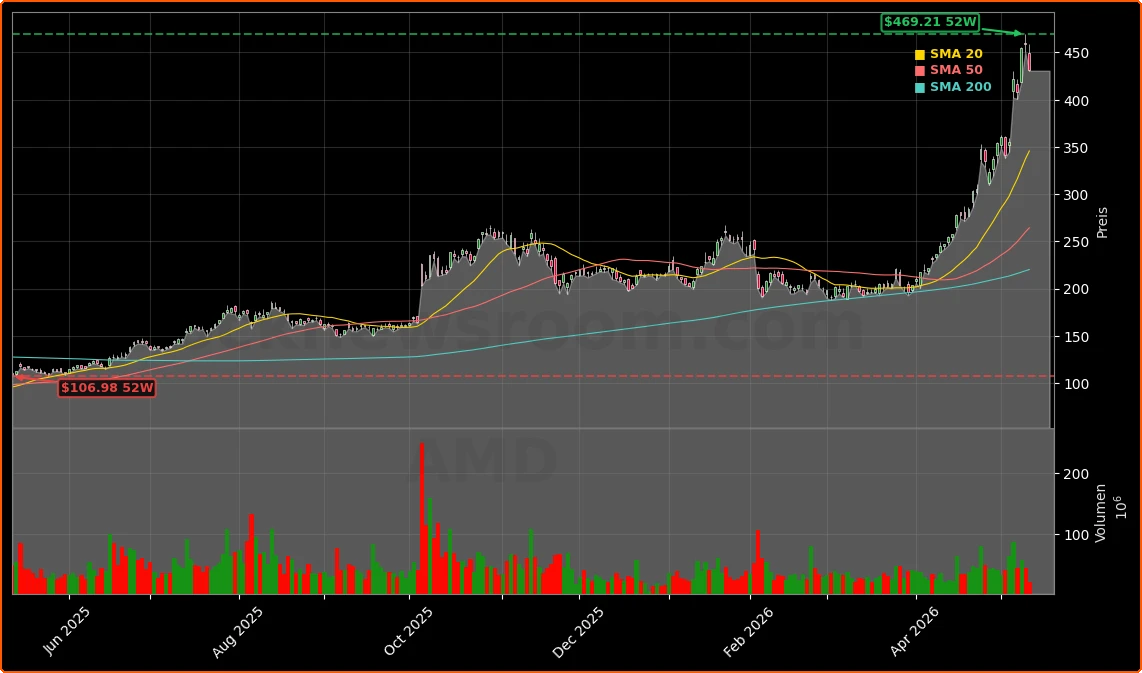
The pullback in Advanced Micro Devices, Inc. comes as semiconductor stocks globally see profit-taking after a powerful AI-driven run. AMD is lower alongside peers in the chip complex, with traders pointing to weakness in high-flying Korean AI names and renewed debate over potential taxes or “AI dividends” as a reminder of how fragile sentiment has become. Despite Tuesday’s slide, AMD shares are still up well over 100% year to date and remain one of the most closely watched names on the NASDAQ and in the S&P 500 technology cohort.
Yet the fundamentals behind the latest AMD Earnings are hard to ignore. The VanEck Semiconductor ETF recently hit an all-time high, helped by what was described as “sizzling” results from key holdings including AMD, underscoring how central the company has become to the AI infrastructure story. The disconnect between robust operating performance and short-term price weakness is now front and center for U.S. portfolio managers attempting to size positions in the AI chip theme.
What did Advanced Micro Devices deliver in Q1 2026?
In Q1 2026, AMD reported revenue of about $10.2 billion, up roughly 38% year over year, highlighting how quickly the business has scaled since the early days of the AI boom. Gross profit climbed around 45%, while net income surged approximately 95%, reflecting powerful operating leverage as high-margin data center products take a larger share of the mix.
The Data Center segment is now the growth engine. Revenue there reached roughly $5.8 billion, increasing about 57% from the same period a year earlier, driven by EPYC server CPUs and Instinct accelerators for AI and high-performance computing workloads. Non-GAAP gross margin improved to about 55%, with management guiding to roughly 56% for Q2, signaling that AMD expects continued pricing power and favorable mix.
Free cash flow also inflected sharply higher, more than tripling to around $2.6 billion, while leverage remains low with modest debt relative to more than $64 billion of equity. For long-only U.S. investors focused on balance sheet strength, the latest AMD Earnings confirm that the company is funding massive R&D and capacity ramps from a position of financial resilience rather than stretching its balance sheet.
Why are analysts raising targets on AMD?
Wall Street has responded to the latest AMD Earnings with a fresh wave of bullish calls. Cantor Fitzgerald analyst C.J. Muse reiterated a Buy rating and set a $500 price target, framing AMD as a core AI infrastructure holding for institutional portfolios. Mizuho went even further, boosting its target from $415 to $515 while maintaining an Outperform rating, and explicitly highlighting AMD as the preferred share gainer in the x86 server CPU duopoly.
These calls reflect growing conviction that AMD is the primary alternative to NVIDIA for hyperscale AI deployments. With the Big Four cloud providers and other hyperscalers expected to spend over $700 billion this year on AI infrastructure, including GPUs, CPUs, networking, and power, AMD’s position in both EPYC CPUs and Instinct GPUs gives it leverage across the stack. Investment firm GF Securities has described the environment as a “server CPU super cycle,” projecting the market’s total addressable size could balloon from the tens of billions today to more than $100 billion by 2030.
At the same time, valuation remains a sticking point. AMD trades at a rich multiple, with trailing and forward P/E ratios dramatically above the broader S&P 500 and even above many mega-cap tech peers. That makes the story especially sensitive to any slowdown in AI orders or execution missteps, a risk that shorter-term traders are watching closely as volatility picks up.
How does AMD stack up against key competitors?
For U.S. investors comparing AI chip plays, AMD sits between NVIDIA and Intel in both scale and strategic positioning. Nvidia continues to dominate AI training workloads, bolstered by its CUDA software ecosystem, which has become the de facto standard for many machine learning developers. A recent deep dive into CUDA emphasized how the software moat makes it hard for rivals to dislodge Nvidia from its leadership position.
AMD, however, is making notable inroads, particularly as cloud customers and large enterprises look to avoid dependence on a single vendor. Hyperscalers are increasingly deploying AMD Instinct GPUs and EPYC CPUs as a second “silicon road,” while server OEMs like Super Micro Computer highlight AMD as a key partner for AI-optimized systems. Intel, meanwhile, benefits from the overall AI build-out but continues to face share pressure in x86 CPUs, where AMD has been chipping away at its long-standing dominance.
Competition is also coming from ARM-based architectures, with Arm and other players promising major efficiency and capex savings compared with traditional x86 designs from AMD and Intel. Over the longer term, custom silicon from cloud giants such as Apple-style in-house chips at big tech platforms could also reshape the market. That dynamic keeps the AMD Earnings story firmly tied to execution and innovation, not just current momentum.
Related Coverage
Investors looking for a deeper dive into the recent AMD rally can read “AMD Earnings +38% Boom: Can AI Power an 11.4% Surge?”, which explores how the explosive growth of AMD’s data center business has fueled the stock’s double-digit gains. That analysis also breaks down how hyperscaler spending and AI demand might influence AMD’s valuation in the coming quarters.
In sum, the latest AMD Earnings showcase a company riding a historic AI infrastructure boom with soaring data center sales, strong cash generation, and a balance sheet built to support continued expansion. For U.S. investors, the combination of bullish analyst targets and rising competitive intensity means AMD is likely to remain a high-beta way to play AI rather than a low-risk compounder. The next few quarters of earnings and AI deployment data will be critical in determining whether today’s volatility is a healthy reset or the start of a more prolonged re-rating, but for now AMD remains a central, if volatile, pillar of the AI chip trade.