Are AMD Earnings finally catching up with the AI hype, or is the latest surge just another momentum trade in disguise?

How do AMD Earnings fit into the AI rally?
Advanced Micro Devices, Inc. has emerged as one of the biggest beneficiaries of the ongoing AI buildout, even as rival NVIDIA still dominates the accelerator market with an estimated share around 80%. Recent AMD Earnings confirmed that demand for AI-focused GPUs and EPYC server CPUs is translating into robust growth, particularly in data-center segments tied to hyperscalers and cloud providers. The company’s stock, now trading about 6% higher at roughly $433 compared with a previous close near $408, reflects growing confidence that AI can support a higher earnings base over the next several years.
Management has highlighted that large cloud operators are collectively pouring more than $200 billion into AI-related infrastructure. That wave of capex is reshaping expectations for AMD Earnings power, as investors increasingly model multi-year growth in accelerator units, high-bandwidth memory, and AI-optimized CPUs. At the same time, concerns remain on Wall Street that such aggressive investment could compress margins or create pockets of oversupply if AI demand normalizes.
What is driving demand for Advanced Micro Devices?
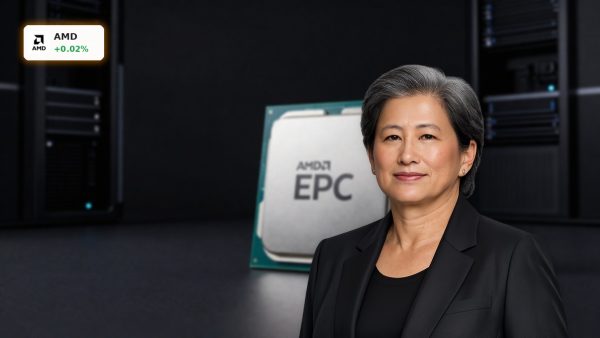
AMD is positioning itself as the leading alternative to NVIDIA in AI accelerators while also leveraging its strength in x86 server CPUs. CEO Lisa Su has repeatedly emphasized that AI “agents” and intelligent workloads are driving huge demand across hyperscalers, enterprises, and edge deployments. Recent quarters showed solid momentum in data-center revenue, supported by Instinct GPUs and EPYC processors used in large training clusters and inference workloads.
The broader market backdrop is highly supportive. The NASDAQ and S&P 500 are trading near historic levels, propelled by a handful of AI beneficiaries, including Apple, Tesla, and their peers in mega-cap tech. AMD sits squarely inside this AI leadership basket, increasingly treated as a core holding in growth- and tech-focused US portfolios. At the same time, some investors are discussing potential rotation away from the most crowded AI names if upcoming IPOs or macro shifts pull capital into other sectors, which could inject volatility into AMD shares even if fundamentals stay strong.
How are hyperscalers and partners shaping AMD Earnings?
The hyperscaler buildout remains central for the AMD Earnings story. Major cloud providers are racing to deploy AI clusters at scale, seeking more choice in accelerators to manage costs and diversify away from single-vendor dependence. Industry executives, including the CEO of cloud infrastructure provider CoreWeave, have warned that capacity constraints at incumbent GPU suppliers could push customers toward AMD’s Instinct platform, making it a credible second source for large AI deployments.
New ecosystem partnerships reinforce this narrative. Rackspace Technology recently signed a Memorandum of Understanding with AMD to create a governed Enterprise AI Cloud aimed at regulated and sovereign workloads. The initiative will embed AMD Instinct GPUs and EPYC CPUs into a fully managed model that spans inference-as-a-service, bare-metal compute, and governance tooling—designed to move AI projects from experimentation into production. In parallel, Hewlett Packard Enterprise is expanding its ProLiant edge portfolio with new servers, including models that integrate AMD EPYC 8005 series processors for energy-efficient AI inferencing at the edge, highlighting AMD’s reach beyond hyperscale data centers.
How does the competitive landscape affect AMD Earnings?
The competitive dynamic between AMD, NVIDIA, and Intel is intensifying as enterprises look to balance performance, cost, and availability. In CPUs, AMD and Intel are both working to swing the CPU-to-GPU ratio in large AI clusters back in their favor, seeking to capture more value from compute nodes that historically skewed toward GPU spending. AMD’s EPYC lineup, with strong performance-per-watt, is increasingly deployed in AI-optimized servers as customers prioritize energy efficiency and total cost of ownership.
On the GPU side, AMD is still gaining share from a smaller base, but each new design win in hyperscale or enterprise AI can add meaningful incremental revenue and bolster future AMD Earnings. The company also benefits indirectly as ecosystem players such as Broadcom roll out platforms like VMware Cloud Foundation 9.1 that explicitly support mixed hardware environments spanning AMD, Intel, and NVIDIA. That multi-vendor support makes it easier for enterprises to integrate AMD hardware into existing AI and cloud stacks without rebuilding their entire infrastructure.
What are traders watching in AMD’s stock setup?
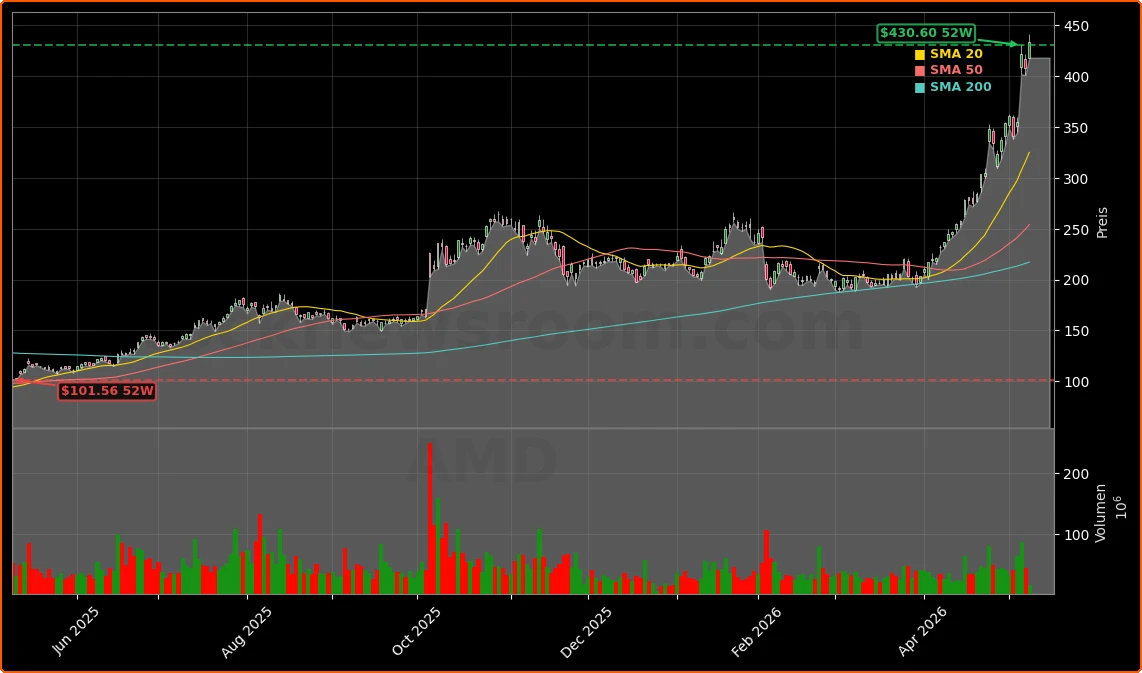
Technically, AMD has been trading in a powerful uptrend. The stock recently formed what chartists describe as a floating-island setup, briefly testing support in the $400–$402 zone before rebounding sharply. Traders had flagged a first upside target around $430, and AMD’s break above that level today triggered what many call a “blue-sky breakout,” given the move into uncharted price territory for the stock.
Short-term swing traders report trimming positions around $437–$438 after that initial target was met, while longer-term investors remain focused on whether future AMD Earnings can justify price targets that now span roughly $385 to as high as $550 from various Wall Street research desks. With implied volatility elevated and AI sentiment still exuberant, pullbacks toward prior support levels are widely viewed as potential entry points for those who believe the AI capex cycle has multiple years left to run.
Related Coverage
For a deeper dive into how the latest AMD Earnings intersect with the AI investment boom and what that means for valuation, see AMD Earnings -3.1%: Can the AI Boom Sustain the Rally?. That analysis explores whether the recent pullback offered a buying opportunity or a warning sign as Wall Street reassesses growth assumptions.
AMD Earnings underscore how central the company has become to the global AI buildout, with hyperscaler demand, new cloud partnerships, and a strengthening ecosystem all feeding into higher expectations. For US investors, the stock’s breakout above $430 highlights both the opportunity and the execution risk embedded in current valuations. The next set of AMD Earnings will be crucial in demonstrating whether management can convert AI hype into durable profit growth and keep AMD firmly in the top tier of Wall Street’s AI leaders.