Are blockbuster AMD Earnings and soaring AI demand enough to justify Wall Street’s aggressive re-rating after the latest pullback?

How are AMD Earnings reshaping Wall Street expectations?
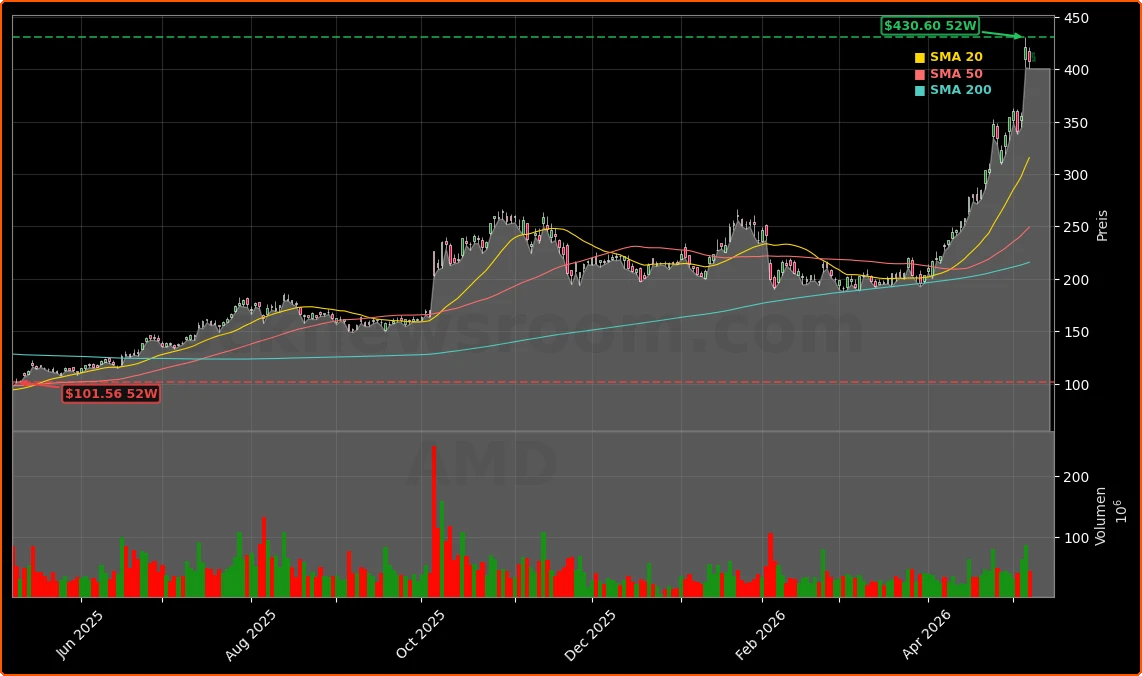
Advanced Micro Devices, Inc. has become one of the focal points of the NASDAQ AI trade after reporting quarterly results that materially beat market expectations. The reaction was swift: the stock jumped roughly 18% following the AMD Earnings release, before recent profit‑taking pulled it back to the low $400s. Even after this consolidation, shares remain up more than 80% year to date in EUR terms, trading around EUR 348, only slightly below their 52‑week highs on European venues.
The AMD Earnings beat was driven primarily by accelerating demand for AI‑focused data center products, signaling that hyperscalers are still in an aggressive investment phase. Management has pointed to a long‑term AI chip revenue opportunity of up to $150 billion annually over the next several years, underpinned by tight supply, strong pricing power and exceptionally high margins in its Instinct GPU line. That narrative has helped position AMD alongside NVIDIA as a core beneficiary of the global AI arms race.
Importantly for U.S. portfolios, AMD now sits at the crossroads of multiple secular growth trends: cloud AI training, inference at the edge, and CPU share gains against traditional incumbents. This gives the stock a structural tailwind that many broader S&P 500 names lack, even as overall equity indices hover near record territory.
Which analysts are driving the latest re‑rating?
The strength of recent AMD Earnings has prompted a rapid reset in Wall Street price targets. Bernstein upgraded AMD to “Outperform” and lifted its target to $525, basing its call on an earnings-per-share forecast of more than $14 by 2027. That implies a continued compound growth trajectory as AI deployments scale and as the company executes on its GPU and CPU roadmaps.
Barclays and Cantor Fitzgerald both followed with $500 price targets, while Bank of America moved its target up to $450. TD Cowen also set a $500 objective. Taken together, the three most recent $500‑level calls imply roughly 20% upside from recent trading levels around $408–$416, assuming AMD can deliver on its multi‑year AI ambitions.
One of the more notable shifts came from DA Davidson. Analyst Gil Luria raised his price target from $220 to $375, a jump of about 70% in a single move. Interestingly, his reassessment was driven not just by AMD Earnings, but by fresh data from a key competitor that reshaped expectations for the broader CPU market. Luria now values AMD at roughly 32 times his projected 2027 earnings, reflecting confidence that the company can sustain outsized growth well into the next decade.
How do AI partnerships extend the AMD Earnings story?
Beyond headline AMD Earnings, the company is deepening its role in AI infrastructure through both open standards and commercial alliances. Together with OpenAI, Microsoft, Broadcom and Intel, AMD has contributed the Multipath Reliable Connection (MRC) protocol to the Open Compute Project. MRC routes data simultaneously over multiple network paths, reducing congestion and responding to failures in near real time—a critical advantage for large AI clusters. AMD has already validated MRC in test clusters at a major cloud provider, reinforcing its position as an architect of open AI networking, not just a chip vendor.
On the commercial front, AMD and Rackspace Technology recently signed a memorandum of understanding to build a governed Enterprise AI Cloud for regulated and sovereign workloads. The platform is designed around AMD Instinct GPUs and EPYC CPUs with Rackspace providing a fully managed environment, governance tools and services such as an Enterprise Inference Engine and Inference‑as‑a‑Service. For institutional investors, this kind of partnership could translate into more predictable, recurring infrastructure demand rather than purely cyclical hardware sales.
Broadcom is also advancing the broader AI stack with its VMware Cloud Foundation 9.1, aimed at cost‑efficient private AI clouds that support mixed hardware environments spanning AMD, Intel and NVIDIA chips. As enterprise customers adopt these platforms, AMD’s presence in both cloud and on‑premise deployments could further reinforce the earnings trajectory opened up by recent AMD Earnings.
Can AMD keep pace with rivals like NVIDIA and Intel?
The AI buildout remains heavily dominated by NVIDIA, which still controls an estimated 80% of the AI accelerator market. Yet AMD is clearly gaining ground. Its upcoming Helios rack‑scale AI system is slated for delivery later this year, with major orders already in hand. OpenAI and Meta have committed to Helios deployments, while Oracle is planning a Supercluster built around 50,000 Helios GPUs. Meta alone has signaled interest in up to 6 gigawatts of AMD Instinct GPUs, a scale that could justify the multiple expansion reflected in post‑earnings analyst calls.
At the CPU level, AMD and Intel are collaborating on AI Compute Extensions for the x86 architecture. These extensions aim to deliver up to 16‑fold improvements in performance per watt for AI workloads, a key metric as data centers collide with rising power costs and grid constraints. Meanwhile, Hewlett Packard Enterprise has expanded its ProLiant edge portfolio, including the DL145 Gen11 server equipped with AMD EPYC 8005 series processors for energy‑efficient edge AI. This ecosystem support underscores that AMD is gaining traction not just in hyperscale clouds, but also at the edge where inference and mission‑critical processing occur.
For NASDAQ investors already exposed to mega‑cap AI names such as Apple and Tesla, AMD offers a leveraged way to participate in the infrastructure layer of the AI cycle. However, with the stock having more than doubled in a matter of weeks at one point and trading well above $400, position sizing and volatility management remain crucial.
Related Coverage
Investors who want a deeper dive into how the latest AMD Earnings connect to the company’s AI roadmap can explore our prior analysis. In “AMD Earnings Surge as Q2 Outlook Ignites AI Boom”, we examine whether the earnings surprise and upgraded AI guidance justify the sharp post‑report price spike and what it could mean for the next phase of AMD’s growth story.
In sum, AMD Earnings have evolved from a simple quarterly scorecard into a key barometer for the entire AI infrastructure cycle. With Wall Street boosting price targets, hyperscalers locking in massive GPU orders and new partnerships extending AMD’s reach into governed enterprise AI, the stock remains a central AI lever for U.S. investors. The upcoming shareholder meeting and AMD’s “Advancing AI 2026” event in July will be pivotal in confirming whether this momentum can continue to power the next leg of the rally.