Are AMD earnings about to justify the AI euphoria—or expose just how far the stock has run ahead of reality?

How is Advanced Micro Devices setting up into the report?
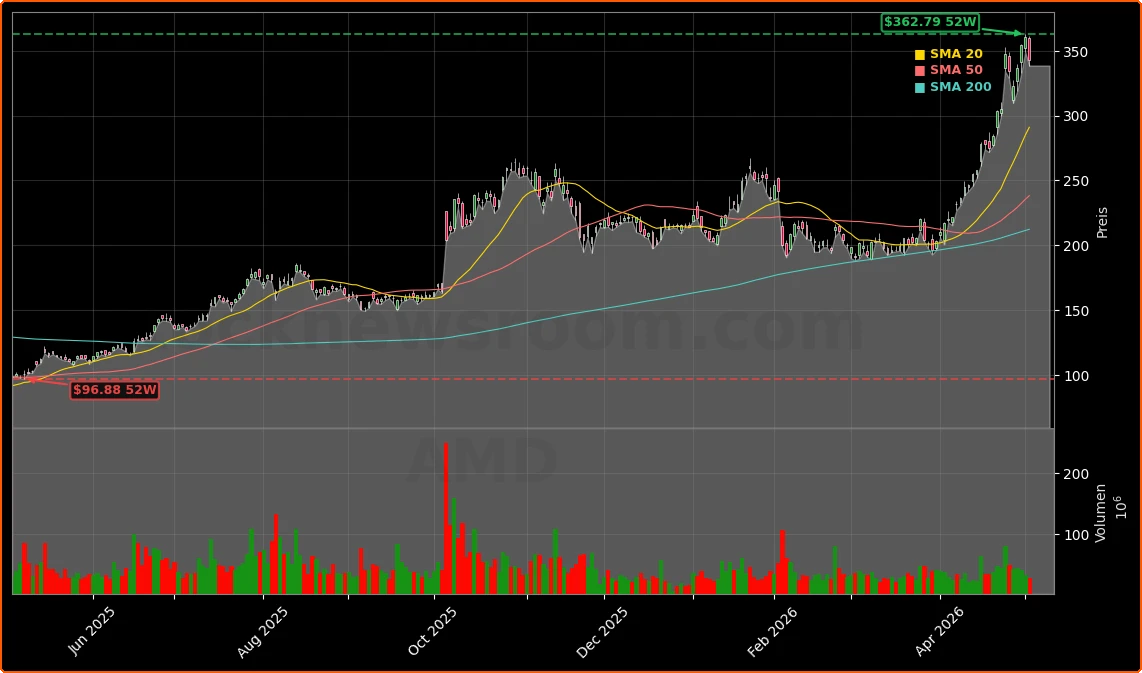
Shares of Advanced Micro Devices, Inc. (AMD) fell roughly 4.9% on Monday to $342.83, extending a pullback from last week’s record high around $362.79. The stock remains near the top of its 52‑week range of $96.45 to $362.79 and is still up more than 240% over the past year, dramatically outpacing both the S&P 500 and the Nasdaq Composite. A recent 74% jump in April alone marked AMD’s strongest monthly performance in more than two decades.
Derivatives markets are signaling that Tuesday night could be volatile. Implied volatility on near‑term AMD contracts sits above 80, with an IV rank in the mid‑80s, indicating traders expect an outsized swing after the numbers hit. Options pricing shows pronounced upside skew, with richer implied volatility on far‑out‑of‑the‑money calls, reflecting persistent demand for AI‑levered upside even after the stock’s historic run.
Under the hood, AMD remains technically extended: the share price is more than 25% above its 20‑day simple moving average and over 50% above the 100‑day, while the relative strength index hovers around 80, a zone often associated with overbought conditions. Key levels on many traders’ screens include resistance near $363 and support around $285, where the rising 20‑day average sits and dip‑buyers have recently stepped in.
What do analysts expect from AMD Earnings?
Wall Street expects AMD to post Q1 2026 revenue of about $9.88 billion and earnings per share near $1.24. That would represent roughly 33% top‑line growth and a sharp jump from the prior‑year EPS of $0.96. AMD has a strong track record heading into this release, having beaten revenue estimates for 14 straight quarters and outperformed on EPS in most of the last ten.
For many institutional investors, however, the headline numbers are only part of the AMD Earnings story. The focus is squarely on AI and data‑center exposure: EPYC server CPUs and Instinct data‑center GPUs tied to generative AI workloads. Recent quarters showed data‑center revenue growing faster than the rest of the business, and analysts want evidence that trend is accelerating, not fading, after last quarter’s guidance left some AI bulls underwhelmed.
Wedbush analyst Matt Bryson, who rates AMD “Outperform,” recently lifted his price target from $290 to $400, arguing that strong server CPU demand and ramping AI GPU sales should position the company to beat and guide higher. RBC Capital Markets maintains a “Sector Perform” rating but raised its target to $325, while Susquehanna reiterated a Positive view and boosted its target to $375. DA Davidson upgraded AMD to Buy with a $375 target as well.
Why is HSBC turning cautious on Advanced Micro Devices?
Not all brokers are leaning into the upside. HSBC downgraded AMD from Buy to Hold even as it nudged its price target from $335 to $340, a level now roughly in line with the current share price. Analyst Frank Lee argues that the massive April rally has brought forward years of optimism about server CPU share gains, leaving little room for disappointment.
HSBC also highlights a key risk that U.S. investors often underappreciate in high‑growth chip names: supply constraints. AMD is heavily dependent on Taiwan Semiconductor Manufacturing for advanced foundry capacity, and tight supply through year‑end could cap unit growth in both CPUs and AI GPUs. That bottleneck may support pricing but could limit upside to revenue volumes versus ultra‑bullish expectations, especially as Intel pursues its own AI‑centric roadmap with in‑house manufacturing advantages.
Some valuation concerns are also creeping in. With AMD trading at more than 130 times trailing earnings and above some fair‑value estimates around $300, portfolio managers who missed earlier in the rally must balance the quality of AMD’s AI franchise against the risk that any miss or conservative outlook could trigger a sharp derating.
How does AMD stack up against AI peers like NVIDIA and Apple?
For U.S. investors, AMD now sits at the center of the AI‑hardware trade alongside NVIDIA and mega‑caps like Apple and Tesla. While NVIDIA remains the dominant AI GPU supplier, AMD is pitching its latest Instinct accelerators as a cost‑efficient alternative for hyperscalers and enterprise customers, particularly for inference workloads. The upcoming AMD Earnings call is expected to highlight progress on the MI‑series roadmap, including the MI455, and to outline how the company plans to convert design wins into multi‑year revenue streams.
Beyond chips, AMD is also expanding its data‑center footprint, recently doubling capacity at a Texas megasite that underscores the industry’s need for power‑dense campuses to support AI build‑outs. That expansion aligns with forecasts that AI‑related revenue could reach tens of billions of dollars annually in the next few years if the current data‑center upgrade cycle persists.
Macro and index dynamics add another layer. AMD is now a top weight in key semiconductor and technology ETFs, meaning a sharp move after AMD Earnings could ripple through sector funds and the broader Nasdaq. With profit‑taking already hitting parts of big tech, any disappointment could pressure high‑multiple AI names, while a strong beat‑and‑raise might reignite momentum across the chip complex.
Related Coverage
Investors looking for more context on the AI backdrop can revisit our recent deep dive on whether AMD’s AI boom marks a cyclical spike or a structural shift. In “AMD AI Demand +4.5% Rally: Is a New Data Center Boom Starting?” we examined how hyperscaler spending plans, data‑center capacity builds, and competition with NVIDIA could shape AMD’s growth trajectory over the coming years. That piece provides additional background on why today’s AMD Earnings may act as a referendum on the next leg of the AI infrastructure cycle.
In summary, AMD Earnings arrive at a moment when expectations, valuation, and AI enthusiasm are all elevated. Bulls see a chance for the company to validate its premium multiple with another beat and a stronger AI roadmap, while skeptics warn that supply constraints and sky‑high sentiment leave little room for error. The next few quarters will reveal whether AMD can convert its historic rally into sustained earnings power, and Tuesday night’s guidance will be a key first test for long‑term U.S. investors.