Can blockbuster AMD Earnings and a red-hot AI data center business really justify the chipmaker’s latest post-market rally?

How did AMD Earnings beat Wall Street?
Advanced Micro Devices, Inc. reported Q1 2026 revenue of $10.253 billion, up 38% year over year and above consensus estimates of roughly $9.89 billion. On a non-GAAP basis, diluted EPS reached $1.37, beating expectations around $1.29 and rising 43% from $0.96 a year earlier. GAAP EPS was $0.84, almost doubling year on year as net income climbed to $1.38 billion.
Gross margin on a non-GAAP basis came in at 55%, up one percentage point from the prior year, while operating margin expanded to 25%. Free cash flow surged to $2.57 billion, underscoring the cash-generating power of the AI buildout. Importantly for equity investors, these AMD Earnings confirm that the company is not just riding AI hype but converting it into material profit growth.
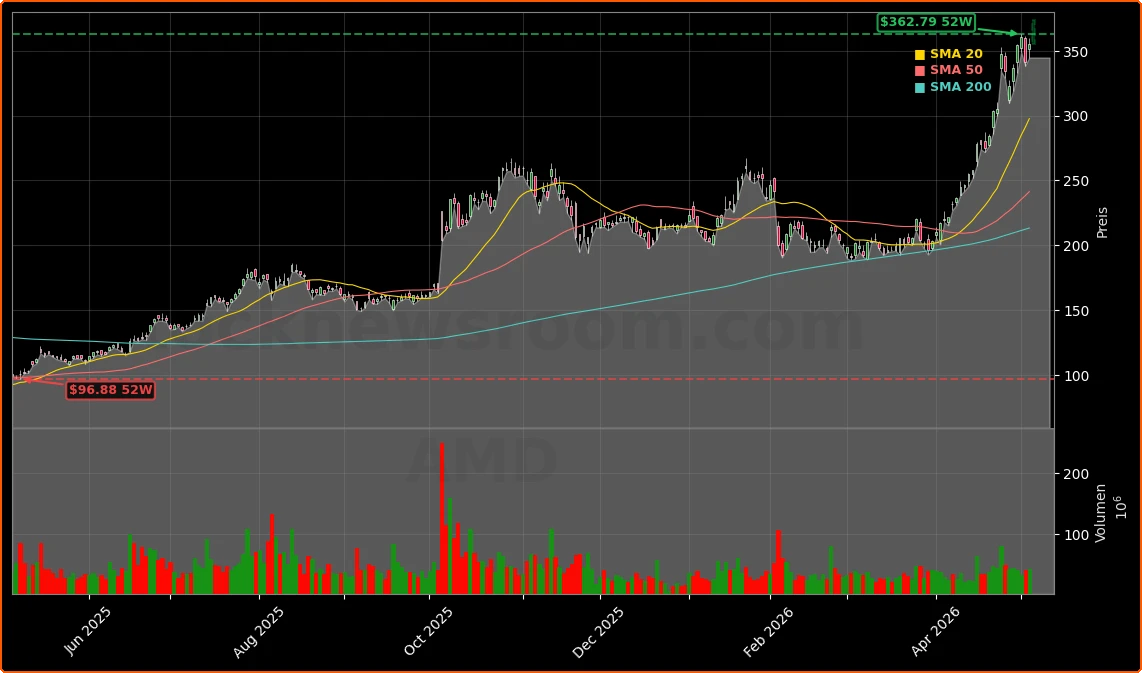
The stock, which closed at $355.26 on Tuesday, up 4.02% on the day, jumped further to about $374.09 in after-hours trading, a gain of more than 5%. That reaction is notable given the elevated expectations already priced into AMD’s valuation after a gain of well over 200% in the past year.
Is the AI data center story holding up for AMD?
The quarter’s headline was the continued acceleration in AMD’s data center business. Data Center segment revenue reached $5.8 billion, up 57% year over year and now clearly the primary driver of revenue and earnings growth. The company highlighted strong demand for EPYC server CPUs and a continued ramp in AMD Instinct AI GPU shipments, as hyperscalers and large enterprises diversify their AI compute stacks beyond NVIDIA.
Client and Gaming revenue totaled $3.6 billion, up 23% year over year, with client PC revenue up 26% on the back of Ryzen-driven share gains and AI-capable laptops. Gaming revenue rose 11%, supported by Radeon GPUs, although semi-custom console chips were a drag. The Embedded segment added $873 million, a 6% increase that reflects a stabilizing industrial and edge market.
CEO Lisa Su emphasized that accelerating AI infrastructure demand and the shift toward inferencing and agentic AI are driving sustained needs for high-performance CPUs and accelerators. She pointed to growing engagement around the MI450 GPU series and the Helios rack-scale AI system, including large deals with major cloud platforms and hyperscalers, as tangible proof that AMD is becoming a credible second source in AI compute.
What does the new AMD Earnings outlook signal?
For the second quarter of 2026, AMD issued a bullish revenue forecast of approximately $11.2 billion, plus or minus $300 million. At the midpoint, that implies about 46% year-over-year growth and roughly 9% sequential growth, handily ahead of prior consensus near $10.52 billion. The company expects non-GAAP gross margin of about 56%, indicating it can pursue aggressive share gains in AI GPUs without sacrificing profitability.
This forward guidance is central to how Wall Street interprets AMD Earnings. The market has already discounted a steep AI ramp; confirming a stronger-than-expected Q2 outlook reduces the risk that the story stalls in the near term. Management also reiterated that server growth should “accelerate meaningfully” as supply scales through the year, giving long-only and hedge fund investors greater confidence in modeling multi-year data center expansion.
At the same time, AMD continues to face intense competition. NVIDIA still commands a deep software moat through CUDA and strong demand for its Blackwell and Vera Rubin platforms, while major cloud players are investing in custom chips that can reduce reliance on merchant GPUs altogether. AMD’s ability to execute on MI450 and Helios deployments at scale will be scrutinized closely over the coming quarters.
How is Wall Street reacting to AMD and its peers?
Analyst sentiment heading into this AMD Earnings release was mixed but skewed bullish. Morgan Stanley recently raised its AMD price target from $255 to $360, citing accelerating data center momentum and the expanding AI GPU opportunity. Susquehanna went even further with a target of $375, arguing that server CPU share gains and an AI accelerator ramp can extend the rally. On the other side, HSBC downgraded AMD to “Hold,” warning that the stock’s massive run-up left limited room for disappointment.
Against that backdrop, a clean beat and higher guidance are exactly what bullish investors wanted to see. AMD’s move higher in the after-hours session contrasts with periods earlier this year when strong numbers still triggered selloffs, suggesting that tonight’s report may help reset sentiment more favorably. The rally also comes as AI infrastructure names across the NASDAQ and S&P 500 — from memory makers to foundry equipment suppliers — remain in focus amid ongoing shortages and capacity constraints.
Options flow today underscored how closely traders were watching the print. A notable call sweep at the $400 strike expiring later this week pointed to speculation on a near-term breakout, even as some institutional accounts used the move to hedge or take profits after a powerful run.
Related Coverage: For readers looking to understand how tonight’s AMD Earnings compare with earlier market fears, it is worth revisiting a recent analysis that asked whether the stock’s explosive AI rally had gone too far. In that piece, stocknewsroom.com examined downside risks if guidance underwhelmed and questioned whether investors were overpaying for growth. You can find that detailed discussion at AMD Earnings: Stock Slides -4.6% as AI Boom Meets Warning, which now serves as a useful contrast to the more constructive outlook emerging after this latest report.
We delivered an outstanding first quarter, driven by accelerating demand for AI infrastructure, with Data Center now the primary driver of our revenue and earnings growth.— Dr. Lisa Su, AMD chair and CEO
Fazit folgt.