
Can AMD AI Infrastructure’s explosive data center growth really justify its lofty valuation against NVIDIA and Intel?

Is Advanced Micro Devices peaking after a historic run?
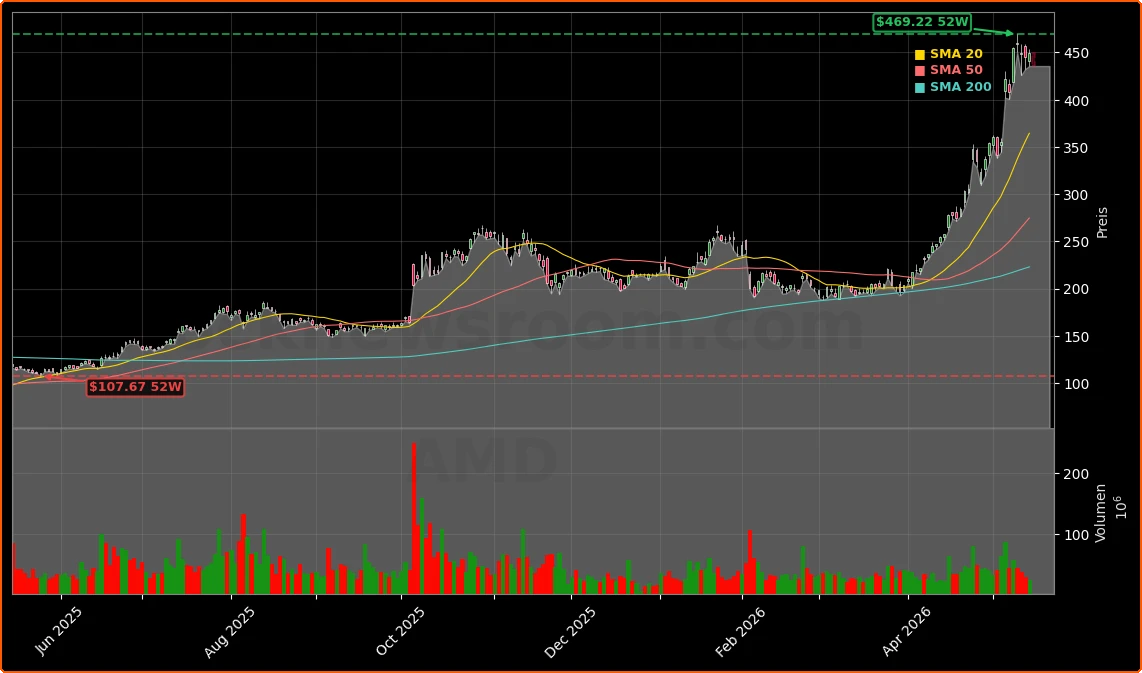
Advanced Micro Devices, Inc. has been one of the standout winners of the generative AI boom on the NASDAQ. The stock closed Thursday at $449.70, up 0.94% on the day and roughly up almost fourfold over the past year in euro terms, before slipping to about $435.30 in early Friday ET trading. That pre-market move reflects growing debate after a blistering rally that left AMD trading around 21 times trailing sales, richer than many S&P 500 technology names but still below NVIDIA and Broadcom on some metrics.
Despite the valuation debate, demand signals from AI data centers remain powerful. Wall Street analysts, including 57 tracked by TradingView, maintain a consensus Buy rating, and the average 12‑month price target has recently been raised to about $467, implying modest upside from current levels. Dan Ives of Wedbush reiterates that the AI chip cycle could still drive a further 15–20% move higher for AMD if execution on AMD AI Infrastructure stays on track.
How is AMD reshaping the data center landscape?
The core of the bull case sits in the data center. In the latest reported quarter, AMD generated roughly $10.3 billion in total revenue, with about $5.8 billion — or 56% — coming from its datacenter segment. That segment expanded 57% year over year as EPYC server CPUs and Instinct accelerators captured more high-value workloads in AI and cloud deployments.
AMD now commands 46.2% of global server-processor spending and just over 27% of units, underscoring a mix shift toward higher-priced, performance-intensive chips. That premium positioning has translated into a jump in profitability, with free cash flow tripling to more than $2.5 billion and adjusted gross margin climbing to 55%, far ahead of Intel’s roughly 41%. For portfolio managers benchmarking against the NASDAQ 100 or S&P 500, this sharp margin differential is a key reason AMD AI Infrastructure is increasingly viewed as a core holding in the AI stack rather than simply a cyclical semiconductor bet.
Can AMD AI Infrastructure chip away at NVIDIA’s lead?
Even with this momentum, NVIDIA still dominates AI accelerators with an estimated 80% market share, and that gap defines the opportunity and the risk for AMD shareholders. AMD’s Instinct GPU roadmap and integrated platform strategy are designed to turn AMD AI Infrastructure into a credible second source for hyperscalers that are hungry for supply diversity and better pricing.
Hyperscale operators are expected to invest more than $200 billion into AI-ready data centers, and AMD is already benefiting from that spend. Meta Platforms is scaling up a new deployment of Instinct GPUs for an AI infrastructure project that could reach up to six gigawatts of power capacity, focused on so‑called agentic AI workloads. This kind of marquee reference customer not only validates AMD’s rack-level designs, it also helps expand the software ecosystem that has historically been a relative weak point versus NVIDIA.
Investors also see growing traction in partnerships such as the recently announced deal with Rackspace Technology to build managed AI solutions on top of AMD AI Infrastructure. Rackspace shares spiked over 20% on the announcement, highlighting how AMD’s platform is becoming a differentiator for downstream cloud and managed‑services players that need alternatives to the biggest public clouds.
How does competition pressure Intel and others?
AMD’s server momentum is directly pressuring Intel, whose share price has struggled as it cedes CPU market share to both AMD and Arm-based designs. Intel’s latest results showed revenue stabilization but ongoing net losses, and its stock fell nearly 4% after updated market-share data confirmed further erosion in key server categories. For US investors, the relative performance spread between AMD and Intel underscores a broader theme: capital is rotating within the semiconductor industry toward companies with clear leverage to AI infrastructure and strong execution.
Valuation remains the single largest pushback. Zacks and other research outlets have flagged that even if AMD’s revenue were to double this year, the stock would still trade at an elevated price‑to‑sales multiple compared with long-term historical norms for chipmakers. However, bulls argue that direct comparisons to past cycles understate the structural nature of today’s AI build‑out and the role AMD AI Infrastructure will play across CPUs, GPUs, and complete rack solutions.
What are analysts watching into the next catalyst?
Wall Street is now focused on several near‑term milestones. CEO Lisa Su has guided for around $11.2 billion in revenue in the current quarter, which would mark another step up in AI‑driven growth. KeyBanc Capital Markets and Bernstein have adjusted their models and now see potential for the shares to reach $530 and $525, respectively, assuming AMD can continue to expand data center share and maintain mid‑50s gross margins.
The next major product catalyst arrives on July 23, 2026, when AMD hosts its “Advancing AI” event in San Francisco. Investors expect the company to unveil the next generation of Instinct accelerators and provide more concrete detail on its Zen 6 CPU architecture. Any signs that performance or efficiency can close the gap with NVIDIA’s leading GPUs — or enable tighter CPU‑GPU integration — would strengthen the argument that AMD AI Infrastructure can secure a durable second-place position with attractive economics.
Related Coverage
For a closer look at how short‑term volatility is intersecting with the long‑term AI narrative, readers can explore AMD AI Forecast: -2.4% Plunge After AI Boom Shock Rally. That analysis examines whether the latest pullback is an early signal of fatigue or a fresh entry opportunity within an ongoing secular uptrend in AI infrastructure spending.
In summary, AMD AI Infrastructure has turned the company into a central beneficiary of the global AI data center build‑out, with surging data center revenue, rising market share, and healthy cash generation to match. For US investors, the key question is less about demand and more about how much AI optimism is already embedded in a stock trading at premium multiples. The upcoming “Advancing AI” event and subsequent earnings reports will be pivotal in determining whether AMD can justify today’s expectations and extend its leadership role in next‑generation compute infrastructure.