
Are the latest Amgen Earnings a buying opportunity after the stock’s sudden plunge, or a warning sign that growth is stalling?

Why did Amgen Inc. sink despite higher guidance?
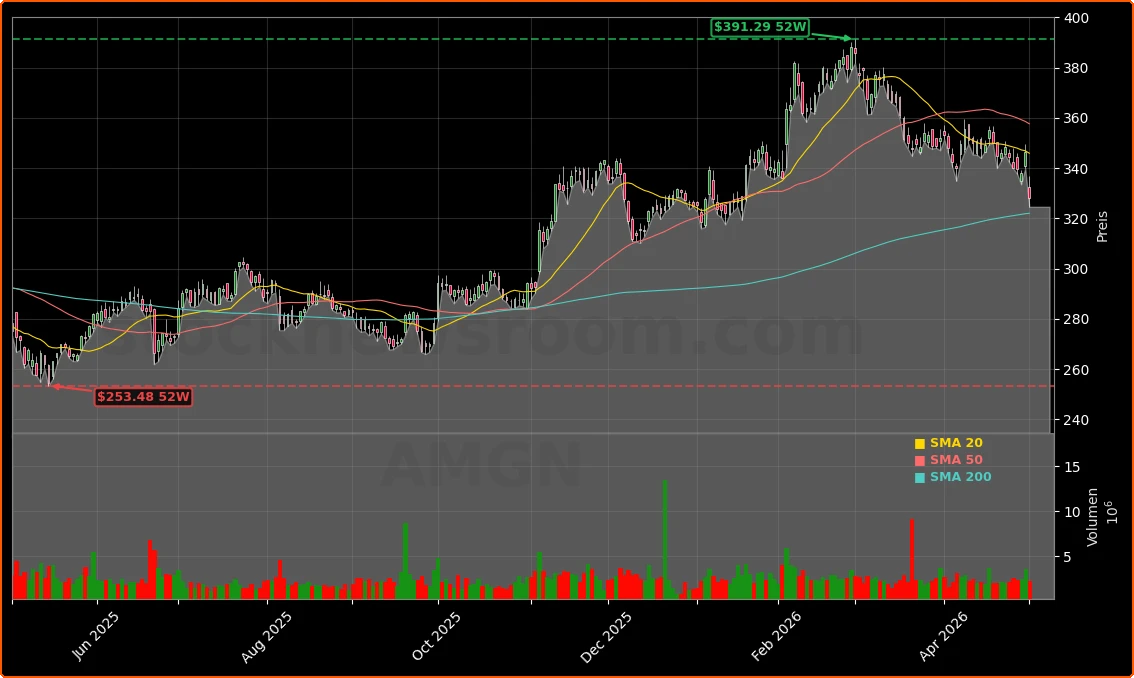
Amgen Inc. delivered a constructive update for investors, lifting its full-year 2026 outlook after a steady start to the year. Yet the stock came under pressure in U.S. trading, with shares recently around $328, roughly 5.3% lower on the day. As a high-priced component of the Dow Jones Industrial Average, Amgen’s decline also weighed on the price-weighted index and added to broader weakness on Wall Street.
The latest Amgen Earnings snapshot shows a company that is executing, but not dramatically outperforming sky-high expectations. Management now expects 2026 revenue between $37.1 billion and $38.5 billion, about $100 million higher at both ends of the prior range. The Street had been looking for about $37.8 billion, so the midpoint of the updated guidance lands slightly above consensus.
On the bottom line, Amgen raised its adjusted earnings per share outlook to a range of $21.70 to $23.10, up just $0.10 from the previous forecast. Analysts had been modeling roughly $22.30, placing their expectations near the center of the new range. While that technically qualifies as an upgrade versus consensus, many investors had hoped for a more decisive signal of upside momentum, especially given the competitive intensity across key therapeutic areas.
What do the latest Amgen Earnings say about demand?
The most recent quarter highlighted resilient demand for Amgen’s portfolio, even as pricing and inventory dynamics created some drag. Revenue rose about 6% year over year to roughly $8.6 billion. That growth was powered by a 9% increase in volumes, partially offset by lower realized prices and leaner channel inventories. In plain terms, Amgen is selling more units, but collecting a bit less per unit and keeping less product parked in the distribution pipeline.
Net income climbed around 5% to approximately $1.8 billion, with both sales and earnings coming in broadly in line with – and slightly above – market expectations. For Jefferies analyst Akash Tewari, the quarter was “okay”: the firm noted that Amgen’s revenue and profit metrics topped its models, and described the upgraded full-year guidance as achievable rather than aggressive.
That nuanced assessment reflects the broader reaction on Wall Street. The Amgen Earnings release did not raise any red flags, but it also did not provide the kind of upside surprise that sometimes drives sharp rallies in large-cap healthcare names. Instead, investors appear to be parsing how much incremental growth Amgen can realistically capture in a landscape that includes intensifying competition from peers like NVIDIA-adjacent AI drug discovery partners, as well as pharma rivals and upstart biotechs targeting overlapping indications.
How does Amgen compare with other large-cap healthcare names?
For U.S. investors, the Amgen Earnings update slots into a broader pattern across the S&P 500 healthcare sector: established franchises are generating steady, if unspectacular, growth while the market increasingly rewards high-octane innovation stories. Whereas technology leaders such as Apple or Tesla can sometimes command premium multiples purely on growth narratives, large biopharma names like Amgen, Pfizer, and others are often judged on a balance of pipeline visibility, pricing power, and capital returns.
Amgen’s ability to grow volumes by high single digits despite price pressure suggests its products remain competitively positioned. However, with the stock already trading at a premium to some traditional pharma peers, investors want clear evidence that pipeline catalysts and new indications can accelerate earnings growth beyond the modest bump contained in the new 2026 guidance.
That context helps explain why the market reaction to the latest Amgen Earnings update has been subdued at best. Even though the company technically beat expectations and raised its outlook, the guidance band still signals only a controlled, incremental trajectory. In a market where growth stories across tech and AI – from NVIDIA’s data center surge to software beneficiaries – continue to set the tone, defensive growth in biotech must compete harder for attention.
What should investors watch after these Amgen Earnings?
Looking ahead, investors will focus on a handful of key questions emerging from the Amgen Earnings discussion. First, can the company maintain its 9% volume growth without further erosion in net pricing, especially as generics and biosimilars exert ongoing pressure in some franchises? Second, how quickly will new products and indications scale to offset maturing revenue streams?
Analysts including Jefferies’ Akash Tewari currently view the raised outlook as realistic, implying that major Wall Street banks are not seeing a dramatic inflection – positive or negative – in Amgen’s near-term trajectory. Any future revisions from firms such as Goldman Sachs, Morgan Stanley, or Citigroup on ratings and price targets will likely hinge on clinical trial updates, regulatory milestones, and signals that management can translate volume growth into more robust earnings leverage.
For portfolio managers benchmarked to the S&P 500 or the Dow, Amgen’s move has immediate index-level implications, but the more important takeaway is strategic: the stock remains a large, relatively stable healthcare holding whose valuation will ebb and flow with each Amgen Earnings cycle. After the latest guidance hike and subsequent share-price pullback, the setup going into the next quarter will be critical in determining whether this episode marks a temporary reset or the beginning of a longer period of investor caution.
The quarter was okay; Amgen beat on revenue and earnings, and the raised full-year guidance looks achievable rather than aggressive.— Akash Tewari, Jefferies
In the end, the core message from the newest Amgen Earnings update is that the company is executing steadily, raising its outlook, yet still struggling to fully convince a market conditioned to demand outsized surprises. For long-term investors in U.S. healthcare, Amgen remains a key blue-chip name to watch, and the next quarterly report will show whether management can turn incremental gains into a more compelling growth story.