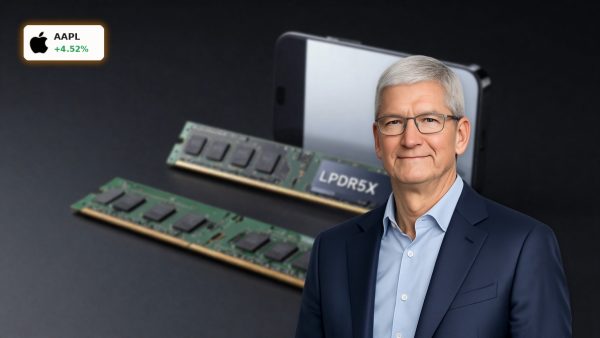

Will the explosive Apple Lawsuit against OpenAI derail the tech giant’s AI ambitions, or can a massive new price target save the stock?

What Is Behind the Apple Lawsuit Against OpenAI?
In a dramatic escalation of the battle for artificial intelligence supremacy, Apple has filed a lawsuit against OpenAI and one of its hardware executives. The Apple Lawsuit alleges the theft of trade secrets related to AI hardware design and proprietary consumer technology. According to details from the legal filing, Apple claims that OpenAI’s hardware chief actively encouraged employees to take physical product components and proprietary files upon leaving the iPhone maker.
The legal complaint highlights that more than 400 former Apple employees now work at OpenAI. In one specific allegation, a former iPhone engineer who joined OpenAI’s hardware division reportedly retained a company-issued MacBook and accessed internal servers to download highly confidential files. While OpenAI has denied these allegations, legal analysts note that this Apple Lawsuit could create a significant regulatory and operational overhang for OpenAI’s consumer hardware ambitions, potentially straining the existing partnership between the two tech giants.
How Is Wall Street Reacting to Apple?
Despite the legal drama, the financial community remains highly optimistic about Apple’s market positioning. Citigroup analyst Asiya Merchant raised the firm’s price target on the stock from $315 to $365, reiterating a Buy rating. The bank cited strong margin expectations driven by recent price increases and anticipation surrounding the upcoming iPhone 18 launch in September. Unlike other hyperscalers, Apple is not spending as heavily on capital expenditures, choosing instead to reward shareholders through massive stock buybacks.
However, the sentiment is not entirely uniform across Wall Street. Analysts at KeyBank recently downgraded the stock, citing concerns over weaker demand in the United States and suggesting that current consensus estimates for iPhone sales might be overly ambitious. This mixed analyst outlook has led to some intraday volatility, with the stock trading slightly lower at $313.70, down 1.13% in late morning trading on Tuesday, following a brief push to a new all-time high earlier in the session.
How Is Apple Performing in Key Global Markets?
While domestic demand faces scrutiny, Apple continues to demonstrate massive strength in critical international regions, particularly China. Recent data from research firm IDC reveals that Apple and Huawei dominated the Chinese smartphone market during the second quarter. Despite an overall market decline of 4.3% in China, Apple grew its shipments by an impressive 25% year-over-year.
This growth is particularly notable given the current industry headwinds. Smartphone manufacturers are currently grappling with memory and component costs that have surged nearly 300% compared to last year. While rising costs forced many Android competitors to raise retail prices, Apple kept its pricing stable in China during the quarter, capturing significant market share from budget-conscious buyers who opted for premium devices instead.
Related Coverage
For a deeper look into how supply chain dynamics are affecting tech valuations, read about the Apple Memory Chips +4.5%: China Supply Push Lifts Shares article, which details the company’s efforts to secure cheaper components. Additionally, the broader semiconductor sector remains highly volatile, as explored in the NVIDIA AI Under Pressure: Stock Drops 3.3% as Tech Sector Slides report, highlighting the mounting supply chain worries affecting top tech firms.
Conclusion
Huawei and Apple held their prices steady while competitors were raising theirs, and that gave hesitant buyers a reason to go ahead and purchase.— Arthur Guo, Research Analyst at IDC China
The newly initiated Apple Lawsuit against OpenAI underscores the fierce battle for intellectual property in the generative AI era. Simultaneously, the significant price target upgrade from Citigroup highlights Apple’s enduring financial resilience and pricing power in global markets like China. For long-term investors, the company’s ability to defend its technology while expanding its market share suggests that Apple remains well-positioned to lead the next generation of AI-enabled consumer hardware.