
Is the latest ASML Forecast a reliable signal that the AI infrastructure boom still has years of upside left?

How is ASML reshaping expectations for AI chips?
ASML Holding N.V. recently raised its 2026 net sales outlook to a range of EUR 36 billion to EUR 40 billion, up from a prior forecast of EUR 34 billion to EUR 39 billion. Management tied the higher guidance to accelerating demand for its most advanced lithography systems, driven by AI-centric semiconductor spending and a global buildout of high-performance data centers. That ASML Forecast comes as trailing 12‑month revenue is already up more than 70% since 2022, highlighting how quickly AI infrastructure is scaling.
In Q1 2026, ASML generated about EUR 8.8 billion in net sales with a gross margin of roughly 53% and net income near EUR 2.8 billion, beating earnings-per-share expectations around EUR 7.15. CEO Christophe Fouquet emphasized that demand for logic and memory chips tied to AI accelerators and high‑bandwidth memory is outpacing supply, pushing customers to pull forward capacity expansion plans into 2026 and beyond. For investors on Wall Street, that makes the ASML Forecast one of the clearest macro signals that AI capex from cloud giants and hyperscalers remains in an early innings phase.
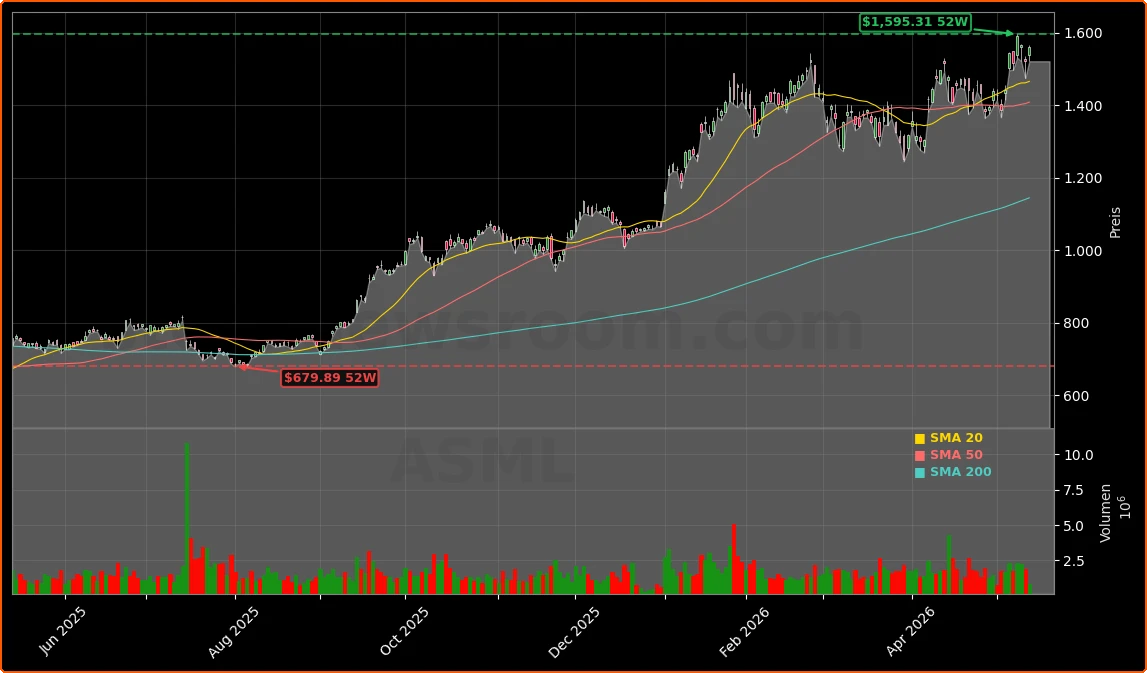
The stock has responded accordingly: ASML shares are up sharply over the past 12 months, with year‑to‑date gains above 40% fueled by growing recognition that EUV and High‑NA EUV lithography have become a critical bottleneck for advanced AI processors. That dynamic positions ASML as a “picks and shovels” play in the AI gold rush, complementing more cyclical chip designers and foundries in NASDAQ growth portfolios.
Why does ASML dominate the AI hardware supply chain?
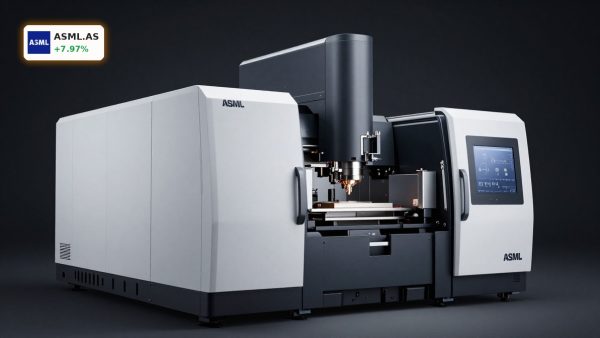
ASML develops and manufactures lithography, metrology, and inspection systems used by leading foundries to produce cutting‑edge chips at process nodes such as 7nm, 5nm, and 3nm. Its extreme ultraviolet (EUV) machines, which can cost well north of $350 million each, are effectively a monopoly product – no other vendor offers comparable tools for high‑volume manufacturing at these geometries. Taiwan Semiconductor Manufacturing, Intel, and Samsung all rely heavily on ASML’s EUV technology to build advanced AI GPUs, CPUs, and high‑bandwidth memory.
The company is also rolling out its High‑NA EUV platform to support future 2nm and sub‑2nm logic production later this decade. That road map is crucial for chip designers that dominate U.S. indices, including NVIDIA in AI accelerators and Apple in premium smartphone and PC processors. ASML has described an unprecedented wave of AI‑driven investment, estimating more than $2.5 trillion could be deployed globally over the next two to three years into AI infrastructure, from data centers to high‑performance computing clusters.
For U.S. investors who already hold large positions in big tech and semiconductor names, the ASML Forecast effectively acts as a capacity gauge: if ASML keeps selling more EUV tools, fabs like TSMC and Intel can keep expanding, sustaining chip supply for downstream players such as Tesla in autonomous driving and cloud giants running generative AI workloads. That makes ASML a strategic diversifier alongside more volatile chip stocks in NASDAQ and S&P 500‑focused strategies.
How are analysts and institutions reading the ASML Forecast?
Wall Street research remains broadly constructive. Bernstein recently reaffirmed a Buy rating on ASML with a price target of EUR 1,700, while Berenberg Bank also maintained a Buy rating and a EUR 1,570 target, citing robust AI‑related demand for advanced lithography. MarketBeat data show a “Moderate Buy” consensus, and institutional investors continue to build positions; Bensler LLC, for example, initiated a stake of roughly $3.06 million in the fourth quarter, seeing ASML as a core long‑term AI enabler.
Valuation, however, is a recurring debate. ASML trades around a forward P/E of roughly the low‑30s, while analysts project earnings growth in the low‑20s percentage range, implying a PEG ratio near 1.4. Bulls argue that a near‑monopoly in EUV, high switching costs, and structural AI demand justify a premium multiple relative to many semiconductor peers. Bears point to geopolitical risks, including U.S.‑led export controls that limit shipments of advanced tools to China, as well as signs of timing shifts like reported delays by certain customers in deploying the costliest High‑NA EUV systems.
Short‑term volatility around headlines such as the proposed U.S. “MATCH Act” on China exports, or occasional analyst downgrades to Hold, has produced sharp pullbacks — including declines of more than 3% on single days. Yet each dip has so far been met with institutional buying, with share buybacks by ASML Holding N.V. itself reinforcing confidence in the company’s long‑term cash‑generation prospects.
What risks could derail the bullish ASML Forecast?
The strongest challenge to the current ASML Forecast is policy risk. Washington continues to tighten restrictions on the export of advanced semiconductor equipment to China, specifically targeting technologies that could accelerate local AI development. ASML has already had to curtail some shipments of its most advanced tools to Chinese customers, and additional measures could cap growth in one of its largest end markets.
Another issue is customer concentration and timing. A handful of leading foundries and memory producers account for a large share of ASML’s orders, and any slowdown in capex from TSMC, Intel, Samsung, or Micron could pressure near‑term bookings. Reports that some fabs may push High‑NA EUV adoption toward the end of the decade due to cost and yield considerations illustrate how lumpy demand can become at the bleeding edge of semiconductor manufacturing.
For now, though, broadening AI demand – from NVIDIA accelerators to CPUs from Advanced Micro Devices and memory supplied by Micron – suggests the order pipeline remains healthy. Many U.S. portfolio managers classify ASML as a “what could go right” holding: a business with exceptional competitive positioning where sustained AI capex, even if uneven, could translate into multi‑year compounding of earnings and free cash flow.
Related Coverage
Investors looking for deeper context on how tool shipments intersect with valuation can review the analysis in “ASML EUV Production +2.9% Surge Fuels AI Boom Bets”, which examines whether ASML’s aggressive EUV production ramp fully explains the stock’s powerful rally. That piece explores how incremental capacity, pricing, and AI demand assumptions feed directly into earnings scenarios and multiple expansion for ASML Holding N.V..
We are looking in the next two-three years at more than $2.5 trillion that will be invested in AI to build basically the infrastructure that is needed in terms of data center and high-performance computing.— Christophe Fouquet, CEO of ASML Holding N.V.
The upgraded ASML Forecast cements the company’s status as a critical bottleneck in the global AI supply chain and reinforces why many Wall Street firms still rate the stock a Buy despite its big run. For U.S. investors, the stock offers leveraged exposure to long‑term AI infrastructure spending, balanced by export‑control and valuation risks that argue for disciplined position sizing. With the next few quarters likely to test whether orders can keep pace with management’s higher targets, ASML will remain a bellwether to watch for anyone betting on the durability of the AI hardware boom.