
Can Atlassian’s aggressive pivot to AI-driven cloud solutions permanently reverse the stock’s year-long downward trend?

How Did the Latest Atlassian Earnings Beat Wall Street Estimates?
The enterprise software provider delivered a highly reassuring performance, proving that enterprise demand for digital collaboration tools remains resilient. During the third quarter, Atlassian Corporation generated total revenue of $1.79 billion, comfortably outpacing the $1.69 billion average estimate compiled by Wall Street analysts. This top-line expansion was matched by impressive profitability, as the company reported adjusted earnings per share of $1.75, which also arrived well ahead of market projections.
This financial rebound comes at a crucial time for the company. While the stock has faced downward pressure over the past year, the underlying business metrics indicate that enterprise clients are expanding their commitments. In the public markets, the stock reacted immediately to the news. On Monday, July 13, 2026, the equity closed at $94.91, representing a solid gain of 6.81% from its previous close of $88.86. Despite this positive momentum, the stock still has significant ground to cover to reach its 52-week high of $155, leaving plenty of room for recovery if the operational momentum persists.
How Is the Shift to Artificial Intelligence Driving Growth?
A central pillar of the positive Atlassian Earnings report is the company’s aggressive pivot toward artificial intelligence. Under its current strategic roadmap, the leadership team has restructured operations to prioritize AI-driven cloud solutions. This restructuring included a difficult decision to reduce the global workforce by approximately ten percent. However, the capital saved from these layoffs has been directly funneled into high-growth cloud engineering and machine learning product lines.
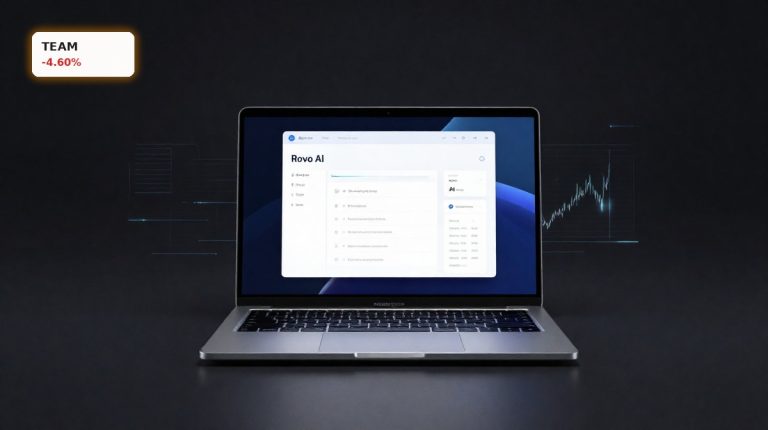
The early fruits of this strategic reallocation are already visible. The company’s newly launched AI assistant, Rovo, has seen rapid adoption among enterprise clients. According to internal performance data, customers utilizing Rovo are growing their recurring revenues at twice the rate of those who have not yet integrated the AI tool. Furthermore, the company is leveraging its proprietary Teamwork Graph technology to deeply embed its software into daily corporate workflows, significantly increasing customer retention rates and raising barriers to entry for competitors like Microsoft and Salesforce.
What Is the Outlook for Atlassian and How Do Analysts React?
Looking ahead to the fourth quarter, management has provided a confident outlook, forecasting revenues to land between $1.65 billion and $1.66 billion. This guidance represents a year-over-year growth rate of approximately 20%, signaling that the momentum observed in the recent Atlassian Earnings is sustainable rather than a one-time spike.
Wall Street analysts have reacted to these developments with cautious optimism. Financial experts at KeyCorp recently updated their outlook, setting a price target of 115 Euros (approximately $125 USD) for the stock. Meanwhile, the broader consensus target among Wall Street analysts remains significantly higher at around $144, indicating that the investment community believes the stock is currently undervalued relative to its long-term software-as-a-service (SaaS) growth potential.
Related Coverage
For investors tracking the broader enterprise software space, comparing different market segments is essential. If you want to understand how previous financial reports impacted the stock, read about the Atlassian Earnings -4.6%: AI Growth Story Faces Market Shock, which details how earlier market volatility created a temporary pullback. For a wider industry perspective, you can also explore how other cloud leaders are performing in our HubSpot Comparison: CRM Stock Surges +6.4% on Strong Q1 Momentum, highlighting how AI expansion is driving valuations across the entire software sector.
The latest Atlassian Earnings demonstrate that the company’s restructuring efforts and intense focus on artificial intelligence are beginning to pay off. For international investors, the combination of a strong revenue beat, rising AI adoption, and disciplined cost management positions the software provider well for a sustained recovery. As enterprise cloud migration continues, the company’s strategic pivot could unlock substantial long-term value for shareholders.