Can a single blockbuster Atlassian Earnings report and an AI revenue milestone really reverse a brutal multi‑year slide in TEAM shares?

How strong were the latest Atlassian Earnings?
The most recent Atlassian Earnings showed a decisive turnaround in sentiment. For its fiscal third quarter, Atlassian Corporation reported earnings per share (EPS) of about $1.75, well ahead of the roughly $1.32 consensus estimate. Revenue climbed to roughly $1.79 billion, topping expectations near $1.69 billion and rising sharply from about $1.36 billion a year earlier. That double‑digit top‑line growth came despite a year of intense skepticism toward software stocks on Wall Street.
The earnings beat was driven primarily by Atlassian’s cloud‑based subscription offerings, which continue to replace older on‑premise and data‑center deployments. Management has been steering customers steadily into the cloud, even at the cost of near‑term disruption. The latest Atlassian Earnings suggest that strategy is now paying off, with improved operating leverage and a healthier mix of recurring revenue.
Investors also cheered disclosures that Atlassian’s AI‑powered service products have surpassed $1 billion in annualized revenue. That milestone indicates that AI is adding new monetization layers on top of flagship tools like Jira and Confluence, rather than cannibalizing them as some bears had feared.
Why did Atlassian Corporation stock rebound so sharply?
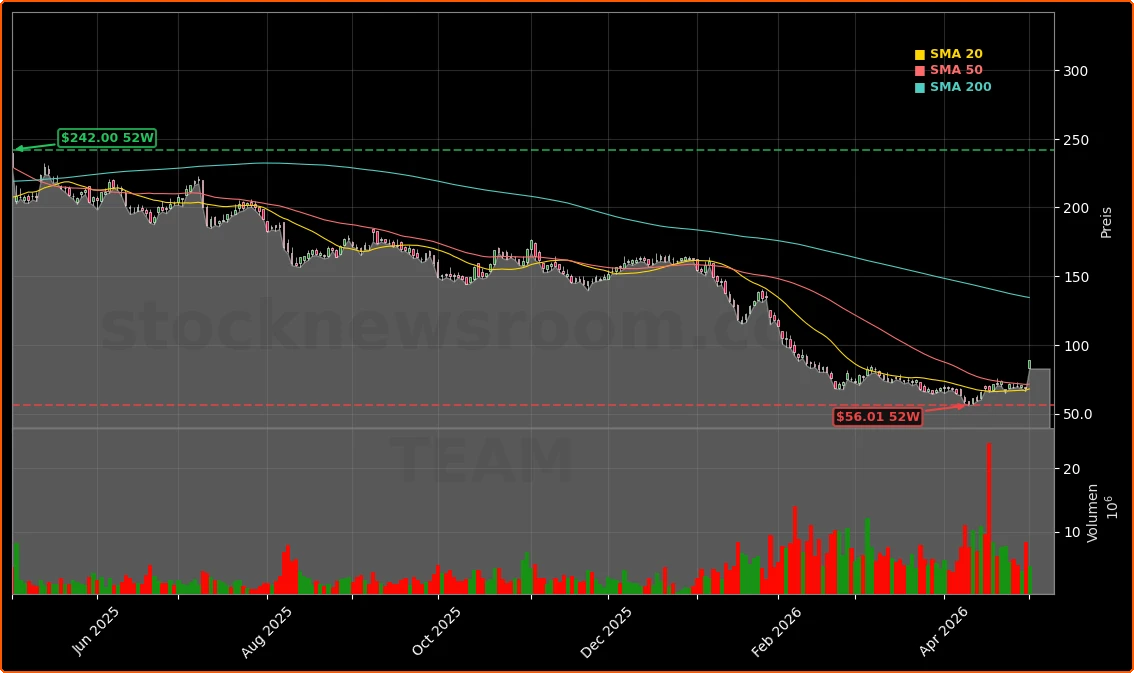
Before this report, TEAM had been one of the NASDAQ’s notable laggards in 2026, down more than 57% year‑to‑date after falling 33% in 2025. Concerns ranged from slowing growth and intense competition to fears that AI‑based code assistants could erode demand for Atlassian’s project and developer tools. Citigroup, for example, cut its price target on the stock in January, citing worries about the cadence and quality of revenue growth and AI‑driven disruption. That downgrade triggered a sharp one‑day drop of more than 7% and helped fuel a broader “SaaSpocalypse” narrative around richly valued cloud names.
The latest Atlassian Earnings and guidance helped flip that script, at least for now. Shares spiked more than 20% in pre‑market trading and continue to trade almost 30% higher intraday, even after some volatility into the U.S. afternoon. While the stock remains far below its 52‑week high, the move represents a meaningful reset for a name that many growth managers had written off as a value trap.
Atlassian is not alone in this rebound. Other SaaS companies such as Twilio and Five9 also rallied strongly after delivering better‑than‑feared earnings updates and highlighting AI as a growth catalyst. For investors used to watching megacap AI beneficiaries like NVIDIA and Apple, the latest action in smaller software names underscores a potential second wave of AI winners emerging beyond the semiconductor and hyperscale cloud complex.
Is AI a threat or a tailwind for Atlassian Corporation?
AI remains the central question for TEAM’s long‑term thesis. Earlier this year, skeptics argued that generative AI and code assistants could replicate or replace much of the functionality in project‑tracking and collaboration suites, pressuring pricing and margins across the sector. The latest Atlassian Earnings push back against that view by showing that enterprise buyers are signing longer and larger contracts specifically tied to AI‑enhanced products.
Management has framed AI as a way to make teams more productive inside Atlassian’s ecosystem, not as a standalone tool that replaces it. Features such as intelligent issue summaries, automated documentation, and AI‑driven service‑desk responses deepen customer reliance on Jira, Confluence and related tools. That mirrors commentary from leaders at other software platforms who see AI as a value‑add on top of existing workflows rather than a complete substitute.
Nonetheless, the company is restructuring to adapt to this new landscape. In March, Atlassian announced it would cut about 1,600 employees, roughly 10% of its workforce, as it reallocates resources toward AI and cloud initiatives. Management expects to incur $225 million to $236 million in restructuring charges. CEO Mike Cannon‑Brookes emphasized that the goal is to reshape the skill mix, not simply replace people with algorithms, but the move highlights how seriously Atlassian is treating the AI pivot.
What do Atlassian Earnings mean for U.S. investors now?
From a portfolio perspective, the latest Atlassian Earnings matter for more than just one mid‑cap software name on the NASDAQ. TEAM has become a bellwether for work‑management and developer‑collaboration tools, a space that competes and integrates with platforms from giants such as Tesla’s internal engineering stacks to enterprise ecosystems dominated by companies like Apple. After a year in which growth‑software exposure has hurt performance relative to broader indices like the S&P 500, the strong print from Atlassian Corporation gives growth‑oriented managers a fresh case study in how cloud‑first, AI‑enhanced SaaS models can still compound at scale.
There are also governance and incentive considerations. Recent SEC filings show substantial restricted stock unit (RSU) awards for senior leaders, including the Chief Revenue Officer and Chief Financial Officer, designed to align management with long‑term shareholder value. At the same time, the company faces ongoing securities‑law investigations from law firms such as Pomerantz and the Portnoy Law Firm related to the earlier share‑price decline and questions about AI‑related risk disclosures. While such probes are not uncommon in the U.S. litigation landscape, they add another layer of uncertainty that risk‑aware investors must factor into position sizing.
Related Coverage: How does this compare with Atlassian’s earlier slump?
Investors looking to put the latest rally in context may want to revisit TEAM’s previous sharp declines. An earlier analysis on StockNewsroom asked whether a mid‑April plunge was merely a routine shakeout or a warning sign for expensive cloud stocks. You can read that perspective in “Atlassian Plunge -8.6%: Is This Tech Rotation Just Starting?”, which dissects how shifting sector rotations and valuation pressures had weighed on the shares. Comparing that earlier caution with today’s more upbeat reaction to the latest Atlassian Earnings offers a useful roadmap for understanding how quickly sentiment can swing in high‑beta software names.
In summary, the latest Atlassian Earnings deliver a clear message: demand for the company’s cloud and AI‑enhanced products remains robust, and fears of immediate AI‑driven obsolescence look overstated. For U.S. investors, TEAM’s rebound underscores that select SaaS franchises can still create value even in a tougher rate and AI environment. The next few quarters of Atlassian Earnings will be critical in proving that this is the start of a sustainable turnaround rather than just a short‑covering rally.