Can the latest Twilio Earnings surprise and guidance hike finally turn this former high-flyer into a durable AI-driven comeback story?

How are Twilio Earnings moving the stock today?
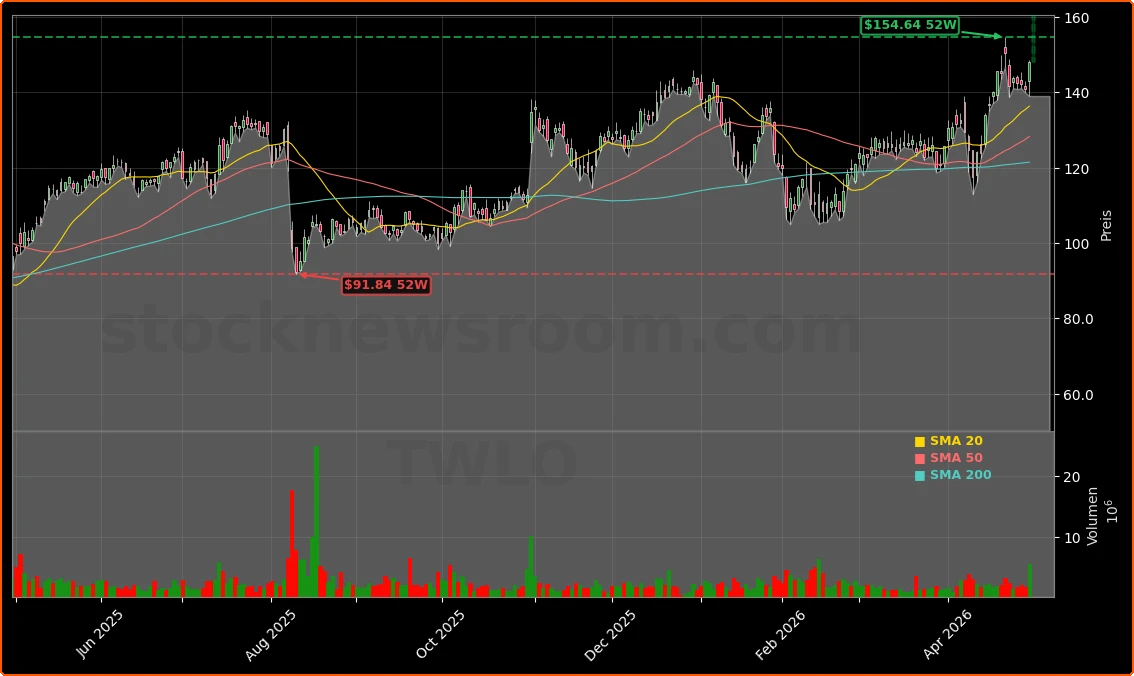
On Friday, shares of Twilio Inc. traded at about $148.06, up 5.07% from the previous close of $174.67, while pre-market indications pointed to a sharp jump toward roughly $180.10, implying a gain of more than 20% ahead of the opening bell on the NYSE (all figures as of early Friday, 7:16 a.m. ET). The spike follows a quarterly report in which Twilio delivered stronger-than-expected results and raised its full-year outlook, reigniting interest in a stock that had been battered since its 2021 pandemic peak. The move also puts Twilio among a growing list of AI-levered software names that have surprised to the upside, similar to recent rebounds seen in Atlassian and Five9.
The latest Twilio Earnings release showed adjusted earnings per share of roughly $1.50, comfortably ahead of Wall Street estimates around $1.27. Revenue reached about $1.406 billion, topping consensus expectations of near $1.342 billion and reflecting roughly 20% year-over-year growth – the fastest pace in about three years. For investors tracking the broader NASDAQ software cohort, a 20% top-line acceleration from a communications-infrastructure player is notable, especially given widespread fears that AI would compress demand for traditional SaaS tools.
What changed in Twilio’s outlook and guidance?
The standout element of this Twilio Earnings update is the push higher in guidance. Management now expects adjusted EPS for the upcoming quarter in a range of roughly $2.50 to $2.60, nearly double prior Street expectations near $1.29. Revenue is projected between $1.42 billion and $1.43 billion versus consensus closer to $1.39 billion. That combination of stronger profitability and slightly higher revenue suggests Twilio’s aggressive cost controls, portfolio focus and AI monetization are gaining traction at scale.
More importantly for long-horizon shareholders and portfolio managers benchmarking against the S&P 500 and NASDAQ-100, Twilio lifted its full-year 2026 revenue outlook to about $5.78 billion–$5.83 billion, up from a prior range of $5.65 billion–$5.70 billion and above average analyst expectations near $5.69 billion. After years of volatile growth and heavy cash burn, the company is now signaling greater confidence in sustained, profitable expansion. Twilio also recently posted its first full year of GAAP profitability with nearly $1 billion in free cash flow, giving management more flexibility to invest in AI and data while still answering activist investors’ calls for discipline.
How is AI reshaping Twilio’s business case?
Under CEO Khozema Shipchandler, who took over in early 2024 after serving as CFO, Twilio has repositioned itself as a core infrastructure layer for digital customer engagement and AI agents. While the company’s roots are in programmable communications—powering app-based calls and texts for platforms like ride-hailing and delivery services—it is now leaning heavily on its Segment customer-data platform to integrate behavioral data with AI models. Shipchandler has described the decision to keep Segment, despite activist pressure to sell the business, as one of the most consequential strategic calls the company has made.
By unifying data and communications, Twilio aims to underpin the next wave of AI-driven customer interactions, from intelligent contact centers to automated marketing journeys. Research firms see a large potential market in AI agents, with projections that Twilio could provide core infrastructure for tens of millions of agents by the end of the decade. Internally, the company is already using generative AI tools such as Gemini and Claude to support coding, customer support and inbound sales, reporting roughly a 15% productivity boost. For investors comparing Twilio to other AI beneficiaries like NVIDIA or platform players such as Apple, the story here is not chips or consumer devices but durable recurring revenue on top of high-value communications data.
What are analysts and insiders signaling on Twilio?
Wall Street’s stance on Twilio Inc. has been steadily improving alongside the stronger Twilio Earnings profile. Jefferies analyst Samad Samana recently upgraded the stock to “Buy” and lifted the price target to $160, helping fuel an upswing that brought shares closer to their multi-year highs before the latest results. TD Cowen has maintained a “Buy” rating with a $160 target as well, even as overall opinions on the broader SaaS space remain mixed. For context, the stock’s strong run has come despite profit-taking episodes linked to scheduled insider sales.
In April, CEO Khozema Shipchandler sold about 15,715 shares of Class A common stock under a pre-arranged Rule 10b5-1 trading plan at prices in the low-to-mid-$130s, while still retaining a substantial stake of well over 200,000 shares. CFO Aidan Viggiano has also executed planned sales, including both discretionary transactions and “sell-to-cover” moves tied to RSU tax obligations, and continues to hold a meaningful position in the company. These insider activities have prompted short-term volatility but, so far, have not derailed the broader positive narrative driven by AI adoption, stronger free cash flow and the upgraded outlook.
We see ourselves positioned as the infrastructure that drives a lot of the AI activity you’re seeing, not as a casualty of the so-called SaaSpocalypse.— Khozema Shipchandler, CEO of Twilio Inc.
For U.S. investors comparing opportunities across high-growth tech—including names like Tesla and software peers benefiting from AI tailwinds—the main takeaway is that the latest Twilio Earnings report strengthens the case for Twilio as a potential long-term winner in the communications and customer-data infrastructure space. The next few quarters will need to confirm that elevated guidance and AI-fueled demand are sustainable, but for now, the company has reset expectations higher and reinserted itself into the conversation among top-tier growth stories on Wall Street.