Is the bold Micron Forecast for a $1,000 share price a realistic AI supercycle bet or late‑cycle euphoria?

Is the Micron Forecast for $1,000 remotely realistic?
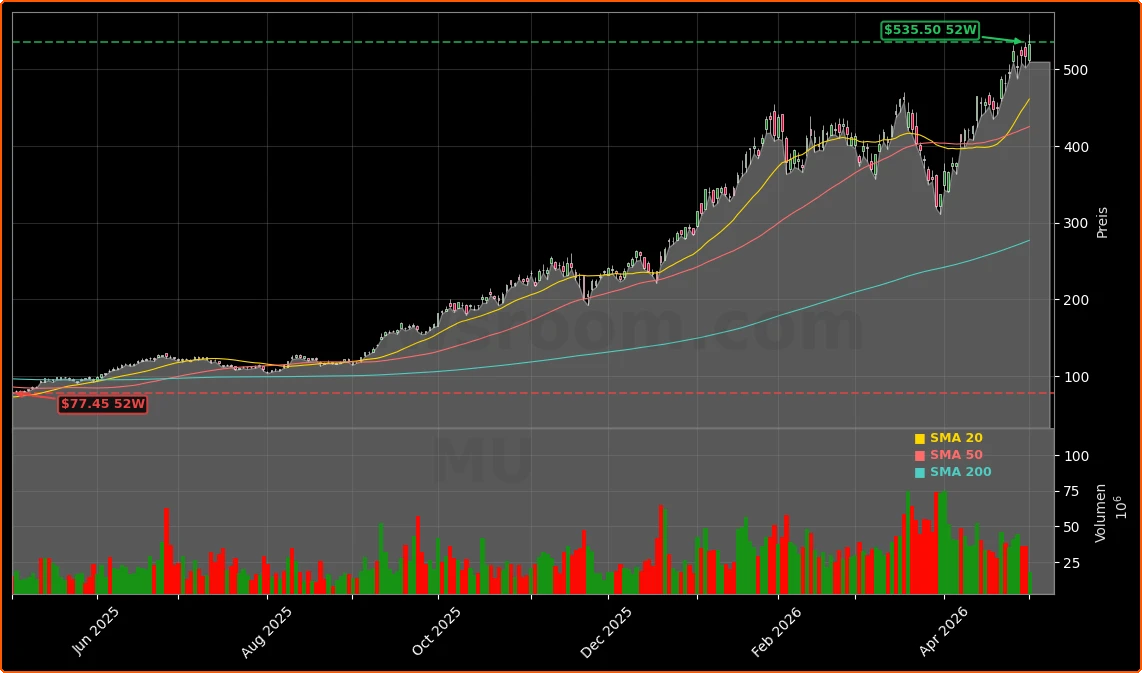
Micron (MU) has staged one of the most dramatic runs on the NASDAQ, up more than 500% over the past year and roughly 64% year to date. The stock gained another 3.03% today to about $532.65, even as broader semiconductor peers cooled after a historic rally. Against this backdrop, DA Davidson analyst Gil Luria initiated coverage with a Buy rating and a headline‑grabbing $1,000 12‑month price target, nearly doubling where shares trade now.
Luria’s Micron Forecast is built on a simple thesis: this memory upcycle, driven by hyperscale AI data centers, will last longer and run hotter than prior cycles. He models Micron generating about $139 in earnings per share by fiscal 2030, implying roughly $1,390 in earnings discounted back to today’s value and a 10x price‑to‑earnings multiple. While that math is long‑dated, near‑term fundamentals are already extraordinary. In Q2 FY2026, Micron posted about $23.9 billion in revenue, up 196% year over year, and non‑GAAP EPS of $12.20 with margins surging.
Wall Street’s base case is more restrained. Consensus 12‑month targets cluster near the mid‑$500s, but the direction of revisions is clearly up as Micron repeatedly beats estimates. The debate for U.S. investors is whether the current Micron Forecast embeds enough of the AI memory supercycle—or still underestimates it.
How is Micron reshaping the AI memory landscape?
Micron has become a core supplier to the AI build‑out by leading in high bandwidth memory (HBM) attached to advanced accelerators from players like NVIDIA. Without sufficient HBM capacity, even the most powerful GPUs cannot be fully utilized, making Micron a bottleneck‑breaker for AI data centers. Management is ramping HBM4 12‑high stacks, with HBM4E slated to follow in 2027, positioning the company in the premium segment where pricing and margins are strongest.
On the demand side, hyperscalers are pouring well over $200 billion into AI data center infrastructure, according to industry estimates, and memory is a non‑discretionary piece of that budget. DRAM and NAND prices have been rising sharply—Micron recently cited mid‑60% increases in DRAM and high‑70% gains in NAND pricing over the latest quarter. CEO Sanjay Mehrotra argues that supply will remain tight beyond calendar 2026, and the company is signing five‑year strategic customer agreements for HBM, locking in visibility that memory producers rarely enjoy.
This structural shift is why firms like Morgan Stanley, via analyst Joseph Moore, now prefer Micron over traditional CPU vendors such as Intel. Moore rates Micron Overweight, emphasizing that AI has changed the memory market’s dynamics, while he keeps Intel at Equal‑weight on execution and valuation concerns. Other institutions are voting with capital: the Goldman Sachs Value Opportunities ETF added Micron in Q1 at about $340 per share and is already sitting on gains exceeding 50%.
What does the Micron Forecast mean for valuation and risk?
Even after its explosive run, Micron trades at a forward P/E near 9, significantly below the S&P 500’s forward multiple around 22. If management hits its Q3 FY2026 guidance—revenue of $33.5 billion, gross margin of 81%, and EPS near $19.15—annualized earnings power could approach $75 per share. At $1,000, Micron would trade at roughly 13x that run‑rate, which is not excessive by large‑cap tech standards, especially versus premium AI names such as NVIDIA or mega‑caps like Apple.
Still, the Micron Forecast is not without risk. Memory remains cyclical, insiders sold over 120,000 shares between February and April, and fiscal 2026 capex will top $25 billion as the company races to add capacity. Competitors in NAND and DRAM, including Western Digital and Sandisk, have also reported blowout AI‑driven quarters, yet their stocks sold off as traders locked in profits. That underscores how fragile sentiment can be once expectations are sky‑high.
Regulatory and political scrutiny are also creeping in. Senator John Fetterman’s well‑timed personal purchase of Micron shares ahead of a major rally has drawn attention, given his role on a committee overseeing CHIPS Act subsidies that benefit Micron. While this does not change the business fundamentals, it adds headline risk at a time when Washington is increasingly focused on semiconductor policy.
Related Coverage
For a deeper dive into how short‑term volatility fits into the broader Micron Forecast narrative, readers can review our recent analysis, “Micron Forecast: -5.2% Plunge as AI Supercycle Bets Grow”. That piece examines April’s sharp pullback and why many investors saw it as a buying opportunity within the ongoing AI memory supercycle.
AI has not just increased demand for memory; it has fundamentally recast memory as a defining strategic asset in the AI era.— Sanjay Mehrotra, CEO of Micron Technology
In the end, the Micron Forecast stretching toward $1,000 reflects how profoundly AI has elevated memory from commodity status to strategic asset. For U.S. investors building exposure to the AI stack beyond headline names like Tesla and Apple, Micron now offers leveraged earnings growth at a still‑discounted multiple. The next few quarters of HBM ramp‑up and hyperscaler orders will show whether today’s lofty scenarios become baseline reality—and whether Micron can cement its place among the market’s next trillion‑dollar contenders.