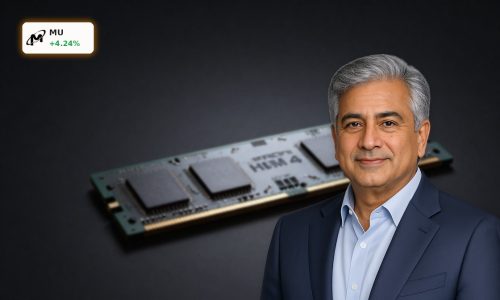
Is Micron’s AI-fueled memory supercycle strong enough to justify four-digit price targets after today’s sharp pullback?

Is Micron Technology entering an AI supercycle?
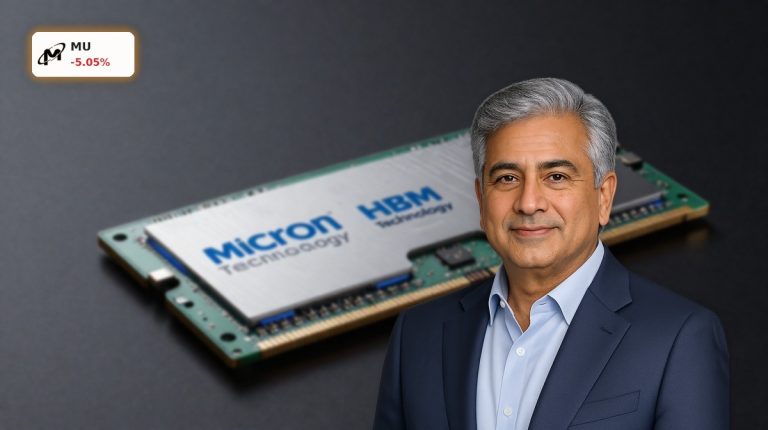
Micron has quickly shifted from a cyclical memory name to a front-line AI beneficiary in many portfolio models. The company is emerging as a key supplier of high-bandwidth memory (HBM), a critical component for advanced AI workloads running on accelerators from players like NVIDIA. Management sees the total addressable market for HBM expanding from roughly $35 billion in 2025 to about $100 billion in 2028, underscoring how central memory capacity and bandwidth have become to the AI build‑out.
Crucially for earnings visibility, Micron has already locked in pricing and volume agreements for its entire 2026 HBM output and reports strong demand visibility into 2027. That kind of contracted backlog is unusual in what used to be a highly cyclical DRAM and NAND industry. It supports the more optimistic Micron Forecast that argues AI could extend the current memory upcycle well beyond a typical 2‑3 year phase.
At the same time, overall memory demand is running ahead of supply, strengthening Micron’s pricing power and margins. The company is pouring capital into large-scale U.S. manufacturing expansions in an attempt to capture more of the AI infrastructure opportunity and reduce reliance on overseas fabs.
Why did Micron drop after hitting record highs?
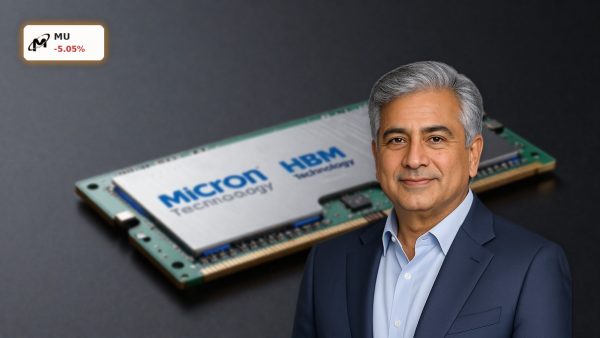
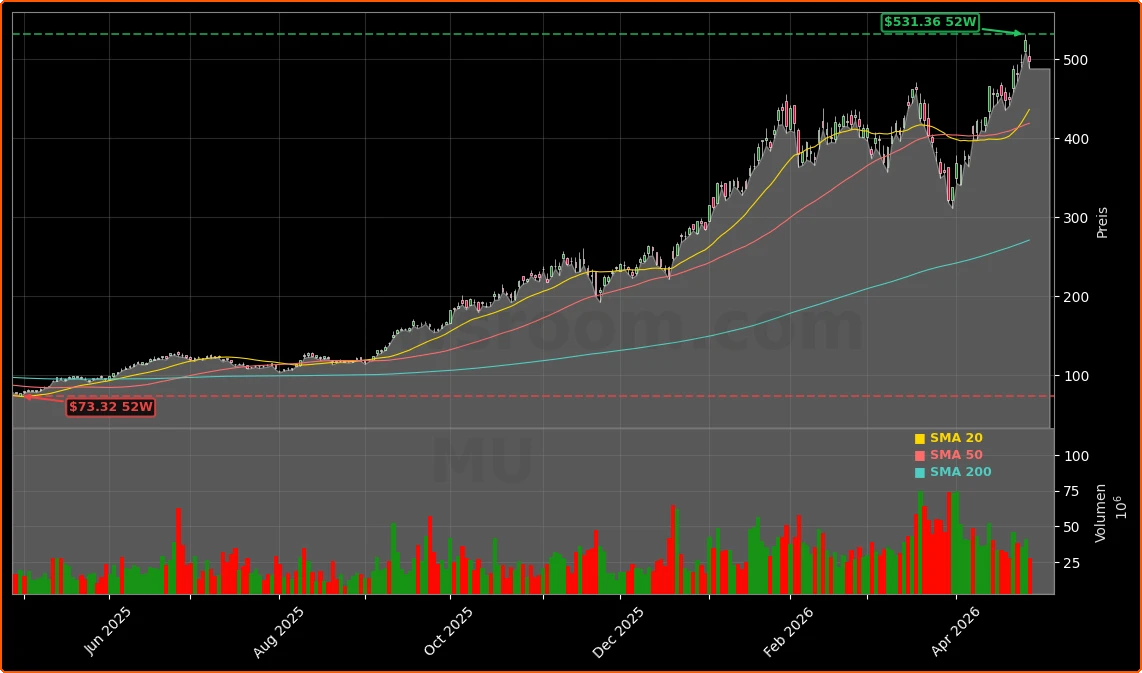
Despite that bullish backdrop, MU is under pressure today, sliding more than 5% to about $497 after a recent run to all‑time highs. The pullback comes as futures for major U.S. indexes like the S&P 500 and Nasdaq Composite turned mixed following a report that OpenAI missed internal user and revenue targets. The report raised questions about AI adoption momentum, and chip names such as Broadcom, Micron, and NVIDIA traded lower during the session.
Paradoxically, even the negative OpenAI narrative contains a silver lining for Micron. The AI leader is reportedly still spending heavily on accelerators and memory to support its models, even as user metrics face scrutiny. That implies continued near‑term demand for HBM and advanced DRAM, reinforcing the Micron Forecast that calls for memory content per AI server to keep rising.
In the past month alone, U.S. chip peers have posted eye‑catching gains: Broadcom is up roughly 39%, Micron about 47%, AMD 65%, Texas Instruments 41%, and Intel nearly 97%, as investors crowd into AI‑linked semiconductor names. Today’s setback looks more like digestion after a steep run than a fundamental reset of the AI memory thesis.
How aggressive is the new Micron Forecast on Wall Street?
On the sell‑side, the Micron Forecast has turned strikingly optimistic. DA Davidson has initiated coverage of Micron with a “Buy” rating and a street‑high $1,000 price target, explicitly citing powerful AI tailwinds and what it calls a longer‑than‑usual memory cycle. The firm argues that as compute deployment and AI demand reinforce each other in a feedback loop, Micron should benefit from structurally higher memory utilization and pricing.
Melius Research recently reiterated its bullish stance with a $700 target, describing AI‑driven memory demand as “unusual” in both strength and duration. TD Cowen has also weighed in on the positive side, lifting its target to $600 and pointing to expectations that memory prices will stay higher for longer. Together, these calls underscore how dramatically the Micron Forecast has moved from cautious to exuberant in just a few quarters.
Even after the stock’s surge, Micron still trades on valuation multiples that look discounted relative to pure GPU names. Historically, MU has often commanded only 8x to 12x forward peak earnings estimates, versus 30x to 40x+ for NVIDIA and 20x to 30x for AMD. Bulls contend that this discount no longer reflects reality now that memory is becoming a structural bottleneck in AI systems, rather than a commodity input.
What does this mean for AI competitors like NVIDIA and Tesla?
The first phase of the AI trade was dominated by accelerators, turning NVIDIA into one of the most influential stocks in the Nasdaq 100. Now, as systems evolve toward more complex, agentic AI workflows, memory capacity and bandwidth are increasingly central to performance. That shift does not displace GPU leaders but broadens the list of winners to include suppliers of HBM and advanced DRAM such as Micron.
Downstream beneficiaries could also include systems and platform players like Apple and Tesla, which rely on high‑performance compute and memory to power on‑device AI, autonomous driving stacks, and cloud services. For diversified U.S. investors, that means the Micron Forecast is less about a single stock and more about how AI infrastructure spend may be spreading across the broader semiconductor and platform ecosystem.
If AI adoption continues to migrate from simple chatbots to persistent, multi‑step, agentic tools inside enterprises, the memory intensity of each workload is likely to increase. That scenario would support the thesis that Micron is transitioning from a cyclical commodity producer into a core AI infrastructure provider, with correspondingly higher and more stable margins than in prior cycles.
Related Coverage
Memory is no longer just a cyclical commodity story; in the AI era it is turning into a structural bottleneck and a core part of the compute stack.— Senior semiconductor portfolio manager at a New York hedge fund
Investors looking for a deeper dive into valuation, risk scenarios, and longer‑term cycle dynamics can explore our dedicated analysis in Micron Forecast +35% Surge: Can AI Memory Boom Last?. That piece examines whether the current rally marks the start of a decade‑long AI memory supercycle or the top of a classic chip boom and discusses positioning strategies around MU in diversified tech portfolios.