Can Atlassian’s booming AI-driven earnings offset a sharp share-price pullback and restore long-term investor confidence?

How did Atlassian Earnings reshape sentiment?
Atlassian Corporation delivered fiscal Q3 2026 results that effectively reset expectations for its AI readiness. The company generated about $1.8 billion in revenue for the quarter, up roughly 32% year over year, easily beating Wall Street estimates around $1.7 billion. That growth rate also accelerated from about 23% in the prior quarter, a notable shift for a name that had been written off by some investors as an AI casualty rather than a beneficiary.
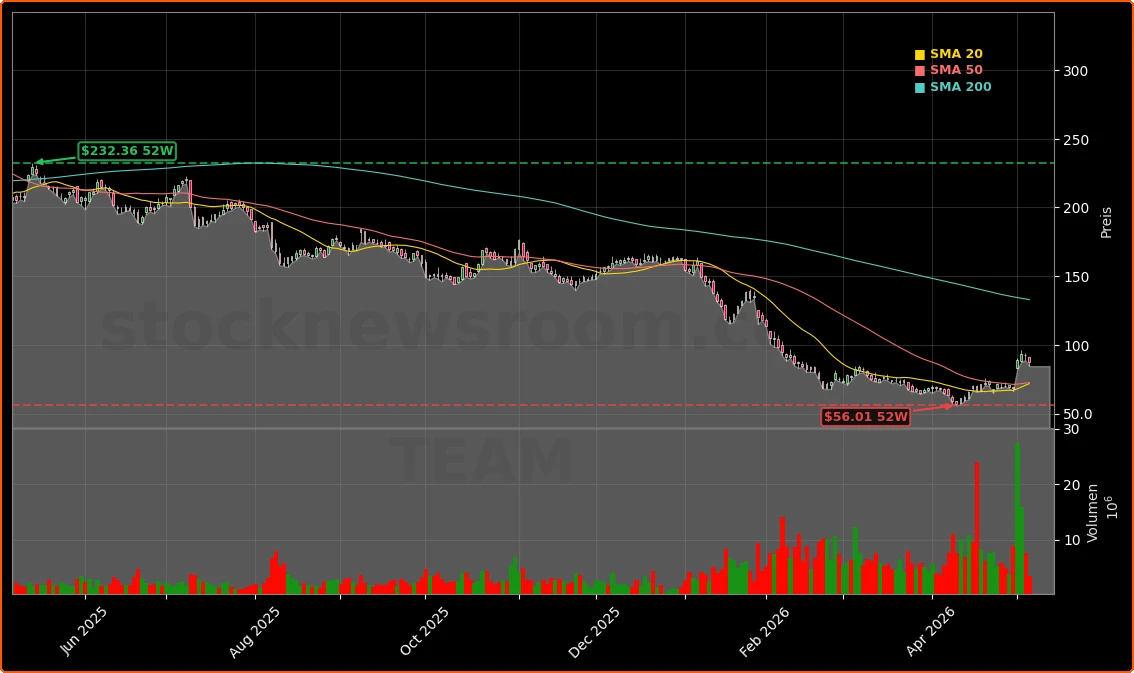
The latest Atlassian Earnings are especially significant because TEAM shares had previously fallen as much as 87% from their all‑time high. Concerns centered on whether AI coding assistants would let enterprises build in‑house alternatives to Jira and Confluence, and whether shrinking headcounts would erode per‑seat subscription revenue. The Q3 numbers, coupled with strong adoption of the Rovo AI platform, have gone a long way toward challenging that bearish narrative.
Despite the fundamental improvement, the stock has been volatile. Atlassian closed near $89 on Friday, May 1, after a roughly 50% rally from an April low around $58, before slipping back to $88.10 in Wednesday’s trading. That pullback underlines how sensitive high‑growth software names remain to shifting risk appetite on the NASDAQ and among growth‑oriented US investors.
Is Rovo Atlassian’s key AI growth engine?
Central to the bullish thesis emerging from recent Atlassian Earnings is Rovo, the company’s AI platform that extends across Jira, Confluence and other products. Rovo can draft and summarize content inside Jira tickets and Confluence pages, act as a coding assistant for developers, and perform enterprise‑wide search that surfaces information even when it sits outside Atlassian tools. For global IT and product teams, that promise of unified, AI‑driven knowledge retrieval is becoming a major differentiator versus more generic AI assistants.
More than 350,000 organizations now use Atlassian, including about 85% of the Fortune 500. That broad installed base gives the company unique telemetry on how complex organizations actually work, which in turn feeds into Rovo’s relevance and quality of recommendations. Early usage data is encouraging: customers actively using the AI platform during the third quarter grew their annual recurring revenue at roughly twice the pace of customers that had not yet adopted Rovo.
That kind of uplift matters in a market where investors are rewarding clear AI monetization, as seen at names like NVIDIA and major cloud providers. For portfolio managers comparing software allocations across the NASDAQ, Rovo’s traction helps position Atlassian alongside other AI‑leveraged application vendors such as ServiceNow and Adobe, instead of lumping it with legacy collaboration tools at risk of commoditization.
How does Atlassian stack up against US software peers?
Application‑based software companies including SAP, Workday, ServiceNow, Atlassian and Adobe have all faced sharp stock price pressure over the past year as investors rotated into infrastructure AI winners and mega‑caps like Apple. In that context, the rebound following the latest Atlassian Earnings stands out. While several peers have leaned heavily on cost controls and workforce reductions to defend margins — Freshworks, for example, recently cut 11% of its staff, noting similar moves at Atlassian and others — Atlassian’s appeal is its combination of cost discipline with visible top‑line acceleration.
The company’s cloud partnerships also matter for US investors. Hosting Jira, Confluence and Rovo on Amazon Web Services and Google Cloud lets customers tap modern infrastructure without building their own data centers. On top of that, the Atlassian Guard security layer adds encryption and a zero‑trust architecture that is increasingly critical for regulated industries. This integrated stack makes it harder for enterprises to justify building in‑house tools solely with AI, even as generative models become more widely available.
On valuation, TEAM still trades at a modest price‑to‑sales multiple of about 3.7, close to its cheapest levels since the 2015 IPO, even after the recent rally. That combination of re‑accelerating growth and subdued multiples is drawing fresh attention from growth and GARP‑oriented managers on Wall Street who are looking for diversified AI exposure beyond the highest‑profile names like Tesla and NVIDIA.
What do Atlassian Earnings mean for the outlook?
The response to the latest Atlassian Earnings underscores a growing belief that AI will be a tailwind rather than a threat to the company’s business model. By bundling 24/7 technical support into subscriptions and reducing the need for customers to hire large in‑house engineering teams to maintain bespoke tools, Atlassian can make a strong total‑cost‑of‑ownership case, particularly for mid‑market and large enterprises in North America.
There is also a risk‑management angle: highly regulated institutions, such as banks, may technically be able to build Jira‑like systems with AI, but then they fully shoulder the liability and reputational risk of any breach or outage. Using a mature, third‑party platform like Atlassian, backed by hyperscale cloud security and Atlassian Guard, can shift part of that risk off their own balance sheets.
Analyst coverage has reflected this improving narrative. While detailed, bank‑by‑bank revisions have not all been published yet, a group of around 39 Wall Street analysts currently tracks Atlassian, with the average 12‑month price target sitting near $125. That implies roughly 40% upside from current levels and places TEAM firmly on the radar of US growth investors, even if not yet in the same league of market‑moving power as Apple or Tesla. Firms such as Goldman Sachs, Morgan Stanley and Citigroup are closely watching whether Rovo’s early ARR uplift can scale across the broader customer base over coming quarters.
Related Coverage
Investors who want a deeper dive into how AI is reshaping the company’s financials can read Atlassian Earnings +29.4% Surge After Record AI Beat, which analyzes the blockbuster quarter that helped ignite TEAM’s recent rebound. That piece also explores whether a single standout report and AI revenue milestone are enough to reverse a long‑running downtrend in the stock, and how the latest trends may translate into medium‑term performance on the NASDAQ.
In summary, the latest Atlassian Earnings highlight a company that is using AI as a growth catalyst rather than a defensive tool, with Rovo already driving faster ARR expansion among adopters. For US and international investors, TEAM now offers a blend of accelerating fundamentals, reasonable valuation and differentiated AI exposure within the software stack. The next few quarters will be crucial in proving that this momentum is durable, but for now Atlassian has convincingly re‑entered the conversation as a serious long‑term compounder on Wall Street.