
Is Bitcoin’s latest drop a breakdown warning, or is the $60,000 zone becoming Wall Street’s new line in the sand?

Is $60,000 Bitcoin’s Institutional Floor?
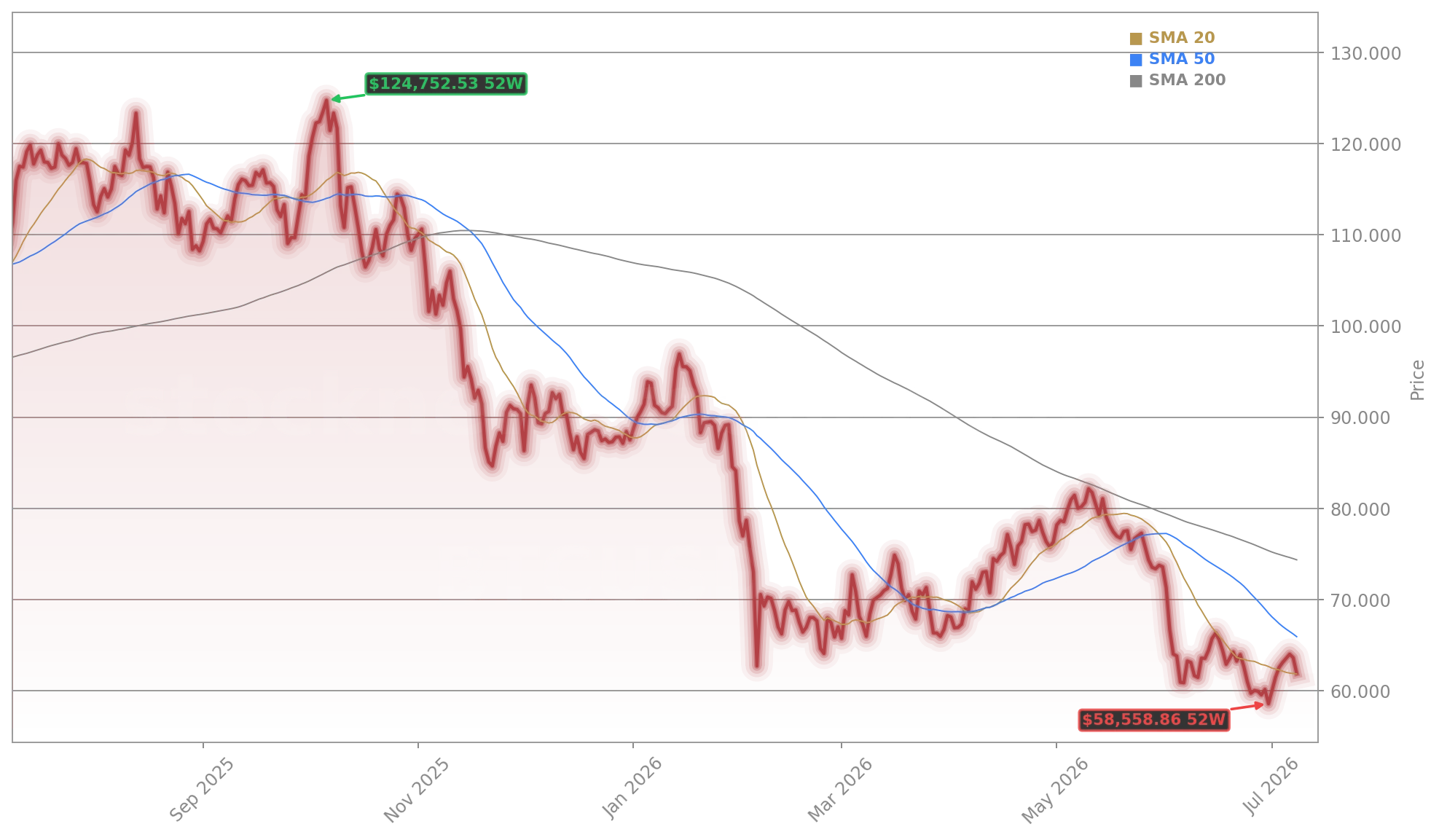
Bitcoin (BTC/USD) has rebounded from a low of $58,240 — its weakest level since October 2024 — to stabilize near $62,000, just above its 200-week moving average at $62,000 and within range of the estimated $60,000 marginal production cost for efficient miners. That floor matters: it’s not just technical — it’s fundamentally backed by on-chain economics. While macro pressures persist — including elevated real yields and a stronger U.S. dollar following hotter-than-expected PCE and GDP data — the $60,000 level has now held three times in Q3 2026. Citigroup analysts note that ETF inflows turned positive again last week, with $842 million flowing into spot Bitcoin ETFs after $4.3 billion in outflows earlier in June — a reversal that signals renewed institutional conviction.
What Do ETF Flows Say About Wall Street’s Bitcoin Market Analysis?
Spot Bitcoin ETFs — led by iShares Bitcoin Trust (IBIT) — drove the recent bounce from $58,000 to $64,000. IBIT alone accounted for over 65% of net inflows last week, pushing its AUM past $62 billion. That’s a sharp pivot from June’s outflow cycle, which coincided with margin call stress among leveraged holders and broad-based risk-off behavior across NASDAQ tech stocks. Morgan Stanley’s latest digital asset strategy note highlights that IBIT’s inflows correlate strongly with declining 10-year breakeven inflation expectations — reinforcing Bitcoin’s role as a debasement hedge when real yields peak. This Bitcoin Market Analysis suggests the ETF channel is now functioning as a real-time sentiment barometer — more responsive than futures or miner activity.
How Is the SEC Shifting Institutional Risk Calculus?
SEC Chair Paul Atkins confirmed in a July 5 speech that the agency will issue new guidance this quarter to clarify custody, disclosure, and listing standards for blockchain-native firms — a move widely interpreted as paving the way for accelerated institutional adoption. While President Trump’s proposal for a U.S. Bitcoin strategic reserve remains politically fraught, the SEC’s framework could unlock capital from pension funds and endowments currently sidelined by compliance uncertainty. RBC Capital Markets upgraded its outlook for Bitcoin-related equities, citing ‘improved regulatory scaffolding’ — particularly for firms like MicroStrategy, whose Bitcoin strategy has come under renewed scrutiny. Notably, MicroStrategy’s stock fell 4.8% on July 7 after analysts questioned whether its $32 billion Bitcoin holdings remain a strategic asset or a liquidity buffer.
Why Is Q3 2026 Historically Weak — and What Comes Next?
July through September typically sees lower crypto trading volumes — a seasonal pattern amplified this year by global vacation schedules and thin liquidity in U.S. Treasury markets. Bloomberg data shows spot Bitcoin options open interest dropped 22% from Q2’s peak, while average daily volume on major U.S. exchanges fell 17% month-over-month. Still, the resilience near $60,000 suggests exhaustion among sellers. Analysts at Goldman Sachs project Bitcoin will test $68,000 by late August if the Fed signals dovish pivot language in its July 29 FOMC statement. That would align with historical patterns where Bitcoin rallies 12–18% in the 30 days following the first meaningful dip in 2-year Treasury yields.
Bitcoin Market Analysis: What Does This Mean for S&P 500 Tech Exposure?
The $60,000 level is no longer just support — it’s a litmus test for whether institutional capital treats Bitcoin as infrastructure, not speculation.— Sarah Chen, Head of Digital Asset Strategy, Citigroup
Bitcoin’s stabilization has direct spillover effects for U.S. tech investors. NVIDIA’s data center revenue growth remains tightly correlated with institutional crypto infrastructure demand — particularly in AI-optimized mining rigs and custody stacks. Meanwhile, Tesla’s $1.8 billion Bitcoin reserve — unchanged since Q1 — is now trading well above its average cost basis of $32,000, offering potential balance sheet flexibility. And for Apple, any acceleration in embedded wallet functionality or CBDC integration could re-rate its services segment. Bitcoin Market Analysis isn’t just about crypto — it’s a leading indicator for capital allocation shifts across the NASDAQ and S&P 500 tech cohort.