
Are Caterpillar Earnings quietly becoming one of the biggest AI infrastructure winners on Wall Street?

How far did Caterpillar Earnings beat expectations?
Caterpillar Inc. started 2026 with a decisive beat on both the top and bottom line. Adjusted earnings came in at $5.54 per share, almost 20% above the roughly $4.60 Wall Street consensus and up about 30% from $4.25 a year earlier. Reported profit was $2.55 billion, or $5.47 per share. Sales and revenues climbed 22% year over year to $17.4 billion, smashing estimates of about $16.5 billion and marking the fastest growth pace since the post‑pandemic rebound in 2021.
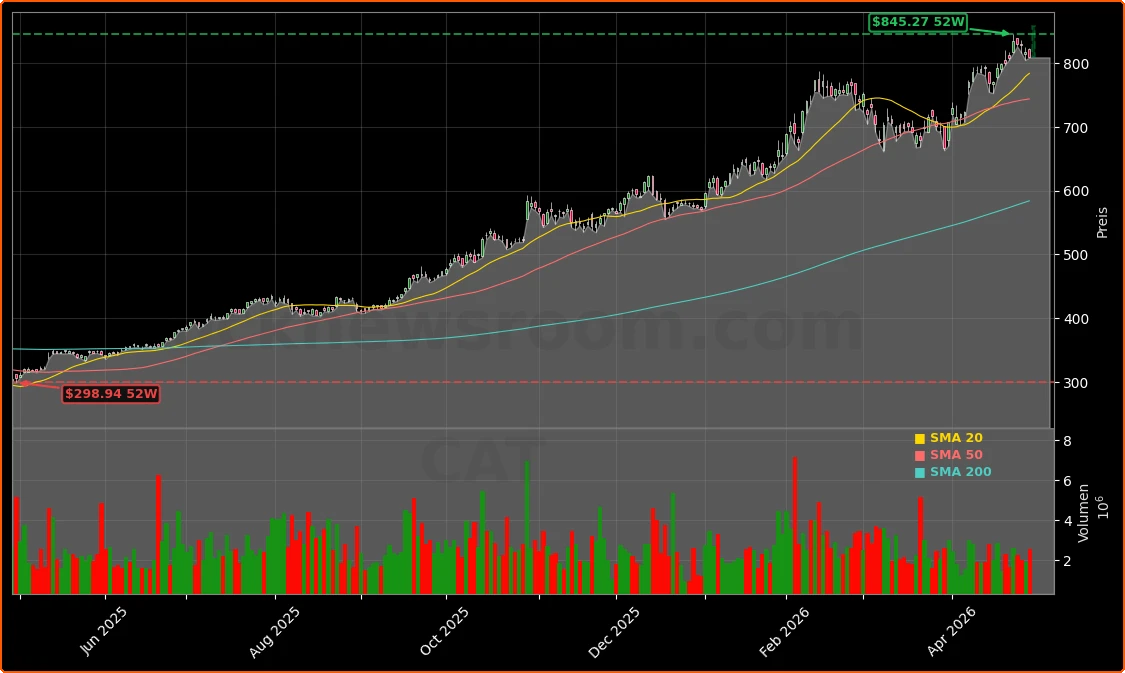
The scale of the upside matters given how strong the stock already was into the print. Caterpillar shares had rallied more than 40% year to date before the numbers, yet the company still cleared what many investors considered a high bar. Management highlighted “robust order activity” and a record backlog as proof that demand is broad‑based, not just a one‑off spike tied to a handful of mega‑projects.
On the cash side, Caterpillar deployed $5.7 billion in the quarter to shareholder returns, including about $5.0 billion in buybacks and $0.7 billion in dividends. The quarterly dividend stands at $1.51 per share, reinforcing the stock’s appeal to income‑oriented portfolios alongside growth‑oriented AI exposure.
Why are AI data centers transforming Caterpillar Earnings?
The most important narrative shift in Caterpillar Earnings is the company’s role in the AI infrastructure boom. Power & Energy segment sales rose 22% year over year to roughly $7.0 billion, driven by large power‑generation sets and turbines supplying data centers that host advanced AI workloads. These projects require massive, highly reliable backup and sometimes primary power, an area Caterpillar is well positioned to serve with its engine and generator portfolio.
Management has previously indicated that this power business can accelerate annual sales growth to the 5%–7% range through 2030, versus roughly 4% historically. That outlook effectively aligns Caterpillar with the same AI‑infrastructure theme that has propelled names like NVIDIA and major hyperscale cloud providers, but from the physical‑asset side of the stack. Unlike pure‑play chipmakers, Caterpillar’s exposure runs through long‑cycle equipment orders and service contracts, potentially smoothing volatility in AI hardware spending cycles.
Caterpillar’s financing arm, Cat Financial, is also participating in the uptrend. It reported first‑quarter revenues of $947 million, up 10%, and profit of $144 million, up 11% from a year ago. Retail new business volume climbed 8% to $3.19 billion, with growth in Mining, North America, Asia Pacific and Power, supporting the broader equipment order momentum.
Where is demand still coming from beyond AI?
The Q1 report makes clear that this is not just a data‑center story. Construction Industries delivered the strongest growth, with sales jumping 38% to about $7.16 billion. That reflects resilient commercial and infrastructure activity in North America and other key regions, as governments and private developers continue to invest in roads, housing, logistics hubs and energy‑adjacent projects.
Resource Industries, which includes mining equipment, posted more modest growth of around 4% to roughly $3.7 billion. While less spectacular than the power and construction segments, the uptick signals that miners are still investing in productivity and replacement cycles even without a runaway commodity super‑cycle. Combined, the three operating segments show a broad industrial recovery rather than a narrow AI‑only spike.
Backlog ended the quarter at a record roughly $63 billion, up 79% year over year and significantly higher than the approximately $51 billion reported just three months earlier. That massive pipeline gives Caterpillar unusually good visibility into future revenue for a cyclical industrial, a key factor in the market’s willingness to assign a richer valuation multiple despite some concerns about overvaluation raised by certain valuation screens.
How did Wall Street react to Caterpillar Earnings?
Wall Street’s immediate reaction was emphatically positive. Caterpillar stock was recently indicated around $858 in pre‑market trading, up about 6% from Wednesday’s close near $810, putting shares at fresh record territory and pushing the company’s market cap deeper into megacap territory. The move helped lift Dow Jones Industrial Average futures and outpaced the broader S&P 500.
Analysts have broadly characterized the quarter as a classic “beat and raise.” Management now expects low double‑digit revenue growth for 2026, slightly above prior guidance that had called for sales growth toward the top end of its target range. That new outlook translates into sales of roughly $76 billion and operating profit between $13 billion and $14 billion, compared with current consensus expectations around $74 billion in sales and $13.4 billion in operating profit.
On the valuation front, research platforms that score stocks on fundamentals note that Caterpillar screens as expensive relative to historical averages, even after factoring in the earnings jump. Some institutional holders trimmed positions in recent quarters, while others added aggressively, reflecting a market debate over how sustainable the AI‑driven power story is. For context, the stock’s performance now rivals some high‑profile industrial and tech winners, with investors increasingly grouping it alongside names like Apple and Tesla as core holdings that bridge old‑economy assets and new‑economy themes.
What should investors watch in the next quarters?
Heading into the rest of 2026, the key question for Caterpillar Earnings is whether AI power demand and construction strength can offset any eventual slowdown in more traditional industrial end‑markets. Investors will watch for signs of margin pressure from tariffs and higher manufacturing costs, which slightly weighed on operating margins this quarter despite the big sales gain.
Free cash flow guidance is another support: Caterpillar now expects free cash flow for 2026 to be higher than in 2025, after previously signaling it could be slightly lower. That matters for continued buybacks and dividend growth, which are central to the company’s long‑term shareholder‑return framework and important for portfolio managers benchmarking against the S&P 500’s total‑return profile.
For comparison, other AI‑linked infrastructure plays—from chipmakers like NVIDIA to cloud and power‑grid names—have seen sharp multiple expansion on the back of similar demand narratives. Caterpillar’s advantage is that it sits at the intersection of infrastructure stimulus, energy transition spending and AI data‑center build‑outs, giving it multiple growth levers even if one theme cools.
Related Coverage
Investors looking for a deeper dive into the strategic side of the company’s power push can revisit our earlier analysis in “Caterpillar Energy Strategy: +2.8% Surge on AI and LNG Power Bet”. That piece explores how the company is positioning its generator and LNG‑linked solutions to capture long‑term AI and energy infrastructure demand, and how that shift could structurally change the earnings profile beyond the current cycle.
A record backlog provides a strong foundation for continued positive momentum.— Joe Creed, CEO of Caterpillar Inc.
In sum, the latest Caterpillar Earnings confirm that the company is evolving from a purely cyclical machinery name into a key beneficiary of the AI‑driven power and infrastructure boom. The record backlog, raised revenue outlook and robust cash returns keep the stock firmly on Wall Street’s radar, even as valuation debates intensify. The next few quarters will show whether execution and end‑market demand can sustain this new, higher earnings base and justify Caterpillar’s freshly minted all‑time highs.