Is the Caterpillar Energy Strategy turning a cyclical machinery name into a structural winner of the AI and LNG power boom?

How is Caterpillar reshaping its energy mix?
At the core of the evolving Caterpillar Energy Strategy is an aggressive capacity build-out to serve oil, gas and power customers. Management is responding to strong demand for gas compression tied to LNG export projects and for distributed power generation by doubling its large-engine capacity and more than doubling turbine capacity by the end of the decade. Those expansions combine investments in Caterpillar’s own plants with deeper collaboration across its supplier network, signaling a multi-year capital commitment rather than a short-lived cycle trade.
Energy and power solutions have now become the largest and fastest-growing part of Caterpillar’s business, surpassing some traditional machinery lines. That shift matters on Wall Street because energy-linked orders tend to be tied to long-duration projects and long-term service contracts, which can smooth earnings versus purely construction-driven swings. For investors comparing Caterpillar to industrial peers like Deere, the increasing weight of power and energy in the portfolio is one of the clearest differentiators in the S&P 500 industrials space.
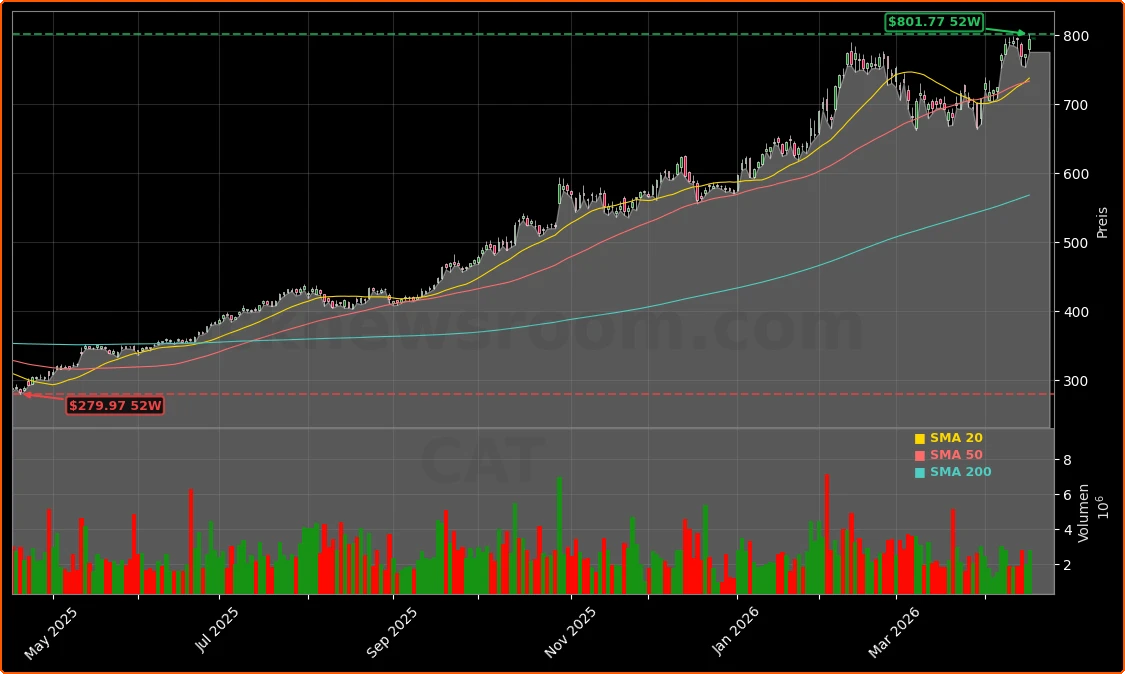
The stock recently traded at $794.65, up 2.85% on the day and just shy of its all-time high around $798.56, underscoring how strongly the market is discounting this structural turn. Several large institutions have taken profits into strength, but others continue to add exposure ahead of the next earnings catalyst on April 30.
What role do data centers and AI play for Caterpillar?
Another pillar of the Caterpillar Energy Strategy is the fast-growing data-center business, tightly linked to the AI buildout led by companies like NVIDIA and hyperscale cloud providers. Customers are asking Caterpillar for tailored power architectures ranging from backup and bridge power to full-scale on-site power plants sized in the hundreds of megawatts. The company has already booked multiple gigawatt-scale orders, a sign that its engines and turbines are becoming embedded in next-generation digital infrastructure.
Importantly for investors worried about a slowdown, Caterpillar sees AI-related demand as relatively recession-resistant. As long as cloud, social and enterprise AI workloads keep scaling, the underlying physical infrastructure will need highly reliable baseload and backup power. That creates a structural growth runway that looks different from traditional earthmoving demand, tying Caterpillar’s prospects more directly to the capex plans of major tech names such as Apple and large cloud operators.
The AI and data-center angle also helps explain why Wall Street has rewarded Caterpillar with fresh record highs over the past year. Citi recently set a bullish price target of $905 on the shares, while Jefferies lifted its own target to $900, both explicitly citing strong earnings momentum and long-duration infrastructure exposure. With the stock already trading above the average analyst target near $751, the debate now centers on how durable those AI and energy-power tailwinds will be into the next cycle.
How big are tariffs and geopolitical risks?
Despite the upbeat narrative around the Caterpillar Energy Strategy, the company is not immune to macro and policy headwinds. Tariffs alone added roughly $800 million in costs in the first quarter, a reminder that global manufacturing footprints can quickly become a liability when trade tensions flare. Thus far, Caterpillar has managed those headwinds through pricing, productivity and mix, but persistent or rising duties could pressure margins, especially in more competitive segments.
Geopolitics also looms in the background. The company reports no major supply-chain disruptions yet from tensions around the Strait of Hormuz, a key chokepoint for oil and gas flows, but management is monitoring the situation closely. Any material interruption of energy shipping lanes could unsettle both Caterpillar’s upstream oil and gas customers and its own logistics, adding another layer of risk to the energy-focused strategy.
For portfolio managers in the U.S., those tariff and geopolitical variables are increasingly important when sizing positions after such a strong run in the stock. Some institutions, including Moran Wealth Management and Asset Management One, trimmed holdings in late 2025 and early 2026, even as others increased stakes, suggesting a healthy rotation between profit-taking and longer-term conviction buyers.
How does Caterpillar compare to other industrial leaders?
Among large-cap industrials on the NYSE, Caterpillar’s pivot into energy, power and AI infrastructure sets it apart from peers more tightly tied to agricultural or commercial aerospace cycles. While rivals like Deere and Mayville Engineering lean heavily on farm and fabrication trends, Caterpillar is building a diversified exposure across construction, mining, LNG, pipeline gas compression and data-center power.
That places the Caterpillar Energy Strategy at the intersection of traditional resource cycles and digital infrastructure investment. The company’s recent acquisition of autonomous tractor startup Monarch further broadens its technology and automation capabilities, echoing moves by innovation leaders such as Tesla on the automotive side. Combined with a long dividend track record and ongoing insider selling that has so far been absorbed by institutional demand, the setup remains attractive but more finely balanced at current valuations.
Options market “whale” activity in industrials, including Caterpillar, shows active hedging and speculative positioning as traders digest record highs, tariff costs and upcoming Q1 results. With analysts at Oppenheimer and others still rating the shares a buy and some targets stretching well above current prices, the key question is whether the energy and AI narrative can keep surprise risk skewed to the upside.
Related Coverage
For more on how leadership changes intersect with the Caterpillar Energy Strategy and AI-driven demand, investors can read this in-depth look at Caterpillar’s CFO transition and its impact on the stock’s rally, which explores whether a veteran insider can keep the momentum going. To broaden the view on transport and industrial risk, this analysis of Lufthansa Cityline’s shutdown examines whether drastic cost moves in another capital-intensive sector signal deeper structural pressure that investors should also keep in mind when evaluating global cyclicals.
In sum, the Caterpillar Energy Strategy is transforming the company from a pure-play machinery name into a leveraged bet on LNG, power generation and AI data-center infrastructure. For U.S. investors, that shift offers both a structural growth story and a new set of tariff and geopolitical risks to monitor. The next few quarters of orders and margins will show whether this energy-centric path can sustain Wall Street’s optimism and justify the rich valuations that come with record highs.