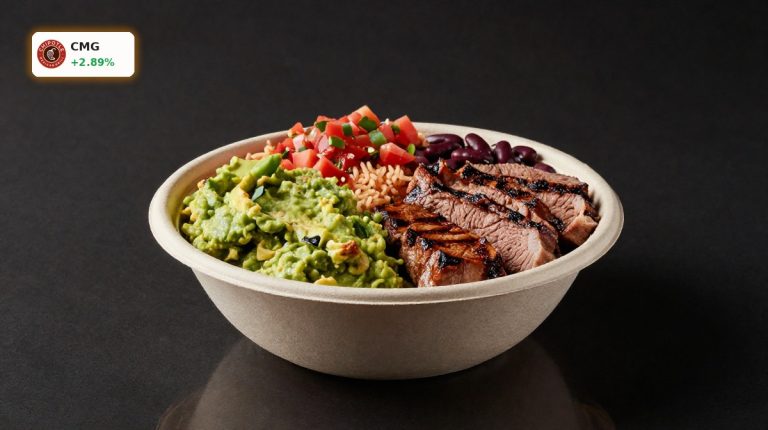
Can Chipotle Earnings keep the stock rallying even as rising costs and thinner margins test the burrito giant’s comeback story?

How did Chipotle Earnings surprise Wall Street?
Chipotle Mexican Grill, Inc. posted first-quarter 2026 revenue of about $3.09 billion, slightly above consensus forecasts near $3.07 billion. Comparable restaurant sales grew 0.5%, defying expectations for a decline of roughly 0.7% and marking a meaningful turnaround from the negative comps that defined 2025. Transaction volume increased 0.6%, while the average check slipped 0.1% as the company leaned more on traffic than price hikes to drive growth.
On the bottom line, Chipotle Earnings came in largely in line with expectations. Adjusted earnings per share landed around $0.24, matching analyst estimates but trailing the prior-year period, when EPS was closer to $0.29. Reported net income declined to about $302.8 million, or $0.23 per diluted share, versus $386.6 million, or $0.28, a year earlier. The stock responded positively, with CMG gaining several percentage points in post-close and next-day trading as investors focused on the return to positive comps.
Digital orders continued to be a major driver, with online and app-based sales representing roughly 39% of food and beverage revenue. That digital mix keeps Chipotle firmly positioned alongside tech-forward restaurant peers and mirrors broader trends at companies like Apple and NVIDIA, where ecosystem engagement and user experience are central to long-term value creation.
What is pressuring Chipotle Mexican Grill margins?
Behind the headline Chipotle Earnings beat, profitability told a more complicated story. The operating margin narrowed to 12.9% from 16.7% a year earlier as inflation and investments in people and brand weighed on results. Food, beverage and packaging costs climbed to 29.6% of revenue, up from 29.2%, primarily on higher beef and freight costs. Labor expense rose to 26.1% of sales from 25.0%, reflecting wage inflation and richer benefits.
General and administrative expense also moved higher, partly due to the company’s biennial All Managers Conference held during the quarter. Management framed these higher costs as necessary investments tied to its “Recipe for Growth” strategy, which includes a high-protein menu push, operational efficiency upgrades, AI-driven initiatives and a revamped loyalty program.
Menu innovation has been central to driving the modest rebound in traffic. Items like Chicken al Pastor, extra protein portions and newly introduced high-protein snack cups have resonated with younger guests, helping reverse the traffic softness that plagued 2025. At the same time, CEO Scott Boatwright emphasized that Chipotle will not chase lower-end fast food chains with deep discounting, arguing that the brand still offers a “very fair” price relative to quality and remains roughly 20% to 30% cheaper than many fast casual peers.
Are Chipotle Earnings enough to shift analyst sentiment?
Wall Street’s reaction to the latest Chipotle Earnings has been mixed, underscoring how pivotal the next few quarters are for CMG. Barclays analyst Jeffrey Bernstein cut his price target on Chipotle Mexican Grill from $40 to $38 while maintaining an Equal Weight rating. He flagged a soft patch in March and questioned how durable the early traffic recovery will be, especially with management guiding to roughly flat comparable sales for full-year 2026.
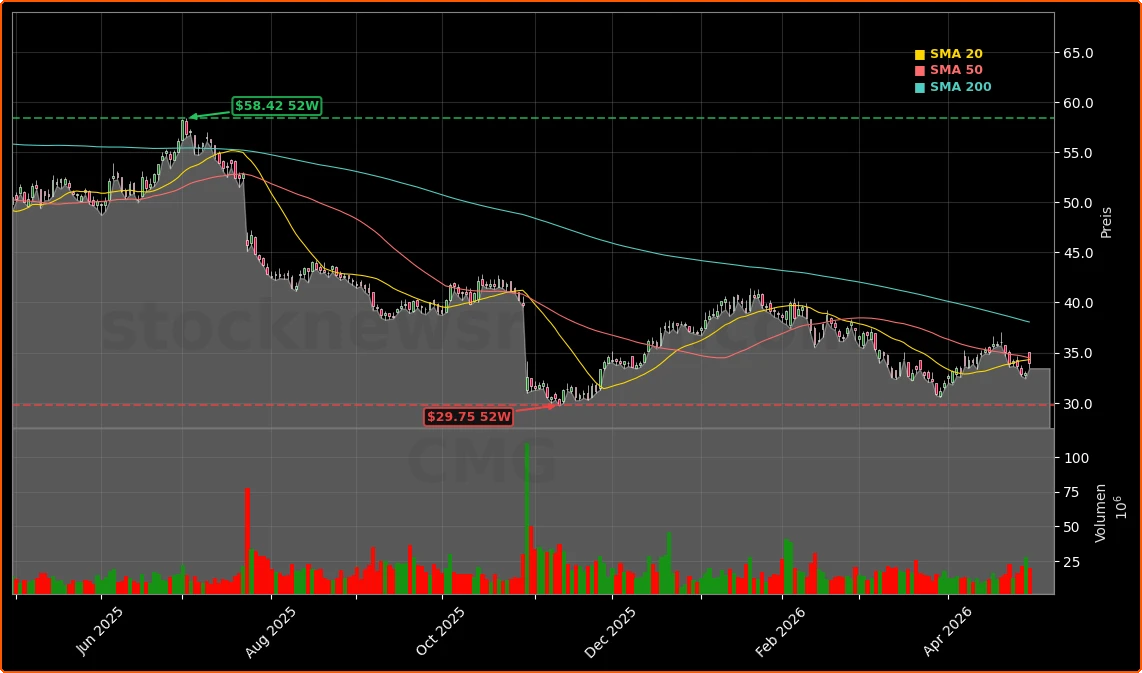
In contrast, Stephens struck a more optimistic tone, raising its Chipotle price target from $38 to $39, also with an Equal Weight rating. The firm highlighted April’s reacceleration in same-store sales as the key takeaway, arguing that improving monthly trends could gradually rebuild investor confidence. Across Wall Street, the broader consensus remains constructive, with a strong majority of Buy or Strong Buy ratings and no outright Sell calls, even after CMG’s sharp pullback from its 52-week high near $58.42.
For diversified U.S. investors who also follow restaurant names like Tesla in EV-driven mobility or tech giants like Apple, Chipotle offers a different type of growth story: a consumer-facing brand with substantial unit-expansion runway and a capital return program, but now tied more tightly to macro-sensitive traffic trends.
What do Chipotle Earnings mean for CMG’s long-term path?
Strategically, Chipotle is doubling down on growth. The company opened 49 new company-owned restaurants in Q1, 42 of them with its Chipotlane drive-through format, and plans to add 350 to 370 locations in 2026. Long term, management continues to see potential for about 7,000 restaurants in the U.S. and Canada. At the same time, Chipotle repurchased roughly $700.8 million of stock during the quarter at an average price of $36.14, leaving $1.0 billion under its current authorization and still more capacity within a broader buyback framework often cited around $1.7 billion.
At a share price near $33.95, CMG now trades at a forward P/E around 29x, below the valuation implied at its mid-2025 highs but still a premium to many restaurant peers in the S&P 500. Bulls argue that if comps continue to recover and margins stabilize, the stock could re-rate toward prior multiples, with some scenarios pointing to a potential path back toward the mid-$50s or even $60 over time. Bears remain focused on the first sustained comp slowdown in years and the risk that value-conscious consumers may resist further pricing moves.
We believe we charge a very fair price point for what we offer the consumer, high-quality ingredients, and we are seeing early results as guests come back to our restaurants.— Scott Boatwright, CEO of Chipotle Mexican Grill, Inc.
For investors, the latest Chipotle Earnings confirm that the brand is moving in the right direction on traffic and unit growth but still has work to do on profitability. The next few quarters will need to show that April’s momentum can be sustained and that cost pressures can be contained without diluting the company’s quality and value proposition.