
Are Cloudflare’s upbeat earnings enough to justify its AI pivot as the stock tanks nearly 19% after hours?

How did Cloudflare Earnings hit expectations?
Cloudflare, Inc. (NET) reported first-quarter revenue of $639.8 million, up 34% year over year, slightly above Wall Street estimates. Adjusted EPS came in around the mid‑$0.20s, also ahead of consensus, underscoring that this round of Cloudflare Earnings delivered on the top and bottom line. Large customers remain the core growth engine: the number of clients spending more than $100,000 annually climbed 25% to 4,416, now contributing 72% of total revenue. Dollar-based net retention reached 118%, improving seven percentage points from a year earlier, though slipping two points sequentially as expansion slowed from prior quarters.
Profitability metrics were solid but showed some pressure. Gross margin came in at 72.8%, down 210 basis points quarter over quarter and 130 basis points year over year, driven by a heavier mix of lower-margin developer platform revenue and a reallocation of network costs. Still, operating income rose to $73.1 million, translating into an 11.4% operating margin versus roughly $56 million a year earlier. Free cash flow improved to $84.1 million, or 13% of revenue, up from $52.9 million and 11% in the prior-year period, giving Cloudflare more flexibility to fund its AI and network build‑out without tapping equity markets.
Why did the stock drop after strong numbers?
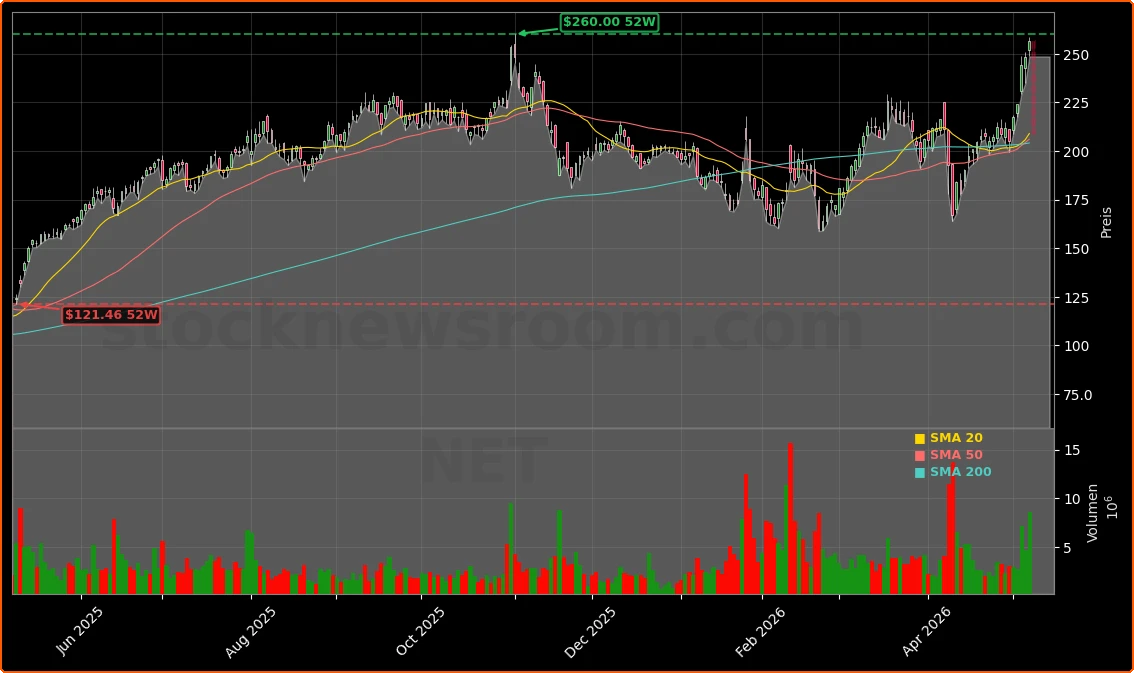
Despite headline beats, Cloudflare shares sold off sharply in after-hours trading, sliding to about $208.50, roughly 19% below the close, as investors focused on forward guidance and the scale of upcoming restructuring. For the second quarter, management projected revenue of $664–$665 million and EPS of around $0.27, essentially in line with consensus but not meaningfully higher. On Wall Street, high‑multiple software names often need to deliver clear upside on guidance to maintain momentum, and these Cloudflare Earnings did not provide the kind of Q2 beat‑and‑raise trajectory some traders were hoping for.
At the same time, the company announced a workforce reduction of more than 1,100 employees, roughly 20% of headcount, as it pivots toward an agentic AI-first operating model. Management expects $140–$150 million in 2026 restructuring and severance costs, including about $40 million of non‑cash charges, with most of the impact hitting in the second quarter. While free cash flow guidance for the year remains intact, the combination of elevated near-term costs, gross margin compression and guidance that only matches expectations helped trigger profit-taking after a powerful share-price run that pushed NET near its 52‑week high of about $260.
How is Cloudflare shifting toward AI and developers?
The strategic heart of these Cloudflare Earnings is the aggressive bet on generative and agentic AI. Internally, the company reports that AI usage has surged 600% in just three months, with 97% of engineers using AI coding tools and some roles seeing “two, 10, even 100 times” productivity gains. Externally, Cloudflare’s developer platform continues to scale: the firm added around 1 million new developers in the quarter, bringing the total to roughly 5.5 million building on its network. This rapid adoption, combined with high GPU utilization in the 70%–80% range — far above the single‑digit levels frequently cited at hyperscale cloud providers like NVIDIA’s largest customers — suggests Cloudflare is extracting strong economic value from its AI infrastructure.
That shift, however, weighs on near-term margins. Developer and AI services typically carry lower gross margin than traditional security and network products, and Cloudflare has increased the share of network costs allocated to cost of revenue. Management still expects network capex to run at 14–15% of revenue for the full year, after clocking in at 9% in the quarter, underscoring continued investment intensity. For long‑term growth‑oriented investors, these Cloudflare Earnings show a company trying to front‑load AI infrastructure and automation, even at the expense of near‑term profitability.
What do guidance and metrics mean for investors?
Cloudflare raised its full‑year 2026 outlook, now guiding to revenue of about $2.805–$2.813 billion, implying roughly 30% growth at the midpoint, and operating income of $418–$421 million. Remaining performance obligations rose 36% year over year to $2.543 billion, with 64% classified as current, giving the company solid visibility into the next twelve months. Management highlighted that, on the updated outlook, Cloudflare’s growth plus margin profile should exceed a Rule of 40 score of 46% this year, with line of sight to topping 50% in 2027.
For U.S. investors comparing cloud-security names, Cloudflare’s growth rate stands out versus more mature platforms like Apple’s services segment or network‑centric offerings from Akamai. At the same time, the stock’s volatility around these Cloudflare Earnings mirrors swings seen in other AI‑levered names such as NVIDIA and Tesla, where sentiment can shift quickly when guidance does not handily beat consensus. With partner‑driven revenue now ~30% of sales and strong momentum in SASE and Zero Trust products — including customer wins that reportedly displace more than a dozen legacy vendors and deliver over $1.3 million in annual savings in some cases — Cloudflare remains firmly positioned in critical security and connectivity budgets.
How does this fit into the broader AI security story?
These results follow a period of heightened focus on Cloudflare’s AI‑based security offerings. Earlier in the year, the company’s shares came under pressure after investors questioned whether new alliances and product pushes would materially accelerate growth. That context makes the current Cloudflare Earnings particularly important: they show that AI and developer workloads are already large enough to influence revenue mix, margins and staffing decisions, rather than being purely experimental.
Related Coverage: For a deeper dive into how Cloudflare is trying to monetize AI security, including its partnerships with emerging vendors Wiz and Mesh, investors can review this analysis of Cloudflare’s latest AI security initiatives and the market’s reaction. That piece explores whether these moves can offset competitive pressure in cloud security and what they might mean for NET shareholders after earlier price declines. Together with the latest Cloudflare Earnings, it offers a broader picture of how the company is positioning itself in the race to secure AI‑driven workloads.
With the guidance in place today, we are getting north of 46% from a Rule of 40 perspective, and we think we have visibility to reaching north of 50% next year.— Thomas Seifert, Cloudflare CFO
In sum, the latest Cloudflare Earnings combine strong growth, an upgraded outlook and a bold AI‑driven restructuring that spooked traders in after‑hours action. For long‑term investors focused on durable cloud and security leaders, the key question is whether AI‑enabled productivity gains and developer adoption can outpace near‑term margin headwinds. The next few quarters of execution on guidance, job cuts and AI monetization will be crucial in determining whether NET’s recent volatility turns into a new leg of sustainable upside.