Can CrowdStrike’s latest earnings strength justify its premium valuation, or is Wall Street already pricing in perfection?

What drove CrowdStrike Earnings momentum?
CrowdStrike Holdings, Inc. reported fiscal Q1 2027 results ending April 30 — a period marked by record annual recurring revenue (ARR) of $5.5 billion, up 24% year over year. The growth was fueled by broad-based adoption of its Falcon Flex subscription model and deepening enterprise penetration, especially among Fortune 500 customers expanding beyond endpoint protection into cloud workload and identity security. Notably, the company added 1,120 net new subscription customers — its strongest quarterly net addition in over two years — with over 70% of new logos originating outside North America. This global expansion, combined with a 98% dollar-based net retention rate, signals durable revenue quality rarely seen in high-growth SaaS firms.
How does CrowdStrike Earnings compare to peers?
Relative to peers, CrowdStrike Holdings, Inc. continues to outpace the cybersecurity sector’s median revenue growth of 14% and gross margin expansion of 82%. While Palo Alto Networks (PANW) posted solid Q4 results, its cloud security growth decelerated to 22% — below CrowdStrike’s 31% platform growth rate. NVIDIA (NVDA) and Meta (META) are increasingly embedding CrowdStrike’s Falcon platform into AI infrastructure stacks, a trend that analysts say validates its ‘critical AI infrastructure’ positioning. Morningstar’s recent comparison of PANW vs CRWD vs Broadcom (AVGO) noted CrowdStrike’s superior AI-native architecture, though it rated AVGO as its top pick due to valuation — underscoring how CrowdStrike Earnings strength is now being weighed against premium multiples.
What do analysts say about CrowdStrike Earnings?
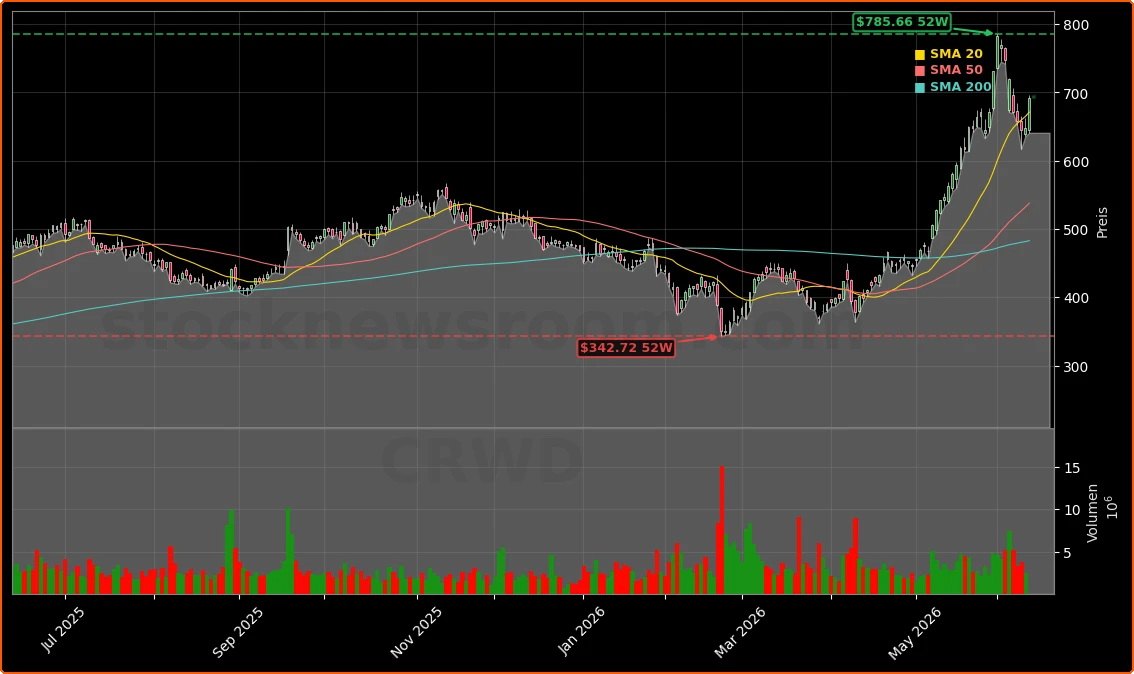
Wall Street’s response to CrowdStrike Earnings has been overwhelmingly positive — but not uniform. Of 54 analysts covering the stock, 78% maintain a Buy or Strong Buy rating, per TradingView data. Rosenblatt Securities analyst Catharine Trebnick raised her price target to $825, the highest on Wall Street, citing the ‘intersection of frontier AI models and cybersecurity’ as a structural tailwind. TradingView’s consensus price target now stands at $720.93, implying ~4% upside from the June 11 close. Yet Berenberg Bank reiterated a Hold rating, warning that the stock’s forward P/E of 111 leaves little margin for error — especially amid rising AI-related R&D spend and a recent $5.25 million insider sale by director Gerhard Watzinger.
What’s next after CrowdStrike Earnings?
A 4-for-1 stock split — approved by the board and set for late July — will lower the entry point for retail investors and improve options liquidity ahead of NASDAQ’s July options expansion. More strategically, CrowdStrike Holdings, Inc. is accelerating development of Charlotte AI’s agentic capabilities, with early integrations into Anthropic’s Claude Mythos Preview identifying thousands of zero-day vulnerabilities. With IBM reporting the global average data breach cost at $4.44 million, demand for AI-augmented threat intelligence is no longer theoretical. The company’s recent recognition as a Leader in Gartner’s 2026 Magic Quadrant for Cyberthreat Intelligence Technologies — its first time in that category — signals a widening moat beyond endpoint protection. Still, Q2 guidance remains conservative, with management citing macro caution and longer sales cycles in large enterprise renewals.
The intersection of frontier AI models and cybersecurity has positioned the Falcon platform as critical AI infrastructure.— Catharine Trebnick, Rosenblatt Securities
CrowdStrike Earnings have redefined expectations for AI-infused security — not just as an add-on, but as foundational infrastructure. For U.S. investors, this means CrowdStrike Holdings, Inc. is no longer just a cybersecurity play, but a proxy for AI risk mitigation across the S&P 500 and NASDAQ. The CrowdStrike Earnings report confirms durable growth, but also sharpens the debate over valuation discipline in an AI-fueled market. CrowdStrike Earnings set the bar high for the sector — and the next quarterly earnings will test whether the momentum holds.