
Did Broadcom Earnings just expose the first real crack in Wall Street’s sky-high AI trade?

Why Did Broadcom Earnings Shake the Nasdaq?
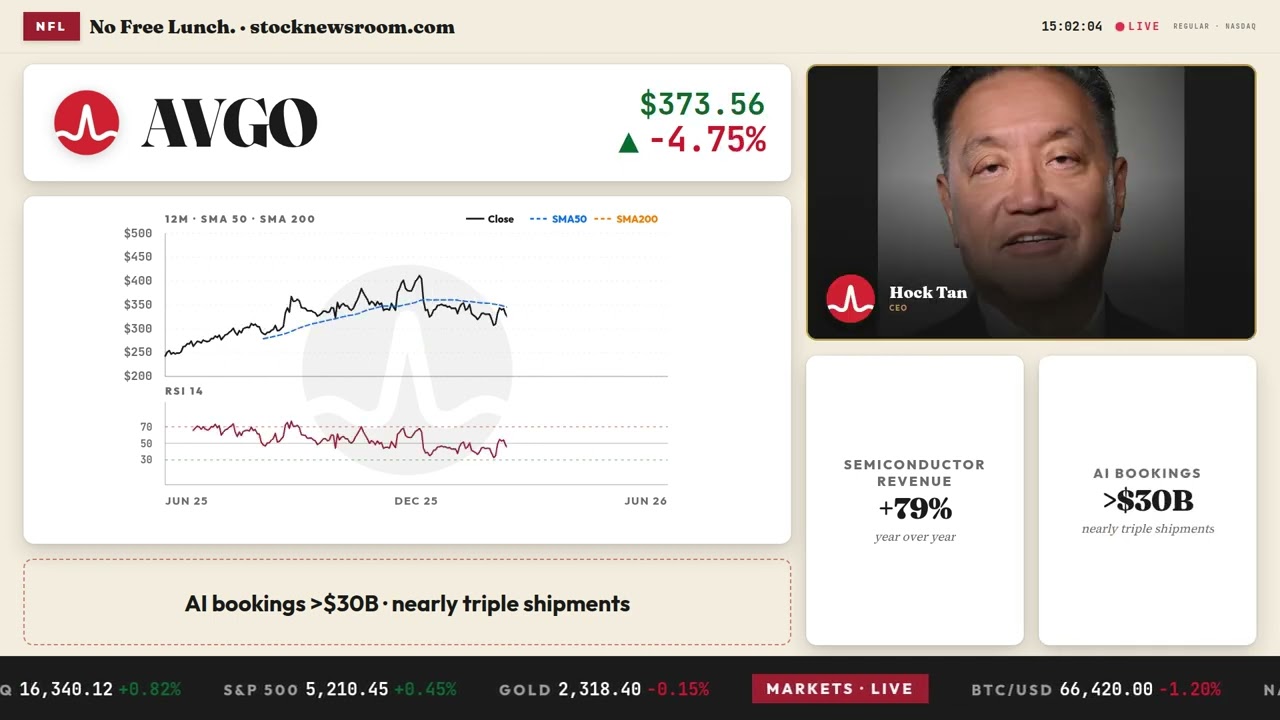
Broadcom Inc. shares dropped 4.7% to $373.72 in after-hours trading on Wednesday, June 10, 2026 — extending a 20% decline since its June 3 earnings release. The selloff wasn’t driven by weak fundamentals: revenue hit a record $22.19 billion, semiconductor revenue jumped 79%, and AI bookings totaled over $30 billion — nearly triple shipments. Yet Wall Street punished the stock for what it didn’t say: no upward revision to its $100 billion AI revenue forecast for fiscal 2027. With analysts expecting $17.2 billion in Q3 AI chip revenue and Broadcom guiding to $16.0 billion — a 200% YoY increase, but short of consensus — the ‘sell-the-news’ reaction intensified. The move dragged down peers: NVIDIA fell 3%, AMD dropped 4%, and the VanEck Semiconductor ETF (SMH) slid 2.9%.
How Is Broadcom’s AI Outlook Reshaping Sector Valuations?
Broadcom’s guidance miss exposed how tightly priced AI infrastructure stocks have become. At 65.3x forward earnings, AVGO trades at a steep premium versus peers — NVIDIA at 46.2x and AMD at 52.8x — yet its projected 5-year EPS growth of 50% lags behind NVIDIA’s 68%. That valuation gap widened after Broadcom Earnings. Bank of America Securities and Mizuho both raised price targets to $530 on June 4, while UBS lowered its target to $485 — reflecting divergent views on whether the AI growth curve remains steep enough to justify current multiples. Crucially, Broadcom’s role in co-designing custom chips for Alphabet, Meta, and Anthropic remains unmatched, yet investors now demand clearer evidence of margin expansion and sustained outperformance beyond scale.
What’s Driving the Broader Tech Weakness?
The Broadcom Earnings fallout coincides with macro stress: May’s 4.2% CPI print — the highest since April 2023 — has pushed Fed rate-hike odds to 100% by year-end. The VIX spiked 26% to 19.87, and oil surged 3.3% after U.S.-Iran strikes, pressuring rate-sensitive tech. The Nasdaq 100 fell 1.4% on June 10, with the Technology Select Sector SPDR Fund (XLK) down 1.6%. Broadcom’s 3.04% weighting in the Invesco QQQ Trust (QQQ) amplified the drag. Meanwhile, defensive sectors surged: Energy (XLE) rose 2.6%, and the Russell 2000 slipped just 0.3%, signaling sector rotation away from high-multiple growth. Analysts at BNP Paribas note investors may be liquidating semiconductor positions to fund upcoming mega-IPOs — adding fuel to the fire.
Is This a Buying Opportunity or a Structural Warning?
The momentum continues and in Q3 we expect semiconductor revenue from AI to grow over 200 percent year-over-year to $16.0 billion.— Hock Tan, CEO of Broadcom Inc.
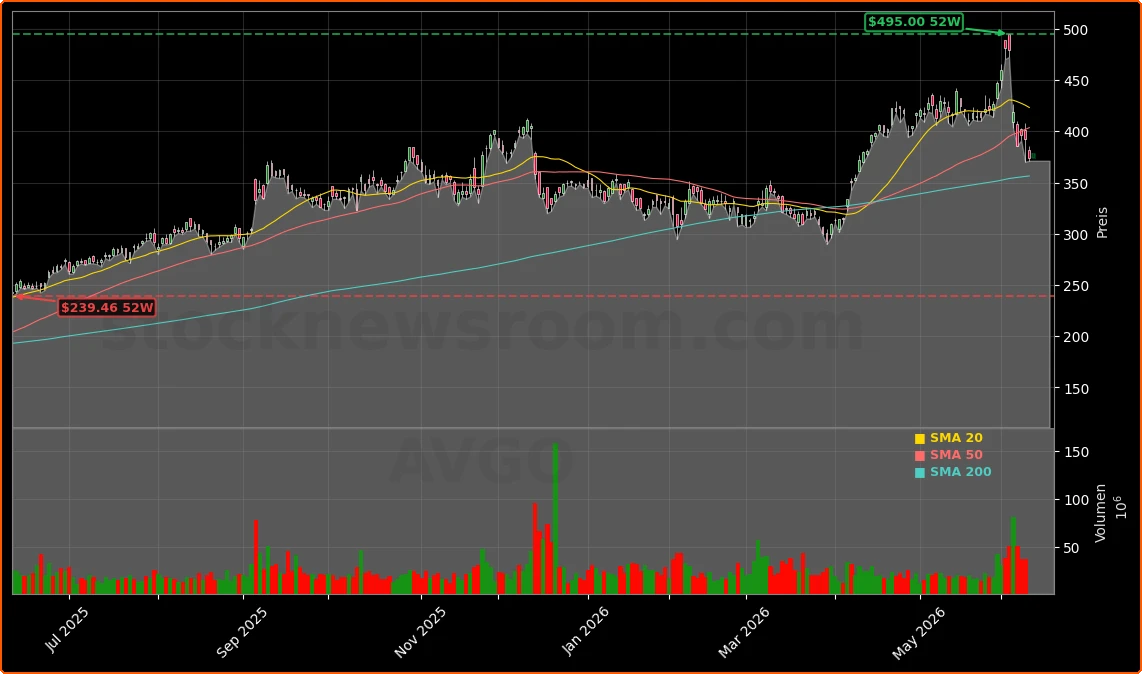
Technical indicators present a mixed picture. Broadcom remains 7.4% above its 200-day moving average — a key support zone — and the 50-day MA recently crossed above the 200-day MA (a ‘golden cross’), confirming longer-term strength. Yet price action sits below both the 20-day and 50-day averages, and the MACD histogram remains negative — signaling fading bullish momentum. Support rests near $324.50, while resistance looms at $429.50. Value investors point to Broadcom’s 95.69 Quality Score and $35 billion Anthropic infrastructure financing role — where it backstops senior debt to secure an investment-grade rating — as proof of durable competitive advantage. Still, Seeking Alpha’s bearish take warns that without superior growth or margin upside, the premium valuation may not hold.