
Did CrowdStrike deliver enough to justify its premium valuation, or are investors finally demanding more than just another earnings beat?

Did CrowdStrike Earnings Beat Justify the Hype?
CrowdStrike Holdings, Inc. reported Q1 fiscal 2027 results that technically exceeded consensus: revenue rose 26% year-over-year to $1.39 billion, non-GAAP EPS landed at $1.10 (a $0.03 beat), and annual recurring revenue (ARR) reached $5.51 billion — up 24% YoY. Net new ARR surged 32% to $256 million, a record. Free cash flow hit $468.5 million, an all-time high. Yet the stock plunged — falling over 9% intraday — as investors weighed the numbers against a 60% year-to-date rally and sky-high valuation. The market’s message was clear: good is no longer good enough.
Why Did CrowdStrike Earnings Trigger a Sell-Off?
The decline wasn’t driven by weakness — it was driven by context. CrowdStrike Holdings, Inc. entered earnings priced for perfection: a forward P/E near 145x and a P/S ratio nearing 40, far above historical norms for even elite SaaS firms. While the company lifted full-year net new ARR guidance to $6.53–$6.56 billion and affirmed $1.44 billion for Q2, analysts at Citigroup noted this represented the ‘smallest ever ARR revenue beat’ — a subtle but telling signal of deceleration. Concerns also surfaced around sequential RPO decline, rising operating costs (+15% YoY), and softer-than-expected billings growth. As RBC Capital Markets observed, the beat ‘did not meet high investor expectations’ — especially given the company’s positioning at the epicenter of AI-driven cyber defense.
How Does CrowdStrike Compare to Peers Like Palo Alto and Fortinet?
CrowdStrike Holdings, Inc. joins a growing cohort of high-flying software names facing valuation reality checks. Palo Alto Networks saw a similar 6% post-earnings dip after its May report, despite strong growth — a pattern analysts link to ‘AI fatigue’ and crowded positioning. Meanwhile, Fortinet and Okta have recently outperformed on clearer execution and more modest valuations. Unlike Broadcom, whose software unit VMware faced margin pressure, CrowdStrike’s issue is structural: its AI narrative has become so embedded in the stock price that even early-stage validation — like its role in Anthropic’s ‘Project Glasswing’ and $50 million+ AI detection and response (AIDR) pipeline — fails to move the needle. The $740 million acquisition of identity security startup SG&L signals strategic urgency, but investors want revenue acceleration — not just R&D signaling.
What’s the Significance of the 4-for-1 Stock Split?
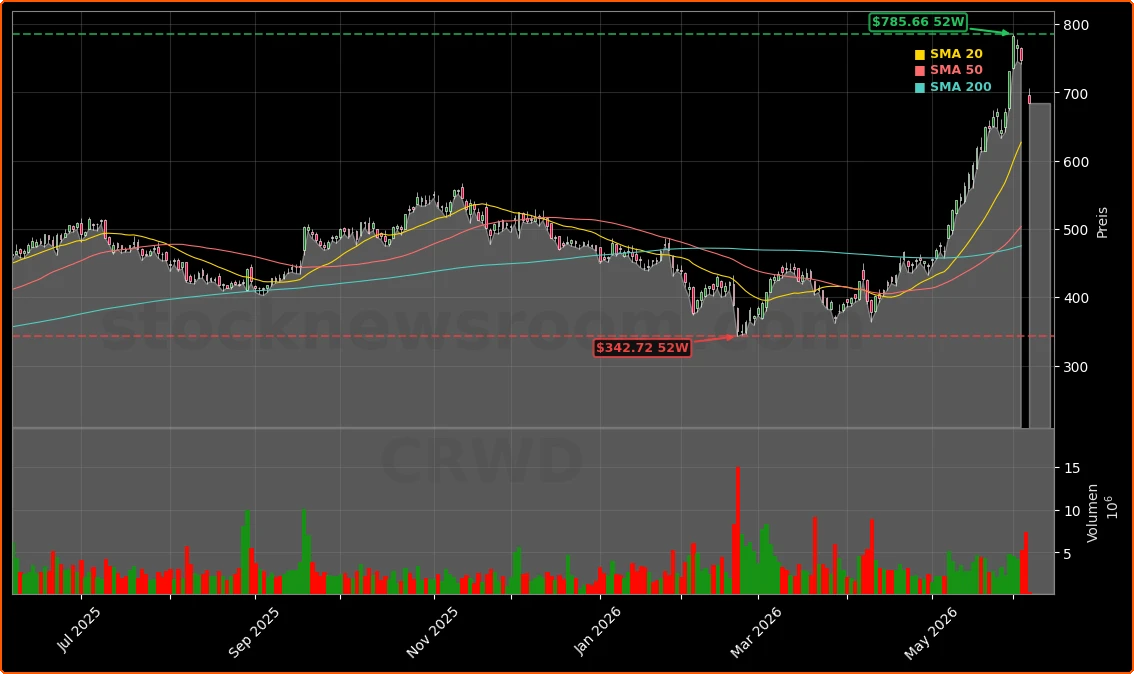
CrowdStrike Holdings, Inc. announced a 4-for-1 stock split effective after market close on July 1, 2026 — its first since its 2019 IPO. The move, while symbolically bullish, reflects its extraordinary run: shares have surged nearly 1,200% since listing. Though fractional shares reduce the practical need for splits, the decision underscores CrowdStrike’s elite status among NASDAQ-listed innovators — joining Booking Holdings and Carvana in 2026’s wave of forward splits. Yet analysts caution against overinterpreting the signal. As one Morgan Stanley note observed, ‘Splits don’t create value — execution does.’ With the stock trading 47% above its 200-day moving average and an RSI of 65.4, technical indicators suggest stretched sentiment — not a buying opportunity.
CrowdStrike Earnings: What Do Analysts Say?
Think of CrowdStrike as the picks and shovels of the world’s largest technology gold rush of all time.— George Kurtz, CEO of CrowdStrike Holdings, Inc.
Despite the sell-off, analyst sentiment remains constructive — but increasingly selective. RBC Capital Markets lifted its price target from $650 to $755 and maintained its Outperform rating, calling the quarter ‘a strong start to the fiscal year.’ Jefferies adjusted its target to $760, while Kennecourt raised its target from $400 to $675. Berenberg upgraded its price target to $720 — but downgraded the stock to Hold from Buy — citing valuation risk. Citigroup echoed that caution, warning that ‘the AI tailwind is real, but monetization lags perception.’ Notably, no major firm cut its rating — affirming confidence in CrowdStrike’s platform dominance, but also highlighting the narrow margin for error in today’s S&P 500 tech rotation.