
Can Dell’s massive AI backlog justify the hype, or is Wall Street already pricing in a flawless future?

What Does the Dell AI Forecast Mean for Wall Street?
Dell Technologies Inc. reported explosive AI-driven demand in its fiscal Q1 2027 (ended May 2026), with AI server revenue surging 757% year-over-year to $16.1 billion. More critically, the company disclosed a $51.3 billion AI-related order backlog — the largest in its history — and added $24.4 billion in new AI orders last quarter alone. That strength prompted management to raise its full-year AI server revenue forecast to ~$60 billion, up from prior guidance. Goldman Sachs maintains its ‘Buy’ rating and lifted its price target to $500 — a 15% upside from current levels — citing Dell’s execution in high-margin AI infrastructure and its tight integration with NVIDIA-powered systems. The broader S&P 500 tech sector, which gained 12% in Q1, is watching Dell as a bellwether for enterprise AI capex trends.
Is Dell’s Valuation Already Priced for Perfection?
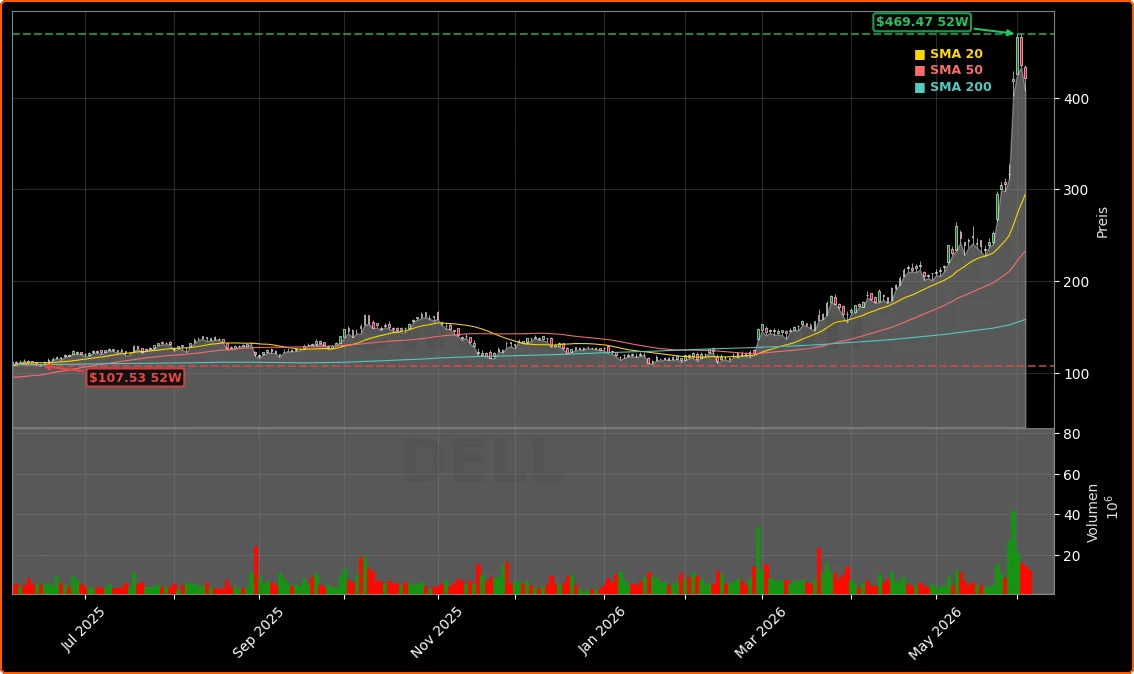
Yes — and that’s raising alarms. Dell Technologies Inc. shares trade at a 160% premium to their 200-day moving average, with a 30-day annualized volatility of 122.89% — more than double the NASDAQ Composite’s average. The Relative Strength Index (RSI) sits at 76.7, solidly in overbought territory. While the stock is up 233% year-to-date, it remains 13% below its 52-week high of $476.10 — a level hit just three days ago on June 2. That divergence between fundamentals and technicals is rare among large-cap tech names. For context, Apple and Tesla have seen 30-day volatilities of 42% and 68%, respectively. Citigroup analysts note that Dell’s valuation now assumes flawless execution on the $51.3 billion backlog — with zero supply chain hiccups, no margin compression, and sustained AI infrastructure spend from hyperscalers and enterprises alike.
Dell AI Forecast: What’s Driving the Earnings Revisions?
Wall Street analysts have collectively raised Dell’s fiscal 2027 earnings estimates by 50% over the past 30 days — the largest upward revision among S&P 500 hardware peers. That surge reflects confidence in the Dell AI Forecast and its linkage to broader AI infrastructure acceleration. RBC Capital Markets upgraded Dell to ‘Outperform’, highlighting its leadership in AI-optimized server platforms and its growing share in the $120 billion AI server market — a segment growing 3x faster than traditional data center hardware. The firm expects Dell to capture 22% of AI server revenue in 2026, ahead of Hewlett Packard Enterprise but behind NVIDIA-aligned OEMs like Supermicro. Importantly, the $60 billion AI revenue target implies ~36% of Dell’s total $165–169 billion full-year guidance comes from AI infrastructure — up from just 8% in fiscal 2025.
Are Insider Sales a Red Flag?
Yes — and timing matters. On Friday, June 5, Dell filed a Form 144 with the SEC signaling the planned sale of 41,300 shares valued at ~$17.5 million. The shares originated from employee compensation plans dating to 2017, but the filing coincides with a 950% surge in leveraged Dell ETFs since February — and a 100% rally in Dell shares over the past 30 days alone. Silver Lake–affiliated entities have also reduced positions recently, consistent with profit-taking after outsized gains. That doesn’t negate the AI story — but it adds pressure on the Dell AI Forecast to deliver tangible earnings acceleration in Q2. For U.S. investors holding tech-heavy portfolios, Dell’s trajectory is now a litmus test for whether AI infrastructure spending is broad-based or concentrated among a few hyperscalers.
How Does Dell Compare to Its AI Infrastructure Peers?
Dell Technologies Inc. stands apart from traditional hardware peers on growth, but not on valuation discipline. While its AI server revenue grew 757% in Q1, Hewlett Packard Enterprise’s AI revenue rose 412%, and Supermicro’s jumped 890% — yet Dell trades at a 28x forward P/E, versus Supermicro’s 42x and HPE’s 14x. That premium reflects Dell’s stronger balance sheet, recurring software/services revenue (23% of total), and deeper integration with enterprise IT procurement cycles. Still, Morgan Stanley warns that Dell’s reliance on third-party AI chips — primarily from NVIDIA — exposes it to supply constraints and margin pressure if chip lead times extend. The firm maintains a ‘Neutral’ rating, citing valuation risk despite strong fundamentals.
Dell’s $51.3 billion AI backlog isn’t just a number — it’s a multi-quarter earnings catalyst, assuming execution stays on track.— Goldman Sachs Analyst Team
Related Coverage: The recent Dell Earnings Down 6.3% as AI Server Boom Faces Reality analysis highlights how quickly momentum can shift in the AI hardware space — especially when revenue growth decelerates or gross margins compress. That article, published just three days ago, underscores the volatility embedded in the current Dell AI Forecast narrative and serves as a cautionary benchmark for investors weighing near-term entry or exit points.