Can the latest Disney Earnings rally and streaming turnaround finally script a lasting comeback for one of Wall Street’s biggest icons?

How did Disney Earnings move the stock?
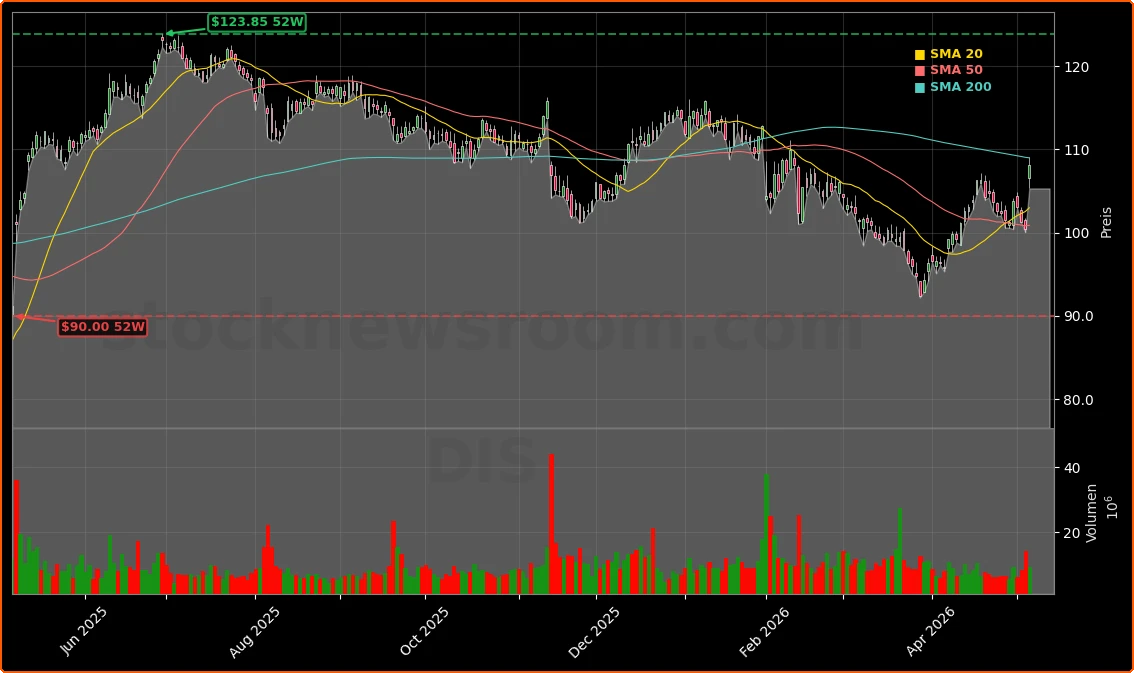
The Walt Disney Company (DIS) jumped around 8% intraday on Wednesday, trading near $108.17, after reporting Disney Earnings that topped consensus and offering more precise guidance. The move snapped a brief losing streak and put the stock on track for its biggest one-day gain in nearly a year, even though DIS remains roughly 46% below its 2021 all-time high and about 12% under its 52-week high.
Adjusted EPS grew 8% year over year to $1.57, versus analyst estimates around $1.49–$1.51. Revenue climbed 7% to $25.17 billion, ahead of roughly $24.8–$24.9 billion expected. Total segment operating income increased 4% to $4.6 billion, reflecting solid growth across entertainment, sports and the experiences division, which houses parks, resorts and cruises.
Management now expects about 12% adjusted EPS growth for fiscal 2026 excluding the 53rd week (around 16% including it), and reiterated expectations for double-digit adjusted EPS growth again in fiscal 2027. Disney also raised its 2026 share repurchase target from $7 billion to at least $8 billion, signaling confidence in cash generation and in the valuation of DIS after a difficult multiyear stretch.
What is driving streaming and entertainment?
The strongest narrative inside these Disney Earnings is the turnaround in streaming. Entertainment SVOD revenue, which includes Disney+ and Hulu, increased 13% year over year, with the segment achieving its first double-digit operating margin—about 10%—and operating income surging 88% to $582 million. That marks a sharp contrast to the near-$7 billion in streaming losses the company racked up across fiscal 2022–2023 and puts Disney back in the conversation with leaders like Netflix and, on the tech side, platforms run by Apple and Amazon.
Management attributed the improvement to a mix of price hikes, higher advertising revenue and better churn control, helped by the integrated Disney–Hulu experience. Disney+ is being repositioned as a “digital hub” for the entire company, with more personalization, short-form content and eventually tighter integration with ESPN, games and park planning, similar in ambition to how NVIDIA and other tech names are using software ecosystems to lock in users.
On the content side, the entertainment division’s total revenue rose 10% to about $11.7 billion, supported by theatrical hits such as the new Avatar: Fire and Ash, Zootopia 2 and Pixar’s original film Hoppers. D’Amaro stressed that the growth plan depends on both extending existing franchises and taking creative risks on new IP, with upcoming titles like The Mandalorian & Grogu and Toy Story 5 expected to feed both box office and streaming engagement.
How healthy are parks, cruises and ESPN?
Despite investor worries about discretionary travel, Disney’s experiences business delivered record Q2 numbers. Segment revenue rose 7% to $9.49 billion, while operating income increased 5% to $2.62 billion, modestly beating internal guidance. Domestic park attendance slipped 1% as international visitation remained soft amid geopolitical tensions, but per-capita spending rose 5% driven by higher pricing and strong on-site spending on food and merchandise. Global attendance, including international parks and cruises, grew about 2%.
New capacity is helping: Disney recently launched the Disney Adventure, its first cruise ship homeported in Asia, and opened the World of Frozen land at Disneyland Paris. The company plans to expand its cruise fleet from eight to 13 ships by 2031 and is pushing ahead with a new Abu Dhabi theme park using a capital-light partnership model. Management expects domestic park attendance to improve year over year in Q3 as it laps current headwinds and shifts marketing toward US guests.
ESPN and the broader sports segment remain a mixed picture. Revenue increased 2% to $4.61 billion, but operating income fell 5% to $652 million due to higher sports-rights fees and marketing costs, particularly around the NBA. Still, Disney argues that live sports materially reduce churn on its streaming platforms, and CEO Josh D’Amaro reiterated plans to build out ESPN’s direct-to-consumer product while keeping linear networks in-house rather than spinning them off.
How are Wall Street and peers responding?
Wall Street reacted positively to the latest Disney Earnings, with several brokers highlighting the combination of streaming profitability, resilient park cash flows and clearer capital-allocation plans. Seaport Research Partners, for example, rates DIS at “Buy” with a $130 price target and called out the strong health of Disney’s core consumer franchises despite macro uncertainty. Broader S&P 500 sentiment was constructive on Wednesday as falling oil prices eased inflation worries, and Disney’s move helped lift the Dow.
For US investors, the key question is whether this quarter marks an inflection like Tesla experienced when it first proved sustainable EV margins, or whether DIS remains a value trap in a structurally challenged legacy media space. Compared with streaming pure plays and mega-cap tech, Disney still trades at a discount to its own five-year average multiple, even after the post-earnings pop. But unlike many legacy peers, it can lean on high-ROIC parks and cruises plus globally recognized IP to fund the streaming and technology transition.
Related Coverage
Cost discipline is central to D’Amaro’s strategy, including marketing consolidation and workforce reductions. Earlier this year we covered how a new round of job cuts is intersecting with the stock’s rebound in “Disney Layoffs Cut 1,000 Jobs as DIS Stock Surges 3.5%”. That piece explores whether restructuring and headcount reductions can structurally lift margins and support a higher earnings base, a theme now reinforced by the latest Disney Earnings beat and upgraded buyback plan.
Our job is to execute with rigor, invest with confidence, and connect our strengths in ways that create lasting value for consumers and shareholders alike.— Josh D’Amaro, CEO of The Walt Disney Company
In sum, Disney Earnings for Q2 2026 show a company finally turning streaming into a profit driver while parks and cruises continue to throw off cash, all under a CEO who is pushing hard on technology and integration. For long-term investors, the combination of double-digit EPS growth guidance and an $8 billion buyback provides a clearer path to value creation if execution holds. The next few quarters will reveal whether D’Amaro’s digital-hub vision can sustain momentum and move DIS closer to reclaiming its former leadership role on Wall Street.