Can the latest Uber Earnings beat and bullish guidance finally turn a choppy 2026 into a sustained rally for the stock?

How did Uber Earnings move the stock today?
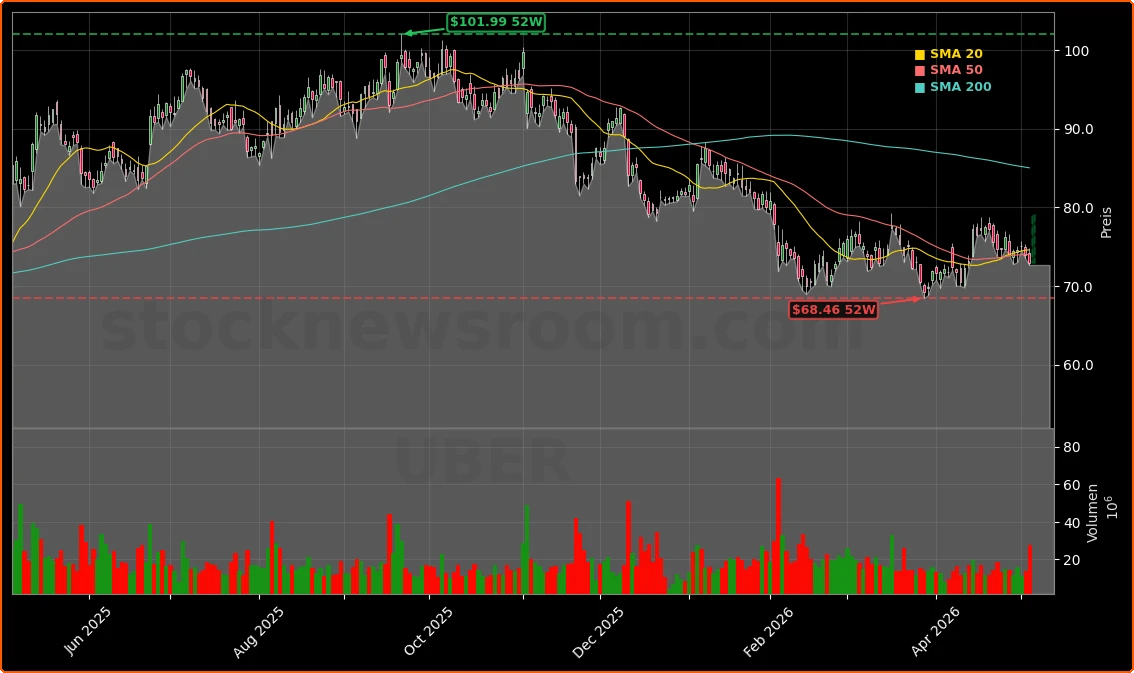
Uber Technologies, Inc. (UBER) is trading sharply higher before the opening bell on Wednesday after its latest Uber Earnings report combined a modest top-line miss with stronger-than-expected profitability and guidance. The stock, which finished Tuesday at $72.95, was indicated around $79 in pre-market action, up roughly 8%, reversing a year-to-date slide that had seen shares lag the broader S&P 500.
The move comes as major indices hover near record highs and investors rotate back into high-quality growth names that can demonstrate operating leverage despite macro headwinds like higher gas prices and geopolitical tensions. With Uber now a key component of ride-hailing and delivery exposure for many U.S. growth portfolios and ETFs, these Uber Earnings are helping reset sentiment after a choppy start to 2026 for the stock.
Uber now trades well below many Wall Street price targets in the $90–$110 range that firms such as Morgan Stanley, Citigroup and RBC Capital have outlined in recent months. The initial reaction suggests buy-side investors are comfortable looking through the small revenue shortfall in favor of evidence that underlying demand and margins remain robust.
What stands out in Uber’s Q1 2026 numbers?
For the March quarter, Uber reported GAAP net income of $263 million, or $0.13 per share, down from $1.78 billion, or $0.83, a year ago. The decline was almost entirely driven by a $1.5 billion pre-tax headwind from revaluing equity stakes in companies such as Didi and Grab. Stripping out these and other one-time items, adjusted earnings came in at $0.72 per share, beating the $0.69–$0.70 consensus range and rising strongly from $0.50 a year earlier.
Revenue climbed 14% year over year to $13.2 billion, slightly below forecasts of roughly $13.3 billion. Management pointed to severe winter storms in the U.S., elevated gas prices following military tensions in the Middle East, and regional impacts from the conflict as the main drags on reported revenue growth.
Under the hood, the engine remains powerful: total trips jumped 20% to 3.6–3.64 billion, while gross bookings surged 25% to $53.7 billion, ahead of expectations around $52.8 billion. Monthly active platform users increased 17%, showing that the ecosystem continues to deepen. Operating income on a GAAP basis rose 57% to $1.9 billion, and adjusted operating margin improved to 3.5% of gross bookings, up from 3.1% a year earlier.
How are Uber’s segments and AI efforts evolving?
Uber’s growth in Q1 was broad-based across mobility and delivery, with a notable inflection in freight. Mobility revenue grew around 5% to $6.8 billion, short of analyst models near $7.1 billion, reflecting weather-related disruptions and gas price pressure on drivers. By contrast, the delivery business continued to shine, with revenue up roughly 34% to $5.07 billion, outpacing estimates near $4.9 billion on strength in markets such as Australia, Japan and the U.K.
Freight, which had been a drag for nearly two years, returned to growth, offering a potential incremental earnings lever if the upturn continues. Uber’s subscription program Uber One reached over 50 million paying members, now responsible for about half of gross bookings in mobility and delivery, improving visibility and cross-sell opportunities.
Management is leaning heavily into productivity gains from artificial intelligence. Roughly 95% of Uber’s engineers are now using AI tools monthly, with autonomous agents generating thousands of code changes each week and already writing more than 10% of new code. That adoption is enabling Uber to moderate hiring while still rolling out features such as an AI assistant for drivers and expanded autonomous-vehicle integrations with partners including Waymo, Waabi, Wayve and Rivian. Similar to how NVIDIA has become synonymous with AI infrastructure and how Apple bundles services around hardware, Uber is working to wrap recurring services, memberships and autonomy around its core network.
What does the Q2 outlook say about demand?
The forward guidance embedded in the latest Uber Earnings may be the biggest driver of Wednesday’s rally. For Q2 2026, Uber expects gross bookings of $56.25–$57.75 billion, comfortably ahead of the roughly $56.1–$56.2 billion Wall Street was modeling. That range already bakes in an estimated 60-basis-point drag from the Middle East conflict, suggesting underlying demand growth remains strong.
On the bottom line, management guided to adjusted EPS of $0.78–$0.82, with the midpoint slightly above consensus around $0.79. The company also targets adjusted EBITDA in the $2.7–$2.8 billion range, reinforcing the view that profit is scaling faster than revenue. Executives emphasized opportunities in higher-margin areas such as Uber for Business, travel integrations including hotel bookings, and new local commerce offerings, all designed to deepen engagement per user rather than chase volume growth at any price.
For U.S. investors comparing options across the mobility and EV ecosystem, Uber’s asset-light, marketplace model contrasts sharply with capital-intensive manufacturers like Tesla and Lucid. Uber is also playing a partnership-first game in robotaxis rather than trying to own the entire self-driving stack, which could limit balance-sheet risk even as autonomous trip volumes expand to as many as 15 cities globally by 2026.
Related Coverage
Investors looking to connect the latest Uber Earnings with the company’s broader platform strategy may want to revisit recent coverage of its travel push. In particular, Uber Hotel Bookings Boom: Can Travel Shock Lift UBER? explores how hotel reservations and new mobility partnerships could turn Uber from a pure ride-hailing app into a more comprehensive travel and commerce platform, potentially supporting multiple expansion if execution stays on track.
Overall, the latest Uber Earnings show a business that is growing bookings faster than revenue, expanding margins and using AI and partnerships to compound operating leverage. For Wall Street portfolios that favor scalable platforms and recurring engagement, Uber’s Q2 outlook keeps the stock firmly on the growth radar. The next few quarters will reveal whether management can maintain this balance of double-digit growth, disciplined investment in autonomy and AI, and rising shareholder returns as the platform matures.