

Are stellar Uber Earnings and robotaxi ambitions enough to offset a sliding share price and keep growth investors on board?

How strong were the latest Uber Earnings?
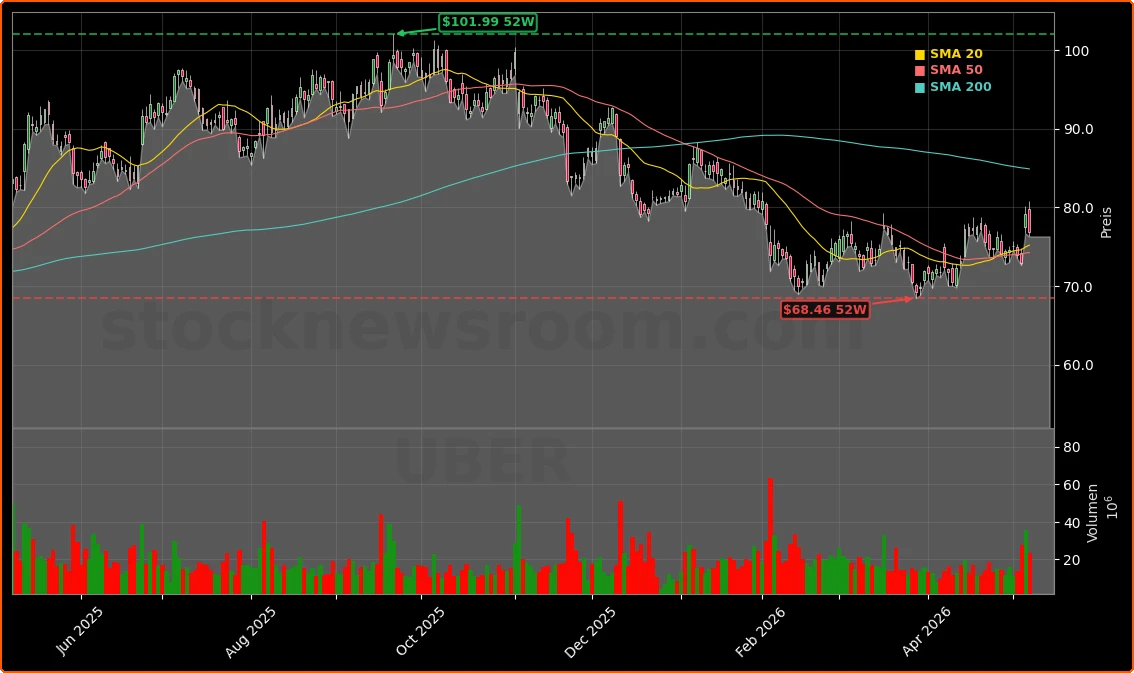
Uber Technologies, Inc. reported Q1 2026 revenue of $13.2 billion, up 14% year over year, with gross bookings jumping 25% to about $53.7 billion. Adjusted earnings power looked solid as well, with non‑GAAP EPS at $0.72. The quarter underlined how far the platform has come from its cash‑burning days, even if the stock is now down about 3% year to date and roughly 8% over the last 12 months.
Under the hood, Uber’s delivery segment was the clear growth engine. Delivery revenue climbed around 34% to $5 billion, benefitting from strong international markets and growing non‑restaurant categories. By contrast, the core ride‑hailing business grew more modestly, with revenue up about 5% to $6.8 billion, reflecting a more mature but still expanding mobility market.
Management highlighted that consumers are still spending locally and have not pulled back on discretionary rides or food delivery despite inflation concerns. That resilience helped the company guide Q2 gross bookings higher, to roughly $57.8 billion, reinforcing the positive tone of the Uber Earnings narrative even as near‑term share price action remains volatile.
What is Wall Street saying about Uber?
Major investment banks remain constructive after the Q1 Uber Earnings. Goldman Sachs described the quarter as broadly positive, with accelerating momentum in both mobility and delivery. The bank cut its price target, but only slightly, from $125 to $115 while reiterating a Buy rating, framing the move as a modeling adjustment rather than a change in thesis.
Piper Sandler took the opposite route on targets but kept the same bullish stance. Analyst Thomas Champion raised his price target from $100 to $105 and maintained an Overweight rating, applauding 20% constant‑currency bookings growth in mobility and highlighting that management’s Q2 2026 bookings and EBITDA guidance sit above prior consensus. Both firms emphasize Uber’s network effects, scale advantages and disciplined capital return as reasons to stay positive.
Other institutions, including Wells Fargo, have also pointed to faster expected growth in Q2 and beyond, lifting their own targets and reinforcing the sense that the recent pullback may be more about sentiment and macro worries than Uber‑specific fundamentals. With the stock now well below these targets, investors focused on the S&P 500’s growth cohort may see room for multiple expansion if execution remains steady.
How do delivery and partnerships drive growth?
Delivery is increasingly central to the Uber Earnings story. The unit’s 34% growth is being fueled not only by restaurant orders but by an expanding retail footprint. A key new step is Uber’s partnership with Ulta Beauty, which brings more than 1,500 Ulta stores onto the Uber Eats marketplace in the U.S. Shoppers can now order makeup, skincare, haircare and fragrance from over 600 brands with on‑demand or scheduled delivery, a timely push ahead of Mother’s Day.
Uber One members benefit from zero delivery fees on eligible Ulta orders, reinforcing the importance of Uber’s subscription base. The company has crossed 50 million Uber One members, and these subscribers now account for roughly half of gross bookings across mobility and delivery. That recurring membership layer gives Uber a more predictable revenue stream, somewhat akin to what Apple and other subscription‑heavy tech names aim for.
Beyond beauty and retail, Uber is integrating travel more deeply into its platform. A new partnership with Expedia will bring hotel bookings into the Uber app, aiming to capture a larger share of the travel wallet. By bundling rides, stays and local delivery on one platform, Uber hopes to build a lifestyle ecosystem that can compete with the likes of Tesla’s mobility ambitions and even travel platforms backed by giants such as NVIDIA‑powered autonomous systems down the line.
Robotaxis, AI and what comes next for Uber Earnings
A big part of the long‑term bull case around future Uber Earnings is the company’s bet on autonomy. Uber has already invested more than $10 billion into robotaxis and related technology. Rather than trying to own every layer of self‑driving hardware, Uber is positioning itself as the aggregator of multiple autonomous vehicle providers, including players like Waymo, on top of its massive demand base of more than 280 million trips per week.
Robotaxis are live in eight cities today, with plans to reach about 15 cities by year‑end. The idea is that as competition among robotaxi manufacturers intensifies, Uber’s marketplace can route demand to whichever fleet offers the best economics and coverage. That aggregation strategy could protect Uber from being disintermediated by any single autonomous platform, including efforts from Tesla.
At the same time, Uber is leaning heavily on AI to improve operations and product development. Management has acknowledged that the company burned through its full annual budget for AI coding tools in just a few months, underscoring both how aggressively engineers are deploying large language models and how high inference costs remain. For now, those costs are being absorbed rather than passed through to customers, which could weigh on margins if not carefully managed—but the payoff in developer productivity and product innovation could support future Uber Earnings growth.
Capital return is another pillar of the story. Uber repurchased about $3.0 billion of its own stock in Q1 2026, following more than $6.5 billion of buybacks in 2025. With the shares trading on roughly 16x earnings and below the consensus target around $104, buybacks give management a tangible way to signal confidence to Wall Street.
Related Coverage
Investors who want a deeper dive into the market reaction around the latest Uber Earnings can read our detailed pre‑market breakdown in “Uber Earnings Q1: Profit Beat And Guidance Fuel Rally”. That article analyzes how the initial profit beat and upbeat guidance sparked a sharp move in the stock before the opening bell and what that early action implied for short‑term traders.
Consumers are still spending locally, and we are not seeing signs of weakness in our core categories.— Dara Khosrowshahi, CEO of Uber
In summary, the latest Uber Earnings confirm that delivery strength, rising gross bookings and disciplined buybacks are offsetting macro and regulatory worries for now. For U.S. investors, the stock’s pullback toward the mid‑$70s offers a chance to reassess risk‑reward against still‑bullish targets from Goldman Sachs, Piper Sandler and others. The next set of Uber Earnings and progress in robotaxis will be key in determining whether the company can turn today’s optionality into durable cash flow growth.