

If Five Below Earnings crushed estimates, why did investors still send the stock sharply lower?

Why Did Five Below Earnings Beat—But Not Lift the Stock?
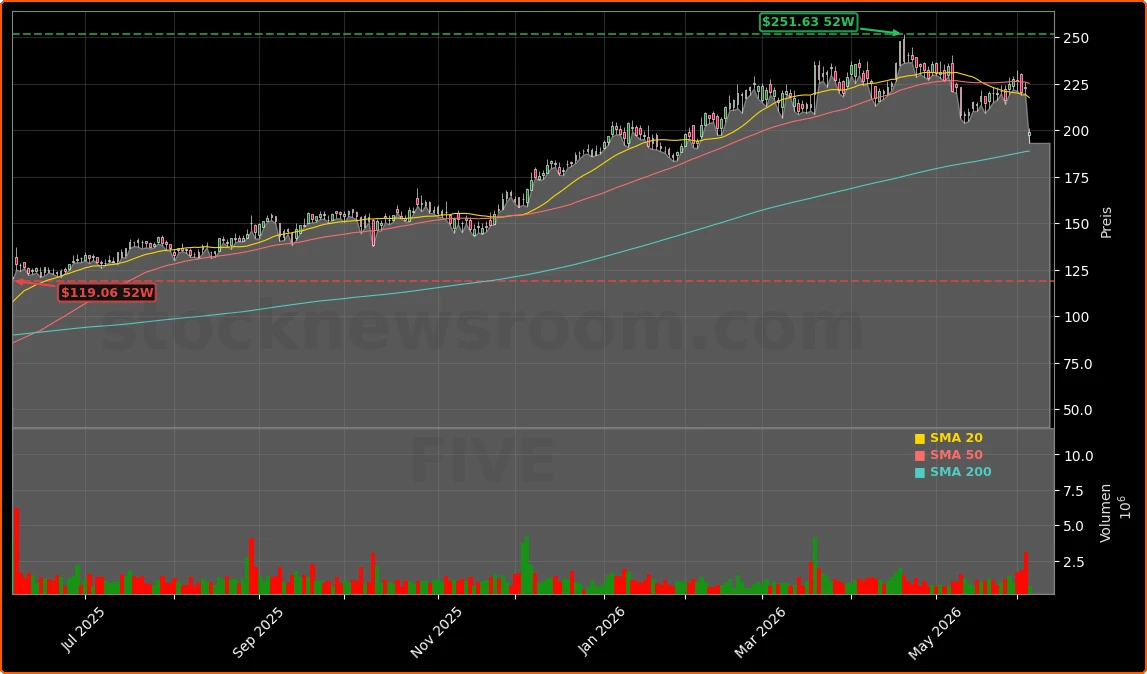
Five Below, Inc. delivered one of the strongest quarterly performances in its history: same-store sales surged 22.7%, net sales jumped 32% year-over-year to $1.29 billion, and adjusted EPS landed at $2.22—43 cents above the Bloomberg consensus of $1.75. Operating income more than tripled to $154.2 million, reflecting both scale and disciplined expense management. The viral ‘squishy dumpling’ toy and expanded ‘Five Beyond’ higher-margin offerings drove traffic and basket size. Yet the market punished the stock—down $23 to $199.01—because the beat came with a stark macro reality check. As CFO Daniel Sullivan said on the call: ‘A piece of that pain [customers are feeling] wasn’t felt in the first quarter purely because of tax proceeds.’ That admission—rare for a retailer riding a 23% comp surge—shifted focus from execution to fragility.
What’s Driving the Consumer Caution?
Five Below, Inc. serves a uniquely sensitive demographic: budget-conscious families, tweens, and teens. Its Q1 strength was turbocharged by elevated tax refunds—a temporary fiscal tailwind now fading. With Iran-related fuel shocks pushing gasoline prices higher and wage growth lagging inflation, households are tightening discretionary belts just as back-to-school season approaches. Unlike NVIDIA or Apple, whose demand is driven by tech cycles and enterprise budgets, Five Below’s revenue is a real-time barometer of working-class cash flow. Analysts at Mizuho noted that while second-quarter trends remain strong, ‘management expressed caution about the consumer spending environment’—and left its second-half outlook unchanged. That pause speaks volumes: growth may be peaking, not accelerating.
How Does Five Below Earnings Compare to Peers?
In the discount retail space, Five Below, Inc. stands apart from Dollar General, Dollar Tree, and Ollie’s Bargain Outlet—not just in growth, but in merchandising agility and digital-native engagement. While those peers struggle with margin compression and inventory overhang, Five Below’s Five Beyond expansion and TikTok-powered trend capture have lifted average transaction value. Still, Bernstein maintains a ‘Hold’ rating with a $247 price target—citing ‘abebbing growth’ and ‘tax refund dependency’ as key risks. That contrasts sharply with Citigroup’s recent upgrade of Target (TGT) on improved inventory health, or RBC Capital Markets’ ‘Outperform’ call on Walmart (WMT) citing grocery resilience. Five Below Earnings may be strong, but its valuation—trading at 28x forward EPS—demands flawless execution amid mounting headwinds.
Five Below Earnings: What’s Next for Investors?
We’re looking at the world that our customers are living in: with rising fuel costs, with very sticky inflation, with a somewhat—soft labor market. And we think a piece of that pain that they are feeling wasn’t felt in the first quarter purely because of tax proceeds.— Daniel Sullivan, CFO of Five Below, Inc.
Despite the selloff, institutional interest remains robust: Norges Bank acquired a $182.79 million stake in Q4, and Geode Capital increased its position by 5.2%—both citing strong Q1 execution and long-term store expansion potential. Five Below, Inc. now operates 1,970 stores and plans 115–125 new openings in fiscal 2026. The raised full-year outlook—$8.65–$9.05 adjusted EPS, up from $7.74–$8.25—implies sustained momentum. But the real test arrives in Q3: without tax refunds, can Five Below, Inc. maintain double-digit comp growth amid rising fuel costs and softening labor data? For investors, the Five Below Earnings report is less about missed numbers and more about recalibrating expectations for consumer resilience in the second half of 2026.